Friday, February 22, 2008

REMEMBERING YANKEE STADIUM: AN ORAL AND NARRATIVE HISTORY OF THE HOUSE THAT RUTH BUILT


“Author Harvey Frommer brings the story of Yankee Stadium’s past to us in its full and vivid glory.”


–Bob Sheppard, legendary New York Yankee public address announcer.


"Another instant classic from Baseball's greatest author, Harvey Frommer"


--Seth Swirsky, "Baseball Letters" & "Something to Write Home About"


The definitive work on YANKEE STADIUM, my newest book (and eighth one with Yankee content), will be published by (Stewart, Tabori, Chang/Abrams) 2008.

Now booking speaking appearances, book store signings, interviews, displays, museum exhibits, excerpts, internet postings, pod casts, reviews, publicity and marketing ops for the book.


This is the only book with a foreword by Bob Sheppard, Yankee
legendary public address announcer.


It mixes and matches voices from as far back as the 1920s to today providing the perspective of the rank and file who give the nitty gritty that the you won’t find from heavier names, those who will say over and over again: “When I stepped out onto the Stadium . . .”


Instead, nearly one hundred voices give the book a sense of place and time and people. There are Hall of Famers, bat boys, fans, vendors, famed broadcasters and authors, Yankee players and managers as well as their rivals, and long-time observers of the Stadium scene. There are game calls from legends like Mel Allen, Frank Messer, Phil Rizzuto, Michael Kay.


There is the smell of mustard and the smell of jockstraps, the feel of being crushed, eight deep on the downtown D train after a game. And a sense of place you won't find in any "official" history enhanced by more than 200 images, many of them archival and many never before published in a book. There are ticket stubs, baseball cards, program covers, scorecards. And there is a large “Stadiumology” section with stats and facts, first and lasts.


home page: http://harveyfrommersports.com/index.htm


"Harvey Frommer
brings a vast amount of experience in the art of the oral history, one of the
many tools at the disposal of the historian. From his Shoeless Joe and Ragtime Baseball to Red Sox-Yankees The Great Rivalry, Frommer shows that he is a
baseball writer and historian of repute."


-SABR executive director John
Zajc.


"First among equals is Harvey Frommer, with his wife Myrna Katz Frommer, a great
expert on all things baseball and New York (and that city within a city,) Brooklyn"


- John Thorn, Baseball Historian


I learned many things about Yankee Stadium through writing this book. Here are 23 of them:

1. Some wanted the brand new Yankee Stadium in 1923 to be called "Ruth Stadium." They settled for the nick-name "the House That Ruth Built."


2. It took 500 workers 185 days to build the original Yankee Stadium.


3. At the start, names of Yankee players were imprinted in white chalk near the top of their lockers.


4. The practice of selling more tickets than existing seats endured until a 1929 stampede in the right field bleachers left two dead, 62 injured.


5. Negro League teams who played at the Stadium when the Yanks were on the road were not allowed to use the Yankee dressing rooms. Instead they were obliged to use the visitors’ dressing room.


6. "Lou Gehrig Appreciation Day" was staged before 61,808 on July 4, 1939 and his uniform number 4 was the first in baseball history to be retired.


7. In 1941, Yankee president Ed Barrow offered Civil Defense the use of Yankee Stadium as a bomb shelter in case of attack. He thought the area under the stands could provide a safe haven.


8. On August 16, 1948, Babe Ruth died of throat cancer at age 53. His body lay in state at Yankee Stadium and was viewed by more than 100,000 fans.


9. The last home run at the original Yankee Stadium on September 30, 1973 was hit by Duke Sims in his seventh day as a Yankee. A coin toss that day tabbed him to play. It was not until much later that Sims realized the significance of his home run shot.


10. The film "61" was filmed in Detroit, not at Yankee Stadium. Billy Crystal explained the Motor City ballpark architecture was better able to be made to resemble that of the Yankee Stadium of 1961.


11. Sal Durante, the guy who caught the ball Roger Maris hit for his 61st homer, bought tickets the day of the game at a less-than-sold- out Yankee Stadium.


12. Mickey Mantle originally wore Number 6, but equipment manager Pete Sheehy switched him to Number 7 after Mantle was recalled from Kansas City.


13. Twenty thousand letters that Mickey Mantle never answered were not bid on in the old Yankee Stadium fire sale in 1974.


14. There was widespread and indiscriminate disposal of valuable items during demolition of much of the Stadium in the mid 1970s.


15. Among the items sold in the refurbishment "fire sale" at Yankee Stadium were player jockstraps which had names on them for identification when they came back from the laundry. The
selling was stopped because of sanitary reasons.


16. In 1976, a homer by Chris Chambliss gave the Yankees the American League pennant. Such
a mob crowded the plate that Chambliss was taken back a few minutes after hitting the homer, and he finally touched home plate.


17. All kinds of crazy things went on in the bullpens - some of them outlandish and some of them sexy and lots having to do with food.


18. In 1988, behind a wall that was closed off for decades, a scorecard, a program and what was supposedly the bases for the 1936 team were unearthed.


19. The 1990 Yankees had but one starting pitcher who won more than seven games,
nine-game winner Tim Leary. But he also lost 19.


20. On September 11, 2001 within 90 minutes of the horrific attacks on the World Trade Center, Yankee Stadium was evacuated.


21. Ron Guidry, a good drummer, once kept a trap set at Yankee Stadium and also played in a post-game concert with the Beach Boys.


22. Joe Torre was witness to all three perfect games in Yankee Stadium history: He saw Don Larsen's beauty as a 16-year-old fan, and the gems spun by David Wells and David Cone from the dugout as Yankee manager.


23. Bob Sheppard holds the record for seeing the most games at Yankee Stadium.


Friday, February 01, 2008

Five O'clock Lightning:YANKEES: Pre Season (Book Excerpt)

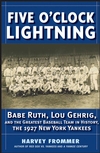
Five O'clock Lightning: Babe Ruth, Lou Gehrig and the 1927 New York Yankees, the Greatest Baseball Team Ever1927 YANKEES: Pre Season (Book Excerpt)

The press release on December 30, 1926 out of the offices of the New York Yankees in Manhattan on 42nd Street overlooking Bryant Park and the old Sixth Avenue El began:


"YANKEES WILL PLAY 21 SPRING BATTLES."

There would be a dozen games in Florida, seven heading north with the Cardinals, and two against the Brooklyn Robins at Ebbets Field.

The Yankee schedule was of interest to a multitude of fans and the players themselves, but to no one more than 23-year-old Tony Lazzeri.

For on a gloomy and overcast October 10, 1926 at Yankee Stadium, Cardinals versus Yankees, he came to bat for the Yankees who had loaded the bases in the seventh inning of the seventh game of the World Series with St. Louis clinging to a 3-2 lead. There were two outs.
"The bullpen in Yankee Stadium, Redbird hurler pitcher Grover Cleveland Alexander recalled "was under the bleachers then and when you're down there you can't tell what's going on out in the field only for the yells of the fans overhead. There was a telephone in the only real fancy, modern bullpen in baseball. Well, I was sitting around down there not doing much throwing. The phone rang and an excited voice said 'Send in Alexander.'"


Having already pitched complete game victories in Games 2 and 6, it was said that the grizzled veteran was recuperating from too much celebrating.

"So I come out from under the bleachers," Alexander continued. "I see the bases full and two out and Lazzeri standing at the box. Tony is up there all alone with everyone in that Sunday crowd watching him. So I just said to myself, 'Take your time, Lazzeri isn't feeling any too good up there and let him stew.'"

The crowd chanted: "Poosh-em-up Tony! Poosh-em-up Tony!" In four at bats the day before against the 39-year-old right-hander Alexander, Lazzeri had gone hitless.

First pitch, curve, a swinging strike.

Next pitch lined into the left-field seats. Foul ball.

"Lazzeri swung," said Alexander, "where that curve started but not where it finished. The ball got a hunk of the corner and then finished outside. If that line drive Lazzeri hit had been fair, Tony would be the hero, and I'd just be an old bum."

Then an over-anxious Lazzeri swung and missed and struck out.

Alexander breezed through the eighth inning. In the ninth with two outs, he pitched around in his phrase "the big son of a bitch" Babe Ruth and walked him. The very dangerous Bob Meusel was next.

"If Meusel got hold of one, it could be two runs and the series," Alexander later said. "So I forgot all about Ruth and got ready to work on Meusel. On my first pitch, the Babe broke for second. I caught the blur of Ruth starting for second as I pitched and then came the whistle of the ball as catcher O'Farrell rifled it to second. I wheeled around and there was one of the grandest sights of my life. Hornsby, his foot anchored on the bag and his gloved hand outstretched, waiting for Ruth to come in."

Incredibly, the Babe had attempted to steal second base and was thrown out. The Cardinals had their first world championship. The Yankees had a long winter talking about what-might-have-been.

Somehow, Babe Ruth got off the hook. The story that made the rounds was that the "Big Bam" had not attempted to steal a base but was cut down in a botched hit and run play. The man on the hook was young Tony Lazzeri who spent a lot of his winter suffering the slings of "what happened?" and the pain of boils.

And that is why when he received the news that his Yankees and the Cardinals would have a series of exhibition games barnstorming north after the spring training of 1927 ended, it was reported that the San Franciscan shouted out: "Vendetta," raising his fists into the air, "I shall have revenge."

There was no doubt that the 1926 World Series loss to the Cardinals stung Babe Ruth. But he did not suffer from boils. He also did not lust for any revenge. An incredible force of nature, he just kept rolling along, engaging in a tidal wave of activities after making that final out of the World Series.

Hither and yon, the great Ruth went, barnstorming vigorously for two weeks. On October 17 in Montreal the Yankee slugger slammed so many shots into a nearby river, according to a report in The South Bend Tribune, that the game was called for lack of baseballs.
Barnstorming completed, the Babe switched gears embarking on a 12 week Pantages circuit single act vaudeville tour. It kicked off in October 1926 in Minneapolis and would finally come to a conclusion in January 1927 in southern California. The gig netted Babe Ruth $8,333 weekly. No performer had ever made that kind of money, not Al Jolson, not Fanny Brice, not even W. C. Fields. There were those who said the Yankee slugger had to be doing something right to be earning all that money.


George Herman Ruth was everywhere doing everything in the time leading up to spring training in 1927. He was a one man endorsement machine - for pure milk, appliances for the home, housing developments, different kinds of cars, some that no longer exist like Reos, Auburns, Packards, Studebakers and Oldsmobiles. All told, it was estimated that the Sultan of Swat earned $250,000 in 1926 from playing baseball, movie work, barnstorming, endorsements and syndicated ghost written pieces.

And the Babe, who it was claimed needed little sleep, even had some spare time for golf, women, fishing, mingling with celebrities and common folk.

But the sluggers of sluggers had not yet signed a new contract and seemed not likely to do so anytime soon. Hands down, he had rejected the $52,000 salary he earned in 1926.
In early February, Yankee owner Jake Ruppert sent another in what would be a series of contract offers to Ruth. This one was for $55,000. The offer annoyed the hell out of the competitive Babe who said he had it on good authority that Ty Cobb, now with the Philadelphia Athletics, was slated to get $75,000.


The peripatetic Yankee outfielder moved on to "Hooray for Hollywood" time, making his first movie, "The Babe Comes Home" for First National pictures. In a break during shooting he said: "Reading, like picture shows is almost taboo, I've got to watch the old optics closer than anything else."

Under strict orders from his trainer Artie McGovern, the Bambino, also got his beauty sleep. He was early to bed by 9 P.M. (it wasn't clear whether he was there alone or had company), and early to rise he was on there on the movie set no later than six A.M.

On Hollywood Boulevard, running three to five miles a day, George Herman winked and smiled at folks all along the way, truly a sight for all kinds of eyes. After the up and downing on the streets, Ruth was rewarded back at his Hollywood Plaza Hotel with a comforting and stimulating rub down by McGovern who had taken leave of his New York City gymnasium on 42nd Street and Madison Avenue to press the flesh of his most illustrious client still unsigned to a Yankee contract for the 1927 season. McGovern, in a comment praising himself and the wondrous work he was accomplishing remarked about his beginnings with Ruth: "He was as near to being a total loss as anyone I ever had under my care."

On February 22, six days before the first Yankees were scheduled to arrive in St. Petersburg for spring training, Babe Ruth mailed to Rupper an outline of what he thought he should be paid for 1927, just another salvo in their continuing out in the public eye contract wrangling. The Babe pressed the point that he would retire from baseball and organize a string of gymnasiums with Artie McGovern if his salary needs were not met.

On February 25, the day before the big man left California for New York, his salary demands were published in the New York Daily News. Two days later a letter he wrote to Colonel Ruppert appeared in The New York Times. The letter's tone was conciliatory. It was also forceful. . .

Thursday, January 03, 2008

PRE-SEASON EXCERPT from FIVE O'CLOCK LIGHTNING


The press release on December 30, 1926 out of the offices of the New York Yankees in Manhattan on 42nd Street overlooking Bryant Park and the old Sixth Avenue El began:

"YANKEES WILL PLAY 21 SPRING BATTLES."

There would be a dozen games in Florida, seven heading north with the Cardinals, and two against the Brooklyn Robins at Ebbets Field.

The Yankee schedule was of interest to a multitude of fans and the players themselves, but to no one more than 23-year-old Tony Lazzeri.

For on a gloomy and overcast October 10, 1926 at Yankee Stadium, Cardinals versus Yankees, he came to bat for the Yankees who had loaded the bases in the seventh inning of the seventh game of the World Series with St. Louis clinging to a 3-2 lead. There were two outs.

"The bullpen in Yankee Stadium, Redbird hurler pitcher Grover Cleveland Alexander recalled "was under the bleachers then and when you're down there you can't tell what's going on out in the field only for the yells of the fans overhead. There was a telephone in the only real fancy, modern bullpen in baseball. Well, I was sitting around down there not doing much throwing. The phone rang and an excited voice said 'Send in Alexander."

Having already pitched complete game victories in Games 2 and 6, it was said that the grizzled veteran was recuperating from too much celebrating of his victory the previous day.

"So I come out from under the bleachers," Alexander continued. "I see the bases full and two out and Lazzeri standing at the box. Tony is up there all alone with everyone in that Sunday crowd watching him. So I just said to myself, 'Take your time, Lazzeri isn't feeling any too good up there and let him stew.'"

The crowd chanted: "Poosh-em-up Tony! Poosh-em-up Tony!" In four at bats the day before against the 39-year-old right-hander Alexander, Lazzeri had gone hitless.

First pitch, curve, a swinging strike.

Next pitch lined into the left-field seats. Foul ball.

"Lazzeri swung," said Alexander, "where that curve started but not where it finished. The ball got a hunk of the corner and then finished outside. If that line drive Lazzeri hit had been fair, Tony would be the hero, and I'd just be an old bum."

Then an over-anxious Lazzeri swung and missed and struck out.

Alexander breezed through the eighth inning. In the ninth ,he pitched around in his phrase "the big son of a bitch" Babe Ruth and walked him with two outs. The very dangerous Bob Meusel was next.

"If Meusel got hold of one, it could be two runs and the series," Alexander later said. "So I forgot all about Ruth and got ready to work on Meusel. On my first pitch, the Babe broke for second. I caught the blur of Ruth starting for second as I pitched and then came the whistle of the ball as catcher O'Farrell rifled it to second. I wheeled around and there was one of the grandest sights of my life. Hornsby, his foot anchored on the bag and his gloved hand outstretched, waiting for Ruth to come in."

Incredibly, the Babe had attempted to steal second base and was thrown out. The Cardinals had their first world championship.

Somehow, Babe Ruth got off the hook. On the hook was young Tony Lazzeri who spent a lot of his winter suffering the slings of "what happened?"

And that is why when he received the news that his Yankees and the Cardinals would have a series of exhibition games barnstorming north after the spring training of 1927 ended, the San Franciscan shouted out: "Vendetta," raising his fists into the air, "I shall have revenge."

Babe Ruth did not lust for any revenge. An incredible force of nature, he just kept rolling along, engaging in a tidal wave of activities after making that final out of the World Series.
Hither and yon, the great Ruth went, barnstorming vigorously for two weeks. On October 17 in Montreal the Yankee slugger slammed so many shots into a nearby river, according to a report in The South Bend Tribune, that the game was called for lack of baseballs. In South Bend, Indiana on October 23, they were ready to handle that little problem.


The local team stocked up on baseballs, costing $1.23 each. The game was called after six innings in large part because the Babe Ruth All Stars arrived two hours late. The South Bend Indians were beaten, 7-3, and the "Bammer" Ruth was 3-for-4 with a home run estimated to have traveled 600 feet.

Barnstorming completed, the Babe switched gears embarking on a 12 week Pantages circuit single act vaudeville tour for $8,333 weekly. No performer had ever made that kind of money, not Al Jolson, not Fanny Brice, not even W. C. Fields.

George Herman Ruth was everywhere doing everything in the time leading up to spring training in 1927. He was a one man endorsement machine - for pure milk, appliances for the home, housing developments, automobiles.

All told, it was estimated that the Sultan of Swat earned $250,000 in 1926 from playing baseball, movie work, barnstorming, endorsements and syndicated ghost written pieces.
And the Babe, who it was claimed needed little sleep, even had some spare time for golf, women, fishing, mingling with celebrities and common folk.


The pieces were falling into place for the 1927 Yankees. But the biggest piece, Babe Ruth, had not yet signed a new contract and seemed not likely to do so anytime soon. Hands down, he had rejected the $52,000 salary he earned in 1926. That was out of the question.

In early February, Jake Ruppert sent another in what would be a series of contract offers to Ruth. This one was for $55,000. The offer annoyed the hell out of the competitive Babe who said he had it on good authority that Ty Cobb, now with the Philadelphia Athletics, was slated to get $75,000.

The peripatetic Yankee outfielder moved on to "Hooray for Hollywood" time. He was now a star on the East Coast and the West Coast, now making his first movie, "The Babe Comes Home" for First National pictures.

In a break during shooting he said: "Reading, like picture shows is almost taboo, I've got to watch the old optics closer than anything else."

Under strict orders from his trainer Artie McGovern, the Bambino, also got his beauty sleep. He was early to bed by 9 P.M. (it wasn't clear whether he was there alone or had company), and early to rise he was on there on the movie set no later than six A.M.

On Hollywood Boulevard, running three to five miles a day, George Herman winked and smiled at folks all along the way, truly a sight for all kinds of eyes. After the up and downing on the streets, Ruth was rewarded back at his Hollywood Plaza Hotel with a comforting and stimulating rub down by McGovern who had taken leave of his New York City gymnasium on 42nd Street and Madison Avenue to press the flesh of his most illustrious client still unsigned to a Yankee contract for the 1927 season.

On February 22, six days before the first Yankees were scheduled to arrive in St. Petersburg for spring training, Babe Ruth mailed to Colonel Ruppert from Hollywood an outline of what he thought he should be paid for 1927, just another salvo in their continuing out in the public eye contract wrangling. The Babe was adamant as he spoke to reporters. He pressed the point that he would retire from baseball and organize a string of gymnasiums with Artie McGovern if his salary needs were not met.

On February 25, the day before the big man left California for New York, his salary demands were published in the New York Daily News. Two days later a letter he wrote to Colonel Ruppert appeared in The New York Times. The letter's tone was conciliatory. It was also forceful.

"You will find enclosed contract for 1927 which I am returning unsigned because of the $52,000 salary figure. I am leaving Los Angeles February 26 to see you in New York and will be prepared to report at St. Petersburg but only on the basis of $100,000 a year for two years, plus $7,700 held out of my salary in the past.. . .

"In fine physical condition today I hope to play as good as last year or better. I have exercised all winter and for the past twelve weeks have been working out of doors. At my own expense I have brought Arthur McGovern from New York to condition me.

Sunday, December 09, 2007

Holiday Reads, 2007: Part II

“How Bill James “Changed Our View of Baseball,” "A Well-Paid Slave,” “Harvard Boys,” “Gretzky to Lemieux,”etc.

The seasons come and go, the books on sports, likewise. Here for your reading edification and enjoyment, another batch of entries from the crowded field of tomes on sports.

“How Bill James Changed Our View of Baseball” (Acta Sports, $19.95, 144 pages hardcover) is an unabashed and mostly deserved batch of raves about the whys and wherefores about the lifetime of work by the man from Kansas who today lives in Boston and is Senior Baseball Operations Advisor for the Boston Red Sox. James and some of his friends (Alan Schwarz, John Thorn, etc.) have a go at it explaining (or at least trying to) the work of the man TIME magazine named one of the “100 Most Influential People in the World.”

“A Well-Paid Slave” by Brad Snyder (Plume, $14.00, paper) is the story of Curt Flood and his lawsuit that broke new ground and changed the face of baseball ushering in free agency. Absorbing stuff.

“Harvard Boys” by John Wolff and Rick Wolff (Skyhorse Publishing, $24.95, 336 pages, hardcover) intermingles life at Harvard, a father, a son, dreams of making it big in the big leagues of baseball. Both made it out of Harvard and into the minors. Their stories are appealing.

“Gretzky to Lemieux” by Ed Willes (McClelland & Stewart, $24.95, 256 pages, hardcover) is a one of a kind look back at the 1987 Canada Cup - three games between Canada and the former Soviet Union. Brilliantly written, jammed with stories from those who were there – this book is a hockey lover’s heaven.

Cecil Harris and Larryette Kyle-DeBose have done a creditable job in “Charging the Net” (Ivan R. Dee, $26.95, 271 pages, hardcover) a book that is as its sub-title proclaims: “A history of blacks in tennis from Althea Gibson to the Williams Sisters.”

“War Without Death” by Mark Maske (Penguin, $25.95, 400 pages, hardcover) by the Washington Post sports columnist is a no holds barred look back at the life in a year’s competition in the National Football League East. In depth, clearly and cogently presented. HIGHLY RECOMMENDED.

Sunday, November 25, 2007

Holiday Reads, 2007: Part I:

“The Best Game Ever,” “Connie Mack,” “The Ultimate Yankees Companion,” etc.

Just in time for hot stove league reading, off season entertainment, sitting before the fire, browsing and or serious reading comes a bevy of books. All have a lot to offer.
This blurb on the back cover of “The Best Game Ever,” by Jim Reisler (Carroll & Graf, $26.00, 280 pages) reads: “A home run of a book! Jim Reisler has a terrific eye for details, a wonderful way with words. He’s done the best job ever with “The Best Game Ever!” That’s a heck of a blurb and really sums up the book and Reisler. I should know. I wrote the blurb. HIGHLY RECOMMENDED!


“Connie Mack and the Early Years of Baseball” by Norman Macht (University of Nebraska Press, $39.95, 708 pages) is a mother lode of data, stories, perceptions about one of the legendary figures in the history of the national pastime. Like a fine wine, “Connie Mack and the Early Years of Baseball” brings back Mack as player, manager, owner. If you are into baseball, get into this tome.


John Grisham once was cut from his college baseball team, but that is another story. Somehow, he has managed to make a living in another field. His 19th novel “Playing For Pizza (Doubleday, $26.95, 262 pages) will delight his fans and fans in general, telling as it does a charming tale of Rick Dockery, former third string qb of the Cleveland Browns who “makes it” playing in Italy for the magnificent Parma Panthers. Read this love of a book in one sitting!

“The Ultimate Yankees Companion” edited by Gary Gillette and Pete Palmer (Maple Street Press, $24.95, 388 pages) is as its sub-title proclaims: “A Complete Statistical and Reference Encyclopedia.” Gillette and Palmer and their talented team have served up feasts
for Yankee fans having produced a book with all matter of Bronx Bomber material. This is a book to place on your bookshelf and go to often - - as Casey Stengel said: “You could look it up” and that surely goes for “The Ultimate Yankees Companion”.

One wouldn’t think that a slim paperback focused on “Haunted Baseball” by Mickey Bradley and Dan Gordon (Lyons Press, $14.95, 275 pages) would have so much appeal. But the book is nifty focusing as it does on ghosts, curses, legends and eerie events that have been a part of the national pastime. I was especially attracted to the chapter “The Ghosts of Yankee Stadium.” I wonder why.


BOOKENDS: Interesting sports paperbacks from the University of Nebraska Press include:” A Season in Purgatory by Tony Moss about Villanova and as the sub-tile notes “life in college football’s lower class; “Tricksters in the Madhouse” by John Christgau, a meticulous flashback to February 19, 1948 – Minneapolis Lakers versus Harlem Globetrotters for the “unofficial world championship” before blacks played in pro basketball; “The Poetics of Golf” by Andy Brumer is just that and if you are a golfer, a fan of the game, read this book and enjoy!

Wednesday, October 10, 2007

New Book Chronicles One of Sport’s Most Storied Teams

FOR IMMEDIATE RELEASE

Media Contact: Tony Viardo
Sourcebooks, Inc.
630-961-3900 ext 234
202-258-8287 (mbl)
Tony.viardo@sourcebooks.com

Has It Really Been a Yankee Century?
New Book Chronicles One of Sport’s Most Storied Teams


"Yankee fans who can't learn enough about their favorite team will think they died and went to heaven with all that Frommer offers on each page."
—Publishers Weekly

In the world of politics, the term is “polarizing.” It’s used for people and organizations that evoke strong feelings, both positive and negative. If you looked up that word in a sports dictionary, however, you’d find a picture of The New York Yankees. No other team in Sport is more simultaneously loved and hated than the embattled Yanks. But by the same token, no other team is more storied, more celebrated, or more woven into the fabric of American culture than the Bronx Bombers.

As far as baseball is concerned, the last hundred years have truly been a Yankee Century. So claims Harvey Frommer, author of Yankee Century and Beyond: A Celebration of the First Hundred Plus Years of Baseball’s Greatest Team (ISBN: 978-1-4022-1002-0; November, 2007; $17.00 US / $22.00 CAN).

Yankee Century captures 106 years of Yankee life in reflections, stats, facts, and historic images. From their beginning as the New York Highlanders, playing in Manhattan's Hilltop Park in 1903, to reigning over Major League Baseball as it entered a new millennium—with World Series Championships in '96, '98, '99 and 2000—the Yankees represent a century-long legacy of triumphs and defeats, legends and lore, as an enduring symbol of America's favorite pastime.

More than just an atlas of statistics, Yankee Century contains reflections, quotes and profiles from individuals who are at the heart of the Yankee Mystique. Personalities include: Mel Allen, Yogi Berra, Chris Chambliss, Don Larsen, and Bob Sheppard. It also includes tributes to the greats: From Mickey Mantle to Don Mattingly, Vic Raschi to Allie Reynolds and Joltin' Joe DiMaggio to Derek Jeter.

Destined to become the defining chronicle of the Yankees’ first hundred years, Yankee Century and Beyond is a must-have collector’s volume not only for Yankee fans, but for anyone who appreciates the history and relevance of American Sport.

ABOUT THE AUTHOR

Harvey Frommer is a noted sports journalist and historian, the author of thirty-eight books on sports, including Shoeless Joe and Ragtime Baseball and The New York Yankee Encyclopedia, as well as autobiographies of legends Nolan Ryan, Tony Dorsett and Red Holzman. He has also written, along with his wife, hundreds of articles for newspapers, magazines and on the internet.

Frommer is a sought after public speaker, and a regular on radio and television sports shows. He is a professor at Dartmouth college and a long time Yankee fan who wrote for Yankees Magazine for sixteen years.

FIVE O’CLOCK LIGHTNING

Media Contact: Mike Onorato
FOR IMMEDIATE RELEASE 201-748-6361 / monorato@wiley.com


"The 1927 Yankees may or may not have been the best team ever, but surely this is the best book about that concentration of talent."–George Will

"An engrossing and entertaining look at a mythical baseball team. Ride the trains and chew the tobacco and have fun."—
Leigh Montville, author of “The Big Bam: The Life and Times of Babe Ruth”


Five O’Clock Lightning:

Babe Ruth, Lou Gehrig and the Greatest Baseball Team in History,
The 1927 New York Yankees

By Harvey Frommer


The 1927 New York Yankees are widely regarded as one of the greatest baseball teams of all-time. From the “Murderer’s Row” lineup to the near mythic status that surrounded them in Prohibition-era New York City and elsewhere, celebrated author Harvey Frommer tells the fascinating story of the greatest season of baseball’s greatest team in FIVE O’CLOCK LIGHTNING.

Based on an oral history, long-buried letters, and diary notations, FIVE O’CLOCK LIGHTNING: Babe Ruth, Lou Gehrig and the Greatest Baseball Team in History, The 1927 New York Yankees (Wiley; November 2007; $24.95; Cloth; ISBN: 9780471778127) paints a vivid portrait of the best team in baseball chasing greatness in Jazz Age New York City just before the Depression changed everything. Told in chronological order and through colorful details from the 1927 Yankees’ private and public lives, as well as the kinds of minutiae baseball fans love (salaries, batting orders, standings, stats) and stories about the complicated task of building a cohesive team from a collection of superstars, FIVE O’CLOCK LIGHTNING reveals the hidden history of America’s greatest ball club, from the team’s compilation in the 1926 off-season (only one year after the Yanks’ disastrous ’25 season) to the World Series’ final pitch.


About the Author:
Harvey Frommer (New York, NY, and Lyme, NH) is a well-known oral historian and sports author who has written 39 sports books and has appeared on numerous television and radio programs. Cited in the Congressional Record and the New York State Legislature as a sports historian, he is Professor Emeritus, City University of New York, and a professor at Dartmouth College in the Master of Arts in Liberal Studies program.


* * *

Five O’clock Lightning:
Babe Ruth, Lou Gehrig and the Greatest Baseball Team in History, The 1927 New York Yankees
By Harvey Fommer
Wiley
Publication Date: November 2007
$24.95, Cloth
ISBN: 978-0-471-77812-7


ATTENTION REVIEWERS
For the convenience of your readers, please include the following in your review: Wiley books are available at your local bookstore or by calling 1-800-225-5945. In Canada, call 1-800-567-4797.


Tuesday, October 09, 2007

Has It Really Been a Yankee Century?

New Book Chronicles One of Sport’s Most Storied Teams

"Yankee fans who can't learn enough about their favorite team will think they died and went to heaven with all that Frommer offers on each page."
—Publishers Weekly

In the world of politics, the term is “polarizing.” It’s used for people and organizations that evoke strong feelings, both positive and negative. If you looked up that word in a sports dictionary, however, you’d find a picture of The New York Yankees. No other team in Sport is more simultaneously loved and hated than the embattled Yanks. But by the same token, no other team is more storied, more celebrated, or more woven into the fabric of American culture than the Bronx Bombers.

As far as baseball is concerned, the last hundred years have truly been a Yankee Century. So claims Harvey Frommer, author of Yankee Century and Beyond: A Celebration of the First Hundred Plus Years of Baseball’s Greatest Team (ISBN: 978-1-4022-1002-0; November, 2007; $17.00 US / $22.00 CAN).

Yankee Century captures 106 years of Yankee life in reflections, stats, facts, and historic images. From their beginning as the New York Highlanders, playing in Manhattan's Hilltop Park in 1903, to reigning over Major League Baseball as it entered a new millennium—with World Series Championships in '96, '98, '99 and 2000—the Yankees represent a century-long legacy of triumphs and defeats, legends and lore, as an enduring symbol of America's favorite pastime.

More than just an atlas of statistics, Yankee Century contains reflections, quotes and profiles from individuals who are at the heart of the Yankee Mystique. Personalities include: Mel Allen, Yogi Berra, Chris Chambliss, Don Larsen, and Bob Sheppard. It also includes tributes to the greats: From Mickey Mantle to Don Mattingly, Vic Raschi to Allie Reynolds and Joltin' Joe DiMaggio to Derek Jeter.

Destined to become the defining chronicle of the Yankees’ first hundred years, Yankee Century and Beyond is a must-have collector’s volume not only for Yankee fans, but for anyone who appreciates the history and relevance of American Sport.

Tuesday, September 25, 2007

THE BABE BOPS NUMBER 60!


(AN EXCERPT FROM: FIVE O'CLOCK LIGHTNING: BABE RUTH, LOU GEHRIG AND THE 1927 NEW YORK YANKEES, THE GREATEST BASEBALL TEAM EVER, by Harvey Frommer coming this fall)

On September 29th, at Yankee Stadium the Big Bammer homered twice to his favorite spot in Yankee Stadium ­ "Ruthville" - the right field bleachers. The shots came off two different Washington pitchers, Hod Lisenbee and Paul Hopkins in a l5-4 Yankee rout. The Babe now had 59 home runs, tying his record set in 1921. He also set a record of hitting grand slams in consecutive games. "I was out in the bullpen at that time," Paul Hopkins recalled. "The bullpen in Yankee Stadium was perched deep in left field and you couldn't even see how the game was going. Well, the call came down that they wanted me to relive and I could see that the Yankees had three men on base. I guess I would have been nervous if I knew who the next batter was. It was Babe Ruth. It was Babe Ruth with the bases loaded. The rest is history. I threw him a series of curveballs and he finally hit one into right field at least five rows in. "John Drebinger wired The Times: "The ball landed halfway up the right field bleacher, and though there were only 7,500 eye witnesses, the roar they sent up could hardly been drowned out had the spacious stands been packed to capacity. The crowd fairly rent the air with shrieks and whistles as the bulky monarch jogged majestically around the bases, doffed his hat, and shook hands with Lou Gehrig."The shot off Hopkins was Number 59. The one off Hod Lisenbee was Number 58. After the game ended Lisenbee had somehow gotten possession of the home run ball and came around to the Yankee clubhouse dressed in street clothes wanting Ruth to sign it. The Babe, always ready with an autograph, obliged not even knowing who Lisenbee was.On September 30th, in the second to last game of the season, only 8,000 were in attendance at Yankee Stadium. The Sultan of Swat needed one more home run to break his former record. So capacious was Yankee Stadium back then that the top deck was never opened in the middle of the week so with the small crowd in the park. New York and Washington were tied, 2-2. Tom Zachary, a Quaker, was on the mound. "I had made up my mind," the Senator pitcher bragged, that I would not "give Ruth a good pitch to hit." Bottom of the eighth. One out. On third after tripling, Mark Koenig stared as his buddy the Babe stepped in. Ruth had two singles in the game. Home run number 59 had been hit with the bat the Bammer called "Black Betsy." His other bats were the ash blond "Big Bertha" and the reddish "Beautiful Bertha." Stepping into the batter's box ,he was lusting for home run #60. The count was one and one. "I don't say it was the best curve I ever threw, but it was as good as any I ever threw," Zachary who also gave up home runs number 22 and number 36 to Ruth, said later.The Babe reached out for the ball with the reddish "Beautiful Bertha." The shot was a gigantic and dramatic exclamation point to an incredible, miracle season and all that the 1927 New York Yankees had accomplished. It was George Herman Ruth's personal flight across the Atlantic (and as well as the Pacific). No steroids, no performance enhancing substances, no corked bats, just the Babe. The ball landed in the first row of the bleachers near the right field foul pole, fair by about l0 feet. In the Yankee dugout players leaped to their feet watching the historic shot go into the bleachers. Fans scaled the bleacher screen, charging out after their hero. Slow trotting out the historic home run in "a triumphant almost regal tour of the paths," according to The New York Times, Ruth doffed his cap a few times to the small crowd in the stands who cheered him as he carefully touched each base. As he crossed home plate, a very happy Ruth was greeted by a double line of Yankees. In the dugout later his teammates banged their bats on the floor and stamped their feet, celebrating the moment. It was like New Year's Eve. Better. The image of the big man with those measured, mincing steps going around the bases, the cast of characters waiting as he stepped on home plate: Washington catcher Muddy Ruel, Home Plate Umpire Bill Dinneen, Eddie Bennett and Lou Gehrig - - a dramatic end to a magic season for the prince of pounders and Murderer's Row. When Ruth took his defensive position in right field, his ecstatic fans in "Ruthville" tossed confetti, hats, programs out onto the field, applauded and screamed at him, waved handkerchiefs. Playful in return, the Babe acknowledged them, snapping back a series of fancy and exaggerated military salutes. In the ninth inning in one of those special moments that baseball always seems to have, the legendary pitcher Walter Johnson made his final appearance as a player, pinch-hitting for Zachary, flying out to Babe Ruth. The Yankees won the game, 4-2.The news of what the Bam had done went out on the wire across America. In small towns in New Hampshire, rural Texas, down in Mississippi, there were many who ran out of cigar stores or gas stations shouting: "He hit sixty! Babe hit sixty!"In the clubhouse after the game was over Babe Ruth bellowed: "Sixty! Let's see some son of a bitch try to top that one!" The clubhouse was strangely reserved. What he had done, what they had done, was expected."See the funny thing about it is," Benny Bengough explained, "we never figured 60 was going to stand. We felt Babe Ruth might hit 65 the next year because, see, he was the only real home run hitter. And Babe never really thought about it. He never figured I'll hit 90 home runs this year or 60 or whatever. He just hit the home runs. He hit 60 and I imagine the next year Babe figured, well, I'll probably hit 65 or 70 - who knows? He never hit that many again, but we thought he might. So it wasn't that important."The first player to reach 30 homers, to reach 40, 50 and 60, a record that stood for 34 years, Babe Ruth would wind up in his fabled career homering once every 11.76 times at bat.Later Zachary explained: "I gave Ruth a curve, low and outside. It was my best pitch. The ball just hooked into the right field seats and I instinctively cried 'foul.' But I guess I was the only guy who saw it that way. If I'd a known it was gonna be a famous record, I'd a stuck it in his ear." Paul Galico was the highest-paid sports editor in the country, earning $25,000 a year from the New York Daily News from 1923 to 1936. A native New Yorker, born in the Big Apple in 1897, he graduated from Columbia University in 1921. His first job with the News was as movie critic but too much attitude in his writing led to his removal. Moving on to the sports department, by 1923, he was the Sports Editor with a daily column. Of the Ruth record setting home run, Galico wrote: "They could no more have stopped Ruth from hitting that home run than you could have stopped a locomotive by sticking your foot in front of it. Once he had that 59, that Number 60 was as sure as the rising sun. A more determined athlete than George Herman Ruth never lived. . . . "A child of destiny is George Herman. .. . I even recall writing pieces and saying that Gehrig would soon break Babe Ruth's cherished record and feeling kind of sorry for the old man, having this youngster come along and steal his thunder, and now look at the old has-been."Succumb to the power and romance of this man," Paul Galico wrote, all journalistic objectivity gone. "Feel the athletic marvel that this big, uncouth fellow has accomplished." Babe Ruth hammered 28 of his 60 home runs in Yankee Stadium while Lou Gehrig hit 24 of his 47 there. "I don't think I would have established my home run record of 60," Ruth reflected later in life, "if it hadn't been for Lou. He was really getting his beef behind the ball that season . . . Pitchers began pitching to me because if they passed me, they still had Lou to contend with." The Babe played in 151 of the 155 Yankee games (one game was a tie replayed). His home run dossier had all kinds of interesting stats. One third of his 60 home runs were hammered in his final 32 games. After 123 games, Ruth had just 40 home runs. September's 17 slams, a record for the time, put the Babe over the top. He homered most against the Red Sox, 11 times, least against the White Sox, 6 times. The 60 home runs came off 33 pitchers, and 16 hurlers gave up one or more homers. The Babe hit one inside-the-parker, 16 home runs in the first inning, one in the second, four in the third, five in the fourth, seven in the fifth and sixth, five in the seventh, nine in the eighth, none in the tenth and two in the eleventh. There were 29 bases empty homers, 22 with one runner on, 7 with two on, and 2 with the bases loaded. Nineteen dingers came off lefthanders. Two were grand slams. The 60 homers accounted for 100 RBIs.

Thursday, August 30, 2007

Has It Really Been a Yankee Century?


FOR IMMEDIATE RELEASE


Media Contact:
Tony Viardo
Sourcebooks, Inc.
630-961-3900 ext 234
202-258-8287 (mbl)
Tony.viardo@sourcebooks.com


Has It Really Been a Yankee Century?
New Book Chronicles One of Sport’s Most Storied Teams

"Yankee fans who can't learn enough about their favorite team will think they died and went to heaven with all that Frommer offers on each page."
—Publishers Weekly

In the world of politics, the term is “polarizing.” It’s used for people and organizations that evoke strong feelings, both positive and negative. If you looked up that word in a sports dictionary, however, you’d find a picture of The New York Yankees. No other team in Sport is more simultaneously loved and hated than the embattled Yanks. But by the same token, no other team is more storied, more celebrated, or more woven into the fabric of American culture than the Bronx Bombers.

As far as baseball is concerned, the last hundred years have truly been a Yankee Century. So claims Harvey Frommer, author of Yankee Century and Beyond: A Celebration of the First Hundred Plus Years of Baseball’s Greatest Team (ISBN: 978-1-4022-1002-0; November, 2007; $17.00 US / $22.00 CAN).

Yankee Century captures 106 years of Yankee life in reflections, stats, facts, and historic images. From their beginning as the New York Highlanders, playing in Manhattan's Hilltop Park in 1903, to reigning over Major League Baseball as it entered a new millennium—with World Series Championships in '96, '98, '99 and 2000—the Yankees represent a century-long legacy of triumphs and defeats, legends and lore, as an enduring symbol of America's favorite pastime.

More than just an atlas of statistics, Yankee Century contains reflections, quotes and profiles from individuals who are at the heart of the Yankee Mystique. Personalities include: Mel Allen, Yogi Berra, Chris Chambliss, Don Larsen, and Bob Sheppard. It also includes tributes to the greats: From Mickey Mantle to Don Mattingly, Vic Raschi to Allie Reynolds and Joltin' Joe DiMaggio to Derek Jeter.

Destined to become the defining chronicle of the Yankees’ first hundred years, Yankee Century and Beyond is a must-have collector’s volume not only for Yankee fans, but for anyone who appreciates the history and relevance of American Sport.


ABOUT THE AUTHOR

Harvey Frommer is a noted sports journalist and historian, the author of thirty-eight books on sports, including Shoeless Joe and Ragtime Baseball and The New York Yankee Encyclopedia, as well as autobiographies of legends Nolan Ryan, Tony Dorsett and Red Holzman. He has also written, along with his wife, hundreds of articles for newspapers, magazines and on the internet.

Frommer is a sought after public speaker, and a regular on radio and television sports shows. He is a professor at Dartmouth college and a long time Yankee fan who wrote for Yankees Magazine for sixteen years.

Friday, August 17, 2007

HOLY COW! REMEMBERING PHIL RIZZUTO

(Today's Rizzuto moment (courtesy of Phil Doherty) is from September 14, 1977 inthe midst of yet anotherheated pennant race with Boston. Here Phil's "Holy Cow" celebrates Reggiebeating Reggie-Jackson vs. Cleveland. WINS RadioClick here:


Back in the late 1980s I was working with Red Holzman on his autobiography "RED ON RED."and having a ball. He mentioned that during WW II he had become friends with Phil Rizzuto. They both were athletes, both originally from Brooklyn. Red and his wife Selma were invited to dinner with Phil and his wife Cora.


Red has his usual scotch or two to start things off. Then he asked for the menu and learned that it would be tomato juice, tomato soup, pasta with tomato sauce.


"And for dessert ­ tomato pie," Red smiled.
'No," Phil said, "huckleberry pie, you huckleberry!"


Under ordinary circumstances Red Holzman , lover of food that he was, might have left the room. But he dearly loved Phil Rizzuto. "That little guy," Red told me, "was one my favorite all time. Just a lovely and decent man."


Now with the passing of "the Scooter," it seems there are hundreds of thousands who shared the same feelings about him, including me.


I was at Yankee Stadium, hungry, with my tray of food in the press room restaurant, if one can call it that. Full house. Phil Rizzuto was there. He gestured that I come over and arranged for another chair at his table so that I could sit and eat. Kindness to a guy he barely knew.


Casey Stengel who rejected the 16-year-old Rizzuto at a Brooklyn Dodger tryout told him that he was too small, too skinny and that he should get a job shining shoes. Later Casey Stengel said: "He's the greatest shortstop I've ever seen. Honus Wagner was a better hitter, but I've seen this kid make plays Wagner never did."


The Dodgers turned him down. The Giants turned him down. But the Yankees did not. Ed Barrow said, "His signing cost me fifteen cents, ten cents for postage and five cents for a cup of coffee we gave him the day he worked out at the Stadium."


As a minor leaguer, the young Rizzuto was knocked down a couple of times by lightning, triggering some of his fears and superstitions like closing his eyes when passing a cemetery to insure getting a hit that day. He always stepped out of bed on the same side, always avoiding stepping on the baselines, was always on guard against insects who he feared. All through a Yankee 19-day winning streak, he kept a large wad of gum on the top of his cap. The smell got so bad, nobody would come near him on the field.


In 1941, Philip Francis Rizzuto replaced Frank Crosetti at shortstop for the Yankees and batted .307. "The Scooter," one of the littlest Yankees went on to be durable, driven, the glue on the Yankee teams he played on for 13 years that won nine pennants and seven World Series.


In what were the original "Subway Series" games for fans but bus rides for most players, the team bus of the Yankees in the 1952 World Series had a police escort to and from Yankee Stadium to Ebbets Field. At one moment a red sports car attached itself to the cavalcade going to the Stadium. A motorcycle cop pulled alongside the flashy auto set to shoo the driver away. It was Phil Rizzuto who had come along for the ride from his home in New Jersey.


Former Yankee batboy Joe Carrierri mused: "Phil Rizzuto was my favorite player. At one point I became his secretary. He would get hundreds of letters every day. He would ask me to answer them so I would take them home and send a postcard with his signature engraved on it just so the good will public relations kept going."


Down the home stretch of the 1956 season the Yankees picked up outfielder Enos Slaughter. They asked Rizzuto to go over the Post season roster with management at the Stadium to find the player to cut to make room for the ex-Cardinal. Each player the little shortstop suggested be cut, management gave reasons why that player should stay. On August 25, 1956, Rizzuto was given his release by the Yankees. The only expendable Yankee was the little shortstop.


Being released in Rizzuto's phrase "was like the end of the world" for him. But he picked himself up and began another career from 1957-1996 as a Yankee broadcaster. A natural at it, he spun the tales of Yankee baseball in a voice punctuated by Brooklynese. "He used to drive me crazy," his WPIX-TV director Don Carney said, his talking about people's birthdays, Italian food or some restaurant or who got married. Once he announced a funeral. He used to take off the 8th and 9th innings, saying he had to go to the bathroom. And that was it. Gone. One of the greatest turnarounds in the history of baseball was when Rizzuto returned around on the George Washington Bridge and came back to the Stadium to do extra innings. He was afraid of lightning. I used to record giant lightning flashes, and before a storm, I'd get out those tapes and scare him half to death.


One of his most famous calls was on WCBS radio, the Roger Maris 61st Home Run:
"They're standing, waiting to see if Maris is gonna hit Number Sixty-one. We've only got a handful of people sitting out in left field," Rizzuto continued but in right field, man, it's hogged out there. And they're standing up. Here's the windup, the pitch to Roger. Way outside, ball one...And the fans are starting to boo. Low, ball two. That one was in the dirt. And the boos get louder...Two balls, no strikes on Roger Maris. Here's the windup. Fastball, hit deep to right! This could be it!


"Way back there! Holy Cow, he did it! Sixty-one for Maris! And look at the fight for that ball out there! Holy cow, what a shot! Another standing ovation for Maris, and they're still fighting for that ball out there, climbing over each other's backs."

"I knew," the Scooter said, "every nook and cranny at Yankee Stadium, and we had the fans behind us. Being from New York, it meant a lot for me to play in my hometown."


It meant a lot for all of us to have Phil Rizzuto.

Thursday, August 02, 2007

AUGUST 1927: THE NEW YORK YANKEES

(An excerpt from FIVE O'CLOCK LIGHTNING: BABE RUTH, LOU GEHRIG AND THE GREATEST TEAM IN BASEBALL HISTORY, THE 1927 NEW YORK YANKEES to be published fall 2007).

The 1927 Yankees were an august presence throughout Major League Baseball as they began the eighth month of the year with a record of 73 wins just 23 losses and a gaudy .730 winning percentage.

Departing New York City on August 8th, Murderer's Row embarked on its most grueling stretch of the 1927 schedule: Philadelphia, Washington, Chicago, Cleveland, Detroit, St. Louis. Back in New York on the 31st for one game against the Red Sox. Then they would take leave of the Big Apple again for seven more games in Philadelphia and Boston. Talk about living out of suitcases.

Hod Lisenbee, a 28-year-old rookie Washington pitcher from Clarksville, Tennessee, was having a season against the vaunted Yanks. On August 11, the submariner pitched a beauty, defeating the team from the Bronx, 3-2 in 11 innings. It was his fifth consecutive triumph over New York. That 1927 season 22 different pitchers won games against the Yankees, but no one had the success Horace Milton Lisenbee had who finished in 1927 with an 18-9 record including four shutouts for the 3rd-place Senators. He never, however, had another winning season.

Wilcy Moore pushed his record to 12-5 on August 13 in Washington nipping the home team 6-3. A wonder of wonders on the Yankee pitching staff he was almost untouchable away from Yankee Stadium where he would post a 1.77 ERA limiting the opposition to a .217 batting average. With the magnificent Moore on the mound as starter/reliever, the Yankees had a 36-13-1 record in 1927.

He was called a lot of names including the "Ambulance Man" for all the emergency work he performed out of the Yankee bullpen. Dubbed "Doc" by sportswriters, one scribe said: "He specializes in treating ailing ball games and putting them back in a healthy condition."
The best rookie in the league, the best relief pitcher in baseball, Moore's strong suit was his coolness under pressure. And, of course, that deadly sinkerball. Inducing mostly ground balls, Moore would be touched up for just two home runs in 212 innings pitched in 1927, lowest in the majors. Overall, he would wind up 19-7, the third best winning percentage (.731) in the league. He also would have a 2.28 earned run average, while holding opponents to a league-low .234 batting average. He won 13 games in relief, leading the league, and saved another 13, tying for the league lead.

On August l5, Gehrig was ahead of the Babe, 38-36, in the home run derby. There were more and more claiming that he would out-homer George Herman in 1927.

But the Buster would manage just nine more home runs the rest of the season. His beloved mother was ill and in the hospital. Anguish over her health had him fretting during games, at the hospital after each home game. The reckless abandon he once had that allowed him to sometimes play baseball until darkness in the streets of his neighborhood with a bunch of kids was no longer something he could do. His non-baseball playing moments were totally reserved for thinking about and being with his mom.

Gehrig faltered. The Babe forged on.

Tuesday, July 24, 2007

THE BOOK REVIEW: "Senior Year" and other Mid Summer Reads

Dan Shaughnessy is one of the most versatile authors around nowadays adept at nostalgia, commentary, big time sports moments and now "Senior Year" ((Houghton Mifflin, $24.00, 228 pages.) The book is a melding of memory and magic, of musings of baseball times, a re-telling of Shaughnessy's son Sam's "Senior Year" of high school. The book is a look at fathers and sons, baseball and boys and men and life's passages. A notable read.

"Love That Dirty Water" by Chuck Burgess and Bill Nowlin (Rounder, $14.95, 221 pages) is a terrific idea for a book and one that will greatly interest Red Sox fans and those who follow the story of the Standells. The book's general focus is music as it relates to the Old Towne team. And more specifically the song, the unofficial BoSox victory anthem - "Dirty Water" ("We'll love that dirty water Oh, Boston, you're my home oh, you're the number one place..."

There is much in the Burgess/Nowlin volume to savor - including the singing careers of Red Sox heroes Mickey McDermott and Tony Conigliaro and the ballpark organ of John Kiley, to cite just a couple of the very interesting music connections. Highly recommended
Rounder Books also brings us "No Greater Love" by Todd Anton ($18.95, 253 pages). With a foreword by Curt Schilling, the book is sub-titled "Life Stories from the Men Who Saved Baseball." And we are there with such as Ted Williams, Jerry Coleman, Johnny Pesky, Bob Feller, Vin Scully and others. Not exactly "Saving Private Ryan," but a moving and important collection of memories. Get it!


"The Kings of New York" by Michael Weinred (Gotham, $26.00. 286 pages) truly proves that a book can be written about any subject and any sport. This one is all about Brooklyn's Edward R. Murrow High School where there are no teams no sports teams that is. But there is the Murrow Chess team and this book follows for a year the geeks, oddballs and geniuses who comprise the top high school chess team in the United States. Very interesting and unusual reading. A terrific read.

"The Fat Lady Never Sings" by Steve Reilly (iuniverse, $18.95, 117 pages) carries a hefty price for a slim paperback, but this is an appealing tome focused on the community of Derby, Connecticut and the true story of the 1992 Derby Red Raiders narrated by one of its assistant coaches. It is all about the little guy the smallest school in its league advancing to the championship game. A very nice summer read.

Tuesday, July 17, 2007

FIVE O'CLOCK LIGHTNING By Harvey Frommer

Coming in October Five O'Clock Lightning
Babe Ruth, Lou Gehrig, and the Greatest Team in Baseball,the 1927 New York Yankees! Look for it!

Sunday, July 01, 2007

YANKEE STUFF

This has not been a memorable year so far for the Yankees of New York.
Roger Clemens has taken the money and fizzled.
Reliever Scott Proctor carried his personal game equipment out to the field long after a 7-0 loss to Oakland and set it ablaze on the gravel outside the Yankees dugout,
And the fans are getting restless waiting to see who thankfully replaces Joe Torre or Brian Cashman or both.

But even with all of the bad news today yesterday (the great, the goofy and the grand) still keeps the Yankee legend aglow:

Babe Ruth Day Speech, April 27, 1947:

Thank you very much, ladies and gentlemen. You know how bad my voice sounds. Well it feels just as bad. You know, this baseball game of ours comes up from the youth. That means the boys. And after you're a boy and grow up to play ball, then you come to the boys you see representing clubs today in your national pastime. The only real game in the world, I think, is baseball. As a rule, people think that if you give boys a football or a baseball or something like that, they naturally become athletes right away. But you can't do that in baseball. You got to start from way down, at the bottom, when the boys are six or seven years of age. You can't wait until they're 14 or 15. You got to let it grow up with you, if you're the boy. And if you try hard enough, you're bound to come out on top, just as these boys here have come to the top now. There have been so many lovely things said about me today that I'm glad to have had the opportunity to thank everybody.

Yankees Manager Saga/Under George Steinbrenner In Chronological Order

Year(s) Name Won-Loss
1973 Ralph Houk 80-82
1974-1975 Bill Virdon 142-124
1975-1978 Billy Martin 279-192
1978 Dick Howser 0-1
1978-1979 Bob Lemon 82-51
1979 Billy Martin 55-40
1980 Dick Howser 103-59
1981 Gene Michael 48-34
1981-1982 Bob Lemon 17-22
1982 Gene Michael 44-42
1982 Clyde King 29-33
1983 Billy Martin 91-71
1984-1985 Yogi Berra 93-85
1985 Billy Martin 91-54
1986-1987 Lou Piniella 179-145
1988 Billy Martin 40-28
1988 Lou Piniella 45-48
1989 Dallas Green 56-65
1989-1990 Bucky Dent 36-53
1990-1991 Stump Merrill 120-155
1992-1995 Buck Showalter 313-268
1996 - Joe Torre


George Steinbrenner's "Seven Commandments" for judging Billy Martin
1. Does he win?
2. Does he work hard enough?
3. Is he emotionally equipped to lead the men?
4. Is he organized?
5. Is he prepared?
6. Does he understand human nature?
7. Is he honorable?


Misconceptions
That the day Gehrig replaced Pipp was the day the 2,130 game streak began. It actually began the day before when the man they could call the Iron Horse pinch hit for Pee Wee Wanninger who replaced shortstop Everett Scott who had the record for consecutive games played (1307) until Wanninger took his place.

That Billy Martin punched St. Louis catcher Clint Courtney. at St. Louis' Sportsman's Park on April 28, 1953 -- Yanks and the Browns was a close one, but in the top of the 10th, Gil McDougald broke the 6-6 tie by barreling into Courtney at home plate and jarring the ball loose.

"I'm going to cut the first guy I reach," Courtney promptly announced when he came to the plate in the bottom of the inning. Yankees hurler Allie Reynolds heard the declaration and tried to go up and in on Courtney, but missed. The St. Louis catcher lined the ball into right field and raced around the bases in search of a double, but was far behind the throw to the second base bag.
But Scrap Iron came through on his promise and slid into second with his spikes high. Phil Rizzuto, covering second on the play and was cut badly.
The Bronx Bombers immediately retaliated. Reynolds, McDougald and first baseman Joe Collins were on top of Courtney, the three of them swinging wildly. Both benches cleared as After a lot of flying dust and a lot of flying punches, the melee cleared. Umpire John Stevens emerged from the brawl with a separated shoulder The fines handed out totaled $850 then a major league record for a brawl. Courtney was docked $250. But the most mysterious fine was the $150 tagged on Yankee second baseman Billy Martin, who never threw a punch.

Thursday, June 21, 2007

"The Pride and the Pressure: A Season Inside the New York Yankee Fishbowl" and Other Interesting Reads

The Book Review

There is an entire tradition of "inside baseball" books and now we have "The Pride and the Pressure: A Season Inside the New York Yankee Fishbowl" by Phillip Morrissey (Doubleday, $23.95, 288 pages). The "New York Post" baseball writer had unrestricted access throughout the 2006 season to all things Yankee - and he has written an insightful, steamy, sometimes sordid account of the happenings that year - what went wrong and why it did, being one of his main themes.
There is gossip galore, embarrassing accounts of grown men acting like teenagers. We have Joe Torre's feud with ESPN and YES. We have the struggles of perhaps the worst Yankee free agent signing ever - Carl Pavano and the enmity he engendered from his Yankee brothers. We have more info than we really need on George Steinbrenner's health condition. We have gossipy treatments of A-Rod vs. Jeter - their relationship and non-relationship on and off the field.

If you are into Yankee gossip, if you are one of those who wants a look at the game within the game - this is the book for you even though reading it in 2007 makes a great deal of the content which is from 2006, dated. .

"Reynolds, Raschi and Lopat: New York's Big Three and the Great Yankee Dynasty of 1949-1953 by Sol Gittleman (McFarland, paper, 230 pages) is not at all dated but a winning look back by the author, a history and literature professor at Tufts University. We are there in the glory days of the team and their workhorse hurlers through the momentous winning days and nights of Bronx Bomber baseball. This slim tome is a real treat.

FOR RED SOX FANS: "Big Papi! My Story of Big Dreams and Big Hits by David Ortiz and Tony Massarotti (St. Martin's Press, $24.95, $16.95 Spanish edition) is the rags to riches story of the Boston strong boy slugger. For BoSox fans this is the book to go for - for the rest out there - optional reading.

NOTABLE: From Frank Deford comes "The Entitled" (Sourcebooks, $24.95, 318 pages) about Howie Traveler who had an 0.91 big league average and now has a shot as a manager of the Cleveland Indians. About a Willy Loman type character, a book Arthur Miller would have enjoyed, an inside look at the game today, "The Entitled" is the kind of tome one would expect from the man GQ dubs "the world's greatest sportswriter."

BACKLIST: There are two especially wonderful books for Yankee fans - by Joe Carrieri, former bat boy for the team - "Joe DiMaggio the Promise (Carlyn Publications, Inc., $22.00, 212 pages) and "Searching for Heroes (Carlyn Publications, Inc., $22.00, 214 pages). Both are wonderful reads detailing Carrieri's time with the Bronx Bombers from 1949-1955.

Tuesday, May 29, 2007

"THROUGH A BLUE LENS" and other Special Reads

Harvey Frommer on Sports
The Book Review

If you love a beautiful book, if you are a baseball fan, if you are a fan of prized archival photographs, if you have a special affection for the old Brooklyn Dodgers - if you are any of these "Through a Blue Lens" is just the book for you.
Sub-titled "The Brooklyn Dodgers Photographs of Barney Stein 1937-1957" by Dennis D'Agostino and Bonnie Crosby (Triumph Books, $27.95, 162 pages), the book is a real page turner. Ms. Crosby is the daughter of the late and great official photographer of the Brooklyn Dodgers. Mr. D'Agostino is a highly respected author and sports public relations executive especially know to many for his sparkling stint at Madison Square Garden. The two make a terrific team serving up words from such bleeding Dodger blue types as Vin Scully, Johnny Podres, Ralph Branca) and images (nearly 200 taken over 21 seasons by Barney Stein.
The result is a fabulous book, re-living the world and time of the Brooklyn Dodgers. For browsing, for gift giving, for treasuring -- make this your next sports book purchase.


" Ted Williams At War" by Bill Nowlin (Rounder Books, $24.95, 352 pages) is a sterling look in words and pictures focused on not only a terrific ball player but an authentic American hero. The "Kid" is the only Hall of Famer who served in two wars. A flight instructor with the Marines in World War II, Williams flew 39 combat missions in the Korean War. Nowlin, the author of 15 books and Vice President of the Society for American Baseball Research, knows his stuff and struts it in page after page in this important tome. The prolific and energetic Nowlin interviewed more than 40 pilots who flew with the Splendid Splinter and more than 100 who knew Williams during his military service.

This August Cal Ripken, Jr. will be officially inducted into the National Baseball Hall of Fame in Cooperstown. In anticipation of that event we have "Get in the Game" from the baseball legend and Donald T. Phillips (Gotham Books, $26.00, 247 pages). The major focus of the work are "eight elements of perseverance that make the difference" and that surely made the difference in Ripken's career as he honed in breaking the Lou Gehrig consecutive games played record and setting the new one at 2,632. If you are a Ripken fan, if you want some sage advice on getting into any game - this is the book for you.

From Thunder Bay Press comes two engrossing picture book: "Ballpark: Then and Now" by Eric Enders and "Chicago: Baseball in the City" by Derek Gentile. The former is a roundup of parks then and now in words and pictures; the latter focuses on the national pastime in the windy city.
Coming soon: "You're Still Away" by Robert Sullivan (Maple Street Press, $19.95) is a on the drawing board and coming to bookstores very soon. Father's Day? It is a delightful and ranging work about so many facets and thrills that the world of golf contains as seen by a man who is the editorial director of LIFE books and accepts the game for what it is, which is much more than a game. Go for it. Highly recommended for golfers and those who like a wonderful read.


BACKLIST: "Great Baseball Films" by Ron Edelman (Citadel Press) is still a page turner and still very relevant. If you are a movie buff and a baseball book lover - Edelman's effort is your cup of tea.

Coming in fall 2007 YANKEE CENTURY AND BEYOND

Coming in fall 2007 YANKEE CENTURY AND BEYOND - an updated and enhanced version of my book A YANKEE CENTURY. Look for it where all Yankee Books are sold.

The cover is the reprint for my A YANKEE CENTURY book new edition.

Monday, May 21, 2007

BABE RUTH, LOU GEHRIG AND THE 1927 YANKEES

(An excerpt from the forthcoming book FIVE O’CLOCK LIGHTNING (Wiley)

It was rare for more than two days to pass when a Babe Ruth or Lou Gehrig home run was not being described in detail in one of the New York newspaper’s sports pages. Daily pools were organized in the press box by the reporters covering the Yankees. Nine slips of paper, each one with a number signifying an inning, were deposited in a hat. Nine dollars were collected, and then the slips were picked out of the hat.
Home run, Ruth!
Bam 'em, Babe!
Home run, Gehrig!
Bust 'em, Lou!
The entire pot would be collected by the happy scribe who had the correct home run inning. There would be cheering and grumbling. And the game would start out all over again.
"I’d rather see Babe Ruth than Lou Gehrig in a tight place," Manager Dan Howley of the Browns said.

"Sometimes you can figure out what the Babe is going to do. But you can never tell about Gehrig. He is likely too hit any kind of ball to any field." There were the casual and professional observations from such as Howley and there were the pseudo scientific comments made by such as Austen Lake in the Boston Evening Transcript: "The Bambino does not wave it (his bat) as others do when addressing the pitcher. He flicks it with a switching motion, in his hands it becomes as responsive as a baton. . .. "His combined leg, shoulders, arms and wrists motion is almost 100 per cent efficient as far as it concerns getting weight behind the swing. Ruth’s bat on a missed strike usually fills a full circle and three- quarters of another. … "Ruth also has that famous "brown eye" which oculists say is unrivaled for sharpness of vision. . . . And lastly comes his co-ordination of eye, mind, and muscle, and action that is so synchronized as to be instant and accurate. " The stride of Gehrig was short, out of a stance that was like a man standing at attention. Using a compact, tight swing, holding the bat down near the knob, swinging with much force, his homers were line drives straight to the seats or out of the park. Early in that magic season of 1927, he attempted to adjust his swing to make it similar to Ruth’s. But he gave up on that saying: "I’m going back to just try and meet the ball. " Gehrig’s was more a business- like swing, much less fluid than that of the "Colossus of Clout." Ruth’s swing was graceful, corkscrew-like. Pulling power came into it from the Babe twisting his skinny ankles. His home runs generally took a longer time to get out and had more air under them, making for high rising home runs.

"I use a golfing swing, loose and easy with a slight upward movement," the Babe compared his approach to that of his home run twin in Babe Ruth’s Own Book of Baseball. "Lou hits stiff-armed. Lou stands with his feet farther apart, and takes a comparatively short stride with his swing. I stand with my feet fairly close together, the right foot a little further in than the left, and take a long stride with the swing. Lou hits with his shoulders. I hit with my entire body coming around on the swing.

Swinging stiff arm, too, Lou usually hits a ball on a line. The hardest balls he hits are those which travel twenty or twenty-five feet above the ground and on a line to the outfield. Any time he lifts a ball into the air (a fly ball) he loses some of the power. The balls I hit most squarely and with most power are apt to go high into the air. My home runs, for the most part, are usually high flies that simply carry out of the park. That's because I take a loose swing with a slight upward angle.

"I’m paid to hit home runs," the Babe continued. "In a way that’s a handicap. I’ve got to swing from the heels with all the power in my body. Which isn’t a good batting style." The batting style of Ruth and Gehrig and the other Bombers was on display Memorial Day in Philadelphia. Connie Mack’s Athletics made a batch of money from that display in a doubleheader at 18-year-old Shibe Park, the major league’s first concrete-and-steel stadium. There was a morning game and a later game. Mack, always looking for the extra buck, charged separate admission prices for each game. The total attendance was 80,000.

Philly took the opener, 9-8. In that game chunky Walter Beall saw his only action of the year for the Yankees, one inning, pitching to four batters, giving up one run. The Yanks won the second game, 6-5, and the mighty Ruth, despite his claims that he did not have such a good batting style, swung with such gusto at a pitch that he ripped the horsehide cover off half of the baseball’s circumference.

Sunday, May 13, 2007

NEW YORK YANKEES: BY THE NUMBERS (III)

We have got your number if you are a number cruncher, a stat guy, a fan or the Yankees or just into baseball trivia.
Single digits, double digist, triple digits and on and on - the world of baseball is one that lives and dies with numbers.

So for your perusal and reading pleasure . . .


1,995 - Most career RBI''s, Lou Gehrig.

2010 ­ Expiration year of Derek Jeter's contract.

2,120 ­ Number of games Babe Ruth played for the Yankees.

2,130 - The number of consecutive games Lou Gehrig played in.

2,401 - Most games played in by a Yankee, Mickey Mantle, 1951-1968.

2,584 ­ Career hits, Reggie Jackson.

2,597 - The record number of career strikeouts by Reggie Jackson.

2,721 - The Yankee record number of hits recorded by Lou Gehrig.

3,654 ­ The number of home runs Yankees hit at old Yankee Stadium,1923-1973

$6,595.38 - The amount payable in 1927 in bi-weekly checks to Babe Ruth that added up to the record salary he earned of $70,000.

$18,000 - Cost of purchasing the franchise of Baltimore and transferring it to New York City.

$50,000 The New York Giants offered that unheard of amount to the Yankees for Yogi Berra.

64,519 - The number of people in attendance at Yankee Stadium in 1956 when Don Larsen pitched the Perfect Game.

$65,000 ­ Gillette and Ford paid this amount for the exclusive sponsorship rights to the first televised World Series shown only in New York City, 1947. Liebmann Brewery had offered $100,000 for the rights, but baseball Commissioner Chandler rejected the offer claiming it wouldn't be appropriate having the Series sponsored by the producer of an alcoholic beverage.

211,808 -The New York Highlanders attendance, 1903

2,561, 123 - Shea Stadium attendance for Yankees, 1974-75

3,451,542 - Hilltop Park attendance 1903-1912

6,220,031 -Polo Grounds attendance 1913-1922

$12,357.143 ­ Annual salary of Bernie Williams in 2001, more than the entire Division play-off opposition Oakland infield and two of its outfieders.

$12.6-million - Annual salary of Derek Jeter that began in 2001.

64,188,862 -Yankee Stadium attendance 1923-1973

Sunday, May 06, 2007

Keepers from Bison Books and other Reads


THE BOOK REVIEW:

The hits keep coming from University of Nebraska Press, Bison Books - fine sports books given a new package and a new life. There is much to savor, to enjoy and to definitely keep in your sports bookshelf. All are a bit pricey for paperbacks, but they are nicely produced.


"Invisible Men" by Donn Rogosin ($24.95, 283 pages) originally published in 1983 is still relevant, perhaps more relevant than ever as it recounts in telling detail life in baseball's Negro Leagues."

"Paper Tiger" by Stanley Woodward originally published in 1963 ($17.95, 286 pages) is not as relevant as the Rogosin tome but if you are into the sporting scene as recalled by an old sportswriter and editor of the "New York Herald-Tribune" - this is a book for you.

"Players and Pretenders" by Charley Rosen ($18.95, 324 pages), originally published in 1981, is as its sub-title states about "the basketball team that couldn't shoot straight." If you are into college sports and a well told humorous narrative, pick up this book.

And finally from University of Nebraska Press comes a new title "Level Playing Fields" by Peter Morris ($24.95, 184 pages). This slim volume focuses on the family Murphy, groundskeepers and their unique contributions to the shaping of the national pastime.

"Professor Baseball" by Edwin Amenta (University of Chicago Press, $25.00, 231 pages) is all about the competitive and insular world of softball as played for real in New York City's Central Park. The title is a tip of the cap to the author's status as a real life prof.

From Dutton there is "The Baseball Economist" by J.C. Bradbury ($24.95, 336 pages) a book that gives Bill James a run for his money and all of us new awarenesses and insights into baseball treating as it does "the real game exposed" and looking at the game behind the game.

Recommended reading.
MOST NOTABLE: Beautifully produced, carefully crafted, priced right for the package one gets, this is the ultimate gift book for the golfer - - "CLASSIC SHOTS: THE GREATEST IMAGES FROM THE UNITED STATES GOLF ASSOCIATION: by Marty Parkes (National Geographic Books, $35.00, 345 pages). Pulled from the USGA's archive of more than half a million images - the range and style and substance of the images is something to savor.