The words and phrases are spoken and written day after day, year after year - generally without any wonderment as to how they became part of the language. All have a history, a story.
For those of you who liked Parts I -VI and wanted more, here is more.
“The Called Shot” A heavier, slower and older Babe Ruth had much more to prove in 1932. And prove he did! Batting .341, driving in 137 runs, slugging 41 homers, the Sultan of Swat pushed the New York Yankees to another pennant. The Cubs of Chicago were the opposition in the World Series.
There was bad recent history between the two teams. Joe McCarthy had been let go as Chicago manager in 1930. He wanted payback. Ruth's old buddy, Mark Koenig, now a Cub, had helped his new team win the pennant. His Chicago teammates voted Ruth's old buddy only a half World Series share. The Babe was not happy about that.
On October l in Chicago during batting practice Ruth shouted:
"Hey, you damn bum Cubs, you won't be seeing Yankee Stadium again. This is going to be all over Sunday." The Babe was referring to the fact that the Yanks had won the first two games in New York.
The game got underway before 49, 986. Lemons from the stands and curses from the Cubs were heaped upon the Yankees. Chicago fans showered Ruth with fruits and vegetables and other projectiles when he was on defense in the outfield. The Babe smiled, doffed his cap, felt the fire.
When he came to bat in the fifth inning, Ruth had already slugged a three run homer into the bleachers in right centerfield. He had more in store. Right-hander Charlie Root got a strike on Ruth, who as accounts go, raised up one big finger and yelled "strike one!"
Another fast ball strike. Ruth, as the story continues, raised two fingers and bellowed "strike two!"
Then as the story has been handed down, the 38-year-old Yankee legend stepped out of the batter's box and pointed. Some said he pointed at Root; others said the pointed at the Chicago bench, others said at the centerfield bleachers.
"To tell the truth," Joe McCarthy said, "I didn't see him point anywhere at all. But maybe I turned my head for a moment."
"The Babe pointed out to right field," said George Pipgras who pitched and won that game, "and that's where he hit the ball."
The count was 2-2 when Babe swung from his heels. Johnny Moore, the Chicago centerfielder started back, then stopped. The ball disappeared into the right field bleachers, 436 feet from home plate, the l5th and last World Series home run for Babe Ruth, the longest home run ever hit to that point in time in Wrigley Field.
"As I hit the ball," Ruth would say later, "every muscle in my system, every sense I had, told me that I had never hit a better one, that as long as I lived nothing would ever feel as good as this one."
Chicago fans cheered and applauded the Babe as he rounded the bases yelling out a different curse for each Cub infielder.
When the "Sultan of Swat" reached third base, he paused. Then he bowed toward the Chicago dugout. Then he came across home plate.
Through the years the debate has continued. Did he or did he not call the home run?
Babe Ruth explained: "I didn't exactly point to any spot like the flagpole. I just sorta waved at the whole fence, but that was foolish enough. All I wanted to do was give the thing a ride...outta the park...anywhere. "Every time I went to the bat the Cubs on the bench would yell ' Oogly googly.'It's all part of the game, but this particular inning when I went to bat there was a whole chorus of Oogly goalies. The first pitch was a pretty good strike, and I didn't kick. But the second was outside and turned around to beef about it. As I said, Gabby Hartnett said 'Oogly googly.'That kinda burned me and I said 'All right, you bums, I'm gonna knock this one a mile.' I guess I pointed, too."
CALLED STRIKE A strike that a batter does not swing at but which is announced as a strike by the umpire.
can of corn An lazy fly ball.
Candy” In 1939, William Arthur Cummings was elected to the Hall of Fame, for his alleged invention of the curve ball more than his talent. His nickname came from fans – as a sign of affection.
"Cannon" Jimmy Wynn, for his power at bat.
“CAN'T ANYBODY HERE PLAY THIS GAME?" In 1960 Casey Stengel managed the New York Yankees to a first-place finish, on the strength of a .630 percentage compiled by winning 97 games and losing 57. By 1962 he was the manager of the New York Mets, a team that finished tenth in a ten-team league. They finished 60 games out of first place, losing more games ( 120) than any other team in the 20th century. Richie Ashburn, who batted .306 for the Mets that season and then retired, remembers those days: "It was the only time I went to a ball park in the major leagues and nobody expected you to win."
A bumbling collection of castoffs, not-quite-ready for prime-time major league ball players, paycheck collectors, and callow youth, the Mets underwhelmed the opposition. They had Jay Hook, who could talk for hours about why a curve ball curved (he had a Masters degree in engineering) but couldn't throw one consistently. They had "Choo-Choo" Coleman, an excellent low-ball catcher, but the team had very few low-ball pitchers. They had "Marvelous Marv" Throneberry, a Mickey Mantle look-a-like in the batter's box—and that's where the resemblance ended. Stengel had been spoiled with the likes of Mantle, Maris, Ford, Berra, etc. Day after day he would watch the Mets and be amazed at how they could find newer and more original ways to beat themselves. In desperation—some declare it was on the day he witnessed pitcher A1 Jackson go 15 innings yielding but three hits, only to lose the game on two errors committed by Marvelous Marv—Casey bellowed out his plaintive query, "Can't anybody here play this game?"
“Cap” Adrian Constantine Anson, a shortening of his managerial title. He was also known as "Big Swede"for his size and Nordic extraction.
“Captain Hook" Manager Sparky Anderson never hesitated to use his Cincinnati bullpen
“Carnesville Plowboy'' Spud Chandler was raised on a farm in Carnesville, Georgia, hence the nickname. Spurgeon "Spud" Chandler was better known during his collegiate days at the University of Georgia as a football player who also played baseball. Chandler's had a career mark of 109-43 with the Yankees from 1937-47. He was a part of seven World Series teams.
"CASEY AT THE BAT" The title of the Ernest Thayer poem, written in 1888, about the legendary hero of the Mudville baseball team. The final stanzas are especially famous:
The sneer is gone from Casey's lip; his teeth are clenched with hate;
He pounds with cruel violence his bat upon the plate;
And now the pitcher holds the ball, and now he lets it go,
And now the air is shattered by the force of Casey's blow.
Oh, somewhere in this favored land, the sun is shining bright;
The band is playing somewhere, and somewhere hearts are light;
And somewhere men are laughing, and somewhere children shout;
But there is no joy in Mudville—mighty Casey has struck out!
"CAT-a-lyst" name given to Mickey Rivers by Howard Cosell for his ability to trigger Yankee team offense.
(to be continued)
Harvey Frommer is his 33rd consecutive year of writing sports books. The author of 39 of them including the classics: "New York City Baseball,1947-1957" and "Shoeless Joe and Ragtime Baseball," his REMEMBERING YANKEE STADIUM, an oral/narrative history (Abrams, Stewart, Tabori and Chang) will be published in 2008 as well as a reprint version of his "Shoeless Joe and Ragtime Baseball.".
Frommer sports books are available direct from the author - discounted and autographed.
FROMMER SPORTSNET (syndicated) reaches a readership in excess of one million and appears on Internet search engines for extended periods of time.
Sunday, May 11, 2008


Sunday, May 04, 2008
Barnstorming Around America with the 1927 New York Yankees
When Colonel Ruppert's “Rough Riders,” as some called them, were not going head to head against their American League competition, they were playing exhibition games in Buffalo, Omaha, Rochester, Columbus, Dayton, Indianapolis . . . .
Everyone in the little cities and small towns wanted to catch a glimpse of the Babe and Lou and the others. Wherever the Yankees went, there were always packed ball parks and playing fields. The team was a magnet, a syncopated jazz band playing a baseball song with the Babe leading, striking up the band with his home run baton, his bat. Whole towns came out early and they stayed late studying the moves of "the Colossus of baseball," how he walked, how he ran, how he swung a bat, how he caught and threw a baseball, how he joked and wrestled with kids in the fields of play, how many different kinds of home runs he hit. Demand for the Yankees came from all over. Murderers Row even played exhibition games in Pittsburgh and Cincinnati, National League cities.
In Omaha, Nebraska, the King of Clouts, Ruth, and his protégé the “Prince of Pounders” Gehrig seemed genuinely happy to make the acquaintance of one “Lady Amco” who was known as the “Babe Ruth of chickens.” She was a world champ at laying eggs. The morning the Babe and the Buster met her she produced on cue, laying an egg for the 171st straight day.
In Indianapolis, the Sultan of Swat failed to homer or even swat the ball out of the infield in his first three times at bats. Each time the smattering of boos and heckling became louder, all good natured, of course. According to reports, Ruth in his fourth at bat tagged the ball, and it leaped over the fence in right field into the street bouncing into box cars in a nearby freight yard. That was the story.
And its punch line: “I guess I did show those people something, make fun of me, will they,” the Big Bam boomed going into the dugout.
In a dilapidated park in Ft. Wayne, Indiana before 35,000 against the Lincoln Lifes, a semi-pro team, the scene was all too familiar. Hundreds of kids screamed, ached to ogle, to get an autograph or just to be close to George Herman Ruth, their idol.
The Bambino, to save his legs, played first base, as was his custom many times during those exhibition games. Gehrig played right field. Going into the tenth inning, the score was tied, 3-3. Mike Gazella was on first base when Ruth stepped into the batter’s box. Always the showman, signaling to the crowd that they might as well start going home, the Big Bam poked the ball over the right field fence giving the Yankees a 5-3 win. Hundreds of boys who had been relatively controlled and contained mobbed their idol as he crossed home plate. It took quite a while before Ruth and the Yankees could clear out of the park
Wherever the exhibition games were staged, overflow crowds sat in the outfield watching the action. Attendance records were broken. Mobs cheered. They roared and howled and jumped to their feet marveling at the power and magic of the mighty Yankees and especially George Herman Ruth.
"God, we liked that big son of a bitch. He was a constant source of joy, Waite Hoyt said. "I've seen them kids, men, women, worshippers all, hoping to get his name on a torn, dirty piece of paper, or hoping for a grunt of recognition when they said, 'Hi-ya, Babe.' He never let them down; not once. He was the greatest crowd pleaser of them all."
In a game played at Sing-Sing, New York against the prison team, Ruth slugged a batting practice home run over the right field wall and then another over the centerfield wall. "I'd love to be riding out of here on those balls," one of the prisoners joked.
During the game the Sultan of Swat turned to the crowd of cons in the stands and bellowed in that big booming baritone voice of his:
"What time is it?"
Many of the cons shouted back the answer.
"What difference does it make?” the showman Ruth yelled. “You guys ain't going anyplace, any time soon."
Everyone in the little cities and small towns wanted to catch a glimpse of the Babe and Lou and the others. Wherever the Yankees went, there were always packed ball parks and playing fields. The team was a magnet, a syncopated jazz band playing a baseball song with the Babe leading, striking up the band with his home run baton, his bat. Whole towns came out early and they stayed late studying the moves of "the Colossus of baseball," how he walked, how he ran, how he swung a bat, how he caught and threw a baseball, how he joked and wrestled with kids in the fields of play, how many different kinds of home runs he hit. Demand for the Yankees came from all over. Murderers Row even played exhibition games in Pittsburgh and Cincinnati, National League cities.
In Omaha, Nebraska, the King of Clouts, Ruth, and his protégé the “Prince of Pounders” Gehrig seemed genuinely happy to make the acquaintance of one “Lady Amco” who was known as the “Babe Ruth of chickens.” She was a world champ at laying eggs. The morning the Babe and the Buster met her she produced on cue, laying an egg for the 171st straight day.
In Indianapolis, the Sultan of Swat failed to homer or even swat the ball out of the infield in his first three times at bats. Each time the smattering of boos and heckling became louder, all good natured, of course. According to reports, Ruth in his fourth at bat tagged the ball, and it leaped over the fence in right field into the street bouncing into box cars in a nearby freight yard. That was the story.
And its punch line: “I guess I did show those people something, make fun of me, will they,” the Big Bam boomed going into the dugout.
In a dilapidated park in Ft. Wayne, Indiana before 35,000 against the Lincoln Lifes, a semi-pro team, the scene was all too familiar. Hundreds of kids screamed, ached to ogle, to get an autograph or just to be close to George Herman Ruth, their idol.
The Bambino, to save his legs, played first base, as was his custom many times during those exhibition games. Gehrig played right field. Going into the tenth inning, the score was tied, 3-3. Mike Gazella was on first base when Ruth stepped into the batter’s box. Always the showman, signaling to the crowd that they might as well start going home, the Big Bam poked the ball over the right field fence giving the Yankees a 5-3 win. Hundreds of boys who had been relatively controlled and contained mobbed their idol as he crossed home plate. It took quite a while before Ruth and the Yankees could clear out of the park
Wherever the exhibition games were staged, overflow crowds sat in the outfield watching the action. Attendance records were broken. Mobs cheered. They roared and howled and jumped to their feet marveling at the power and magic of the mighty Yankees and especially George Herman Ruth.
"God, we liked that big son of a bitch. He was a constant source of joy, Waite Hoyt said. "I've seen them kids, men, women, worshippers all, hoping to get his name on a torn, dirty piece of paper, or hoping for a grunt of recognition when they said, 'Hi-ya, Babe.' He never let them down; not once. He was the greatest crowd pleaser of them all."
In a game played at Sing-Sing, New York against the prison team, Ruth slugged a batting practice home run over the right field wall and then another over the centerfield wall. "I'd love to be riding out of here on those balls," one of the prisoners joked.
During the game the Sultan of Swat turned to the crowd of cons in the stands and bellowed in that big booming baritone voice of his:
"What time is it?"
Many of the cons shouted back the answer.
"What difference does it make?” the showman Ruth yelled. “You guys ain't going anyplace, any time soon."
Monday, April 28, 2008
Baseball Names - and How They Got That Way! Part IV
The words and phrases are spoken and written day after day, year after year - generally without any wonderment as to how they became part of the language. All have a history, a story.
For those of you who liked Part I, Part II, Part III and wanted more, here is more.
As always, reactions and suggestions always welcome.
ALL-AMERICAN BOY Superstar slugger Dale Murphy had a long career with the Atlanta Braves and had many nicknames including: "Murph," "Gentle Giant," "John Boy," "Lil' Abner."
ALL-STAR GAME (BASEBALL) The idea was conceived in 1933 by Arch Ward, Chicago Tribune sports editor. To give the fans a real rooting interest, Ward suggested that they be allowed to vote for their favorite players via popular ballot. In perhaps no other game do fans have such a rooting interest, although there have been a few periods when voting by fans has been abandoned. Today it appears that Ward's original principle will remain permanently in effect. The American League won 12 of the first 16 All-Star games, but went on to lose 20 of the next 23 to the National League through 1978. Some memorable moments have taken place in the contest often referred to as the Midsummer Dream Game. In the first game ever played, Babe Ruth slugged a towering home run. The next year, New York Giants immortal Carl Hubbell struck out Babe Ruth, Lou Gehrig, Jimmy Foxx, Al Simmons, and Joe Cronin in succession to make for some more baseball history.
AMAZIN' METS The first run they ever scored came in on a balk. They lost the first nine games they ever played. They finished last their first four seasons. Once they were losing a game, 12-1, and there were two outs in the bottom of the ninth inning. A fan held up a sign that said "PRAY!" There was a walk, and ever hopeful, thousands of voices chanted, "Let's go Mets." They were 100-l underdogs to win the pennant in 1969 and incredibly came on to finish the year as World Champions. They picked the name of the best pitcher in their history (Tom Seaver) out of a hat on April Fools' Day. They were supposed to be the replacement for the Brooklyn Dodgers and the New York Giants. They could have been the New York Continentals or Burros or Skyliners or Skyscrapers or Bees or Rebels or NYB's or Avengers or even Jets (all runner-up names in a contest to tab the National League New York team that began playing ball in 1962). They've never been anything to their fans but amazing-the Amazin' New York Mets.
APOLLO OF THE BOX Hurler Tony Mullane, a tribute to his handsome appearance and playing position. Mullane was also called "The Count" or "Count."
ARKANSAS HUMMINGBIRD Lon Warneke, a pitcher for the Chicago Cubs and St. Louis Cardinals from 1930-1945, hailed from Mt. Ida, Arkansas.
AROUND THE HORN A phrase describing a ball thrown from third base to second base to first base, generally in a double-play situation.
ASTROTURF Not all of the artificial carpets that now have taken root in ball parks and stadiums in the United States and around the world are produced by the Monsanto Chemical Company. AstroTurf was the first, however, having been installed when the Houston Astrodome opened in 1965, and that's why the term has almost become a generic one for artificial sod. There is also Tartan Turf (made by Minnesota Mining and Manufacturing) and Poly-Turf (a product of American Bilt-Rite). Resistant to all types of weather, more efficient to keep up than grass, better for traction than most other surfaces, synthetic "grass" has continued to "grow" throughout the world of sports, despite complaints that it results in more injuries for players. Studies focused on injuries are still in progress, while other research is under way aimed at improving the quality of the artificial carpets.
ATLANTA BRAVES The franchise began in 1871 known as the Boston Red Stockings and then by several other names including Beaneaters through 1906, Doves when the Dovey family owned the franchise, 1907-1910. In 1911, the nickname changed for new owner James Gaffney, a Tammany Hall "Brave." From 1936-1940, the team was called Rustlers, Braves, Bees. In 1941, the Braves nickname returned and has stuck with the franchise through moves to Milwaukee in 1953, Atlanta in 1966.
AWAY A pitch out of the reach of a batter. A side retired in its half of an inning.
away uniform (grays) distinctive (non-white) clothing worn by a team when playing "away" games.
B-12 SHOTS Clubhouse code for steroids.
THE BABE George Herman Ruth probably leads the list for most nick-names acquired. First called "Babe" by teammates on the Baltimore Orioles, his first professional team because of his youth, G.H.Ruth was also called "Jidge" by Yankee teammates, short for George. They also called him "Tarzan." He called most players "Kid," because he couldn't remember names, even of his closest friends. Opponents called him "The Big "Monk" and "Monkey" Many of Babe Ruth's nick-names came from over-reaching sports writers who attempted to pay tribute to his slugging prowess:" The Bambino", "the Wali of Wallop", "the Rajah of Rap", "the Caliph of Clout", "the Wazir of Wham", and "the Sultan of Swat", The Colossus of Clout, Maharajah of Mash, The Behemoth of Bust, "The King of Clout."
His main nickname was rooted in President Grover Cleveland's Baby Ruth. Perhaps the greatest slugger of all time and also one of baseball's most colorful characters, Ruth set some 50 records in his 22 years as a player. His accomplishments, his personality, his nickname--all combined to rocket major league baseball firmly into the nation's psyche.
BABE AND RUTH In spring training 1927, Babe Ruth bet pitcher Wilcy Moore $l00 that he would not get more than three hits all season. A notoriously weak hitter, Moore somehow managed to get six hits in 75 at bats. Ruth paid off his debt and Moore purchased two mules for his farm. He named them "Babe" and "Ruth "for Ruth
BABE RUTH'S LEGS Sammy Byrd, for his stints as a pinch runner for Ruth.
BABY DOLL JACOBSON Allegedly, in Mobile (in the Southern League) in 1912, the grandstand band played "Oh, You Beautiful Doll" after Jacobson's opening day homer.
BACKSTOP Another name for the position of catcher, area behind home plate at base of stands.
back-to-back jacks two home runs hit in the same inning one after another.
BALLANTINE BLAST Expression in deference to beer sponsor that legendary Yankee announcer Mel Allen used to describe a home run.
BALK Illegal movement by a pitcher that, when executed with runner(s) on base, allows the runner(s) to advance one base; with the bases empty, a ball is added to the count of the batter.
BALTIMORE CHOP A hard-smashed ball in or just beyond the home plate area that bounces high in the air and gives the runner a good chance to beat the fielder's throw to first base.
BALTIMORE ORIOLES The St. Louis Browns moved to Baltimore in 1954 and a traditional Baltimore team nickname, the Orioles, named for the State bird of Maryland, was brought back. The 19th century version of the team became the New York Yankees.
BANJO HITTER A "punch and judy" or weak batter.
BANTY ROOSTER Casey Stengel's nickname for Whitey Ford because of his style and attitude.
BARBER, THE Sal Maglie had the unique distinction of pitching for the Brooklyn Dodgers, the New York Yankees and the New York Giants in the 1950's. A curveballing clutch pitcher, his nickname came from two sources. A swarthy 6'2" right-hander who always seemed to need a shave, he was a master at "shaving" or" barbering" the plate. His pitches would nick the corner, and he wasn't too shy about nicking a batter if the occasion demanded it.
BASEBALL CARDS About 20 years before the American League was organized in 1901, the first baseball cards appeared. Photographs were taken in an artist's studio. Action was simulated to approximate game conditions: the baseballs that players apparently were hitting were suspended from the ceiling by a string, and the bases that players were shown sliding into were actually set into a wooden floor. These early baseball cards were printed on paper with sepia tone and included in packs of cigarettes from the leading companies of that era: Old Judge, Piedmont, Sweet Caporal. Polar Bear, and Recruit. Bubblegum baseball cards originated in 1933 with cards made of heavy cardboard. Their popularity grew until World War II caused a halt in their production. In 1951 Topps entered the baseball-card field and has continued to innovate and dominate the market. The most valuable baseball card in existence is a 1910 Honus Wagner that was issued by the Sweet Caporal Tobacco Company. Wagner did not smoke and objected to the use of his name and image on a card; therefore, all the Wagner cards were removed from circulation except for the seven known to exist today. The largest collection of baseball cards is housed in New York City's Metropolitan Museum of Art--over 200,000 cards make up the collection.
(to be continued)
For those of you who liked Part I, Part II, Part III and wanted more, here is more.
As always, reactions and suggestions always welcome.
ALL-AMERICAN BOY Superstar slugger Dale Murphy had a long career with the Atlanta Braves and had many nicknames including: "Murph," "Gentle Giant," "John Boy," "Lil' Abner."
ALL-STAR GAME (BASEBALL) The idea was conceived in 1933 by Arch Ward, Chicago Tribune sports editor. To give the fans a real rooting interest, Ward suggested that they be allowed to vote for their favorite players via popular ballot. In perhaps no other game do fans have such a rooting interest, although there have been a few periods when voting by fans has been abandoned. Today it appears that Ward's original principle will remain permanently in effect. The American League won 12 of the first 16 All-Star games, but went on to lose 20 of the next 23 to the National League through 1978. Some memorable moments have taken place in the contest often referred to as the Midsummer Dream Game. In the first game ever played, Babe Ruth slugged a towering home run. The next year, New York Giants immortal Carl Hubbell struck out Babe Ruth, Lou Gehrig, Jimmy Foxx, Al Simmons, and Joe Cronin in succession to make for some more baseball history.
AMAZIN' METS The first run they ever scored came in on a balk. They lost the first nine games they ever played. They finished last their first four seasons. Once they were losing a game, 12-1, and there were two outs in the bottom of the ninth inning. A fan held up a sign that said "PRAY!" There was a walk, and ever hopeful, thousands of voices chanted, "Let's go Mets." They were 100-l underdogs to win the pennant in 1969 and incredibly came on to finish the year as World Champions. They picked the name of the best pitcher in their history (Tom Seaver) out of a hat on April Fools' Day. They were supposed to be the replacement for the Brooklyn Dodgers and the New York Giants. They could have been the New York Continentals or Burros or Skyliners or Skyscrapers or Bees or Rebels or NYB's or Avengers or even Jets (all runner-up names in a contest to tab the National League New York team that began playing ball in 1962). They've never been anything to their fans but amazing-the Amazin' New York Mets.
APOLLO OF THE BOX Hurler Tony Mullane, a tribute to his handsome appearance and playing position. Mullane was also called "The Count" or "Count."
ARKANSAS HUMMINGBIRD Lon Warneke, a pitcher for the Chicago Cubs and St. Louis Cardinals from 1930-1945, hailed from Mt. Ida, Arkansas.
AROUND THE HORN A phrase describing a ball thrown from third base to second base to first base, generally in a double-play situation.
ASTROTURF Not all of the artificial carpets that now have taken root in ball parks and stadiums in the United States and around the world are produced by the Monsanto Chemical Company. AstroTurf was the first, however, having been installed when the Houston Astrodome opened in 1965, and that's why the term has almost become a generic one for artificial sod. There is also Tartan Turf (made by Minnesota Mining and Manufacturing) and Poly-Turf (a product of American Bilt-Rite). Resistant to all types of weather, more efficient to keep up than grass, better for traction than most other surfaces, synthetic "grass" has continued to "grow" throughout the world of sports, despite complaints that it results in more injuries for players. Studies focused on injuries are still in progress, while other research is under way aimed at improving the quality of the artificial carpets.
ATLANTA BRAVES The franchise began in 1871 known as the Boston Red Stockings and then by several other names including Beaneaters through 1906, Doves when the Dovey family owned the franchise, 1907-1910. In 1911, the nickname changed for new owner James Gaffney, a Tammany Hall "Brave." From 1936-1940, the team was called Rustlers, Braves, Bees. In 1941, the Braves nickname returned and has stuck with the franchise through moves to Milwaukee in 1953, Atlanta in 1966.
AWAY A pitch out of the reach of a batter. A side retired in its half of an inning.
away uniform (grays) distinctive (non-white) clothing worn by a team when playing "away" games.
B-12 SHOTS Clubhouse code for steroids.
THE BABE George Herman Ruth probably leads the list for most nick-names acquired. First called "Babe" by teammates on the Baltimore Orioles, his first professional team because of his youth, G.H.Ruth was also called "Jidge" by Yankee teammates, short for George. They also called him "Tarzan." He called most players "Kid," because he couldn't remember names, even of his closest friends. Opponents called him "The Big "Monk" and "Monkey" Many of Babe Ruth's nick-names came from over-reaching sports writers who attempted to pay tribute to his slugging prowess:" The Bambino", "the Wali of Wallop", "the Rajah of Rap", "the Caliph of Clout", "the Wazir of Wham", and "the Sultan of Swat", The Colossus of Clout, Maharajah of Mash, The Behemoth of Bust, "The King of Clout."
His main nickname was rooted in President Grover Cleveland's Baby Ruth. Perhaps the greatest slugger of all time and also one of baseball's most colorful characters, Ruth set some 50 records in his 22 years as a player. His accomplishments, his personality, his nickname--all combined to rocket major league baseball firmly into the nation's psyche.
BABE AND RUTH In spring training 1927, Babe Ruth bet pitcher Wilcy Moore $l00 that he would not get more than three hits all season. A notoriously weak hitter, Moore somehow managed to get six hits in 75 at bats. Ruth paid off his debt and Moore purchased two mules for his farm. He named them "Babe" and "Ruth "for Ruth
BABE RUTH'S LEGS Sammy Byrd, for his stints as a pinch runner for Ruth.
BABY DOLL JACOBSON Allegedly, in Mobile (in the Southern League) in 1912, the grandstand band played "Oh, You Beautiful Doll" after Jacobson's opening day homer.
BACKSTOP Another name for the position of catcher, area behind home plate at base of stands.
back-to-back jacks two home runs hit in the same inning one after another.
BALLANTINE BLAST Expression in deference to beer sponsor that legendary Yankee announcer Mel Allen used to describe a home run.
BALK Illegal movement by a pitcher that, when executed with runner(s) on base, allows the runner(s) to advance one base; with the bases empty, a ball is added to the count of the batter.
BALTIMORE CHOP A hard-smashed ball in or just beyond the home plate area that bounces high in the air and gives the runner a good chance to beat the fielder's throw to first base.
BALTIMORE ORIOLES The St. Louis Browns moved to Baltimore in 1954 and a traditional Baltimore team nickname, the Orioles, named for the State bird of Maryland, was brought back. The 19th century version of the team became the New York Yankees.
BANJO HITTER A "punch and judy" or weak batter.
BANTY ROOSTER Casey Stengel's nickname for Whitey Ford because of his style and attitude.
BARBER, THE Sal Maglie had the unique distinction of pitching for the Brooklyn Dodgers, the New York Yankees and the New York Giants in the 1950's. A curveballing clutch pitcher, his nickname came from two sources. A swarthy 6'2" right-hander who always seemed to need a shave, he was a master at "shaving" or" barbering" the plate. His pitches would nick the corner, and he wasn't too shy about nicking a batter if the occasion demanded it.
BASEBALL CARDS About 20 years before the American League was organized in 1901, the first baseball cards appeared. Photographs were taken in an artist's studio. Action was simulated to approximate game conditions: the baseballs that players apparently were hitting were suspended from the ceiling by a string, and the bases that players were shown sliding into were actually set into a wooden floor. These early baseball cards were printed on paper with sepia tone and included in packs of cigarettes from the leading companies of that era: Old Judge, Piedmont, Sweet Caporal. Polar Bear, and Recruit. Bubblegum baseball cards originated in 1933 with cards made of heavy cardboard. Their popularity grew until World War II caused a halt in their production. In 1951 Topps entered the baseball-card field and has continued to innovate and dominate the market. The most valuable baseball card in existence is a 1910 Honus Wagner that was issued by the Sweet Caporal Tobacco Company. Wagner did not smoke and objected to the use of his name and image on a card; therefore, all the Wagner cards were removed from circulation except for the seven known to exist today. The largest collection of baseball cards is housed in New York City's Metropolitan Museum of Art--over 200,000 cards make up the collection.
(to be continued)
Thursday, April 17, 2008
REMEMBERING YANKEE STADIUM Coming Fall 2008

ADVANCE PRAISE FOR
REMEMBERING YANKEE STADIUM
(The Definitive Book)
Coming Fall 2008
REMEMBERING YANKEE STADIUM
(The Definitive Book)
Coming Fall 2008
WHAT THEY HAVE SAID ABOUT THE BOOK
"I feel very fortunate that I experienced the mystique of playing in Yankee Stadium. There is no other stadium that had that aura. And Harvey Frommer captures it all in this terrific book."
-- Nolan Ryan
"In this biography of a building in the Bronx, Harvey Frommer, an accomplished writer about many facets of baseball, illuminates the truth of Winston Churchill's famous aphorism that "we shape our buildings; thereafter they shape us." This history of Yankee Stadium is a fine contribution to the history of the national pastime."
-- GEORGE F. WILL
"When you're a kid growing up in the Bronx in the 40's, a visit to Yankee Stadium is something you never forget. It was a thrill then and now all these years later, it means even more to me. In this terrific book, Harvey Frommer brings it all back again."
- - REGIS PHILBIN
"Author Harvey Frommer brings the story of Yankee Stadium's past to us in its full and vivid glory." - -- BOB SHEPPARD
"You're going to keep this book around the house for a long time. You're going to devour it. You're going to keep going back to it five years, 10, 20, 30 years in the future as you sit with kids and grandkids and tell them about the people who ran across a stretch of green grass in the Bronx." - - -- LEIGH MONTVILLE, "The Big Bam"
"Another instant classic from Baseball's greatest author, Harvey Frommer"
-- SETH SWIRSKY, "Baseball Letters"
"As a Red Sox fan living behind enemy lines, this one's kind of hard to take: a lively, colorful, altogether winning illustrated biography of the House Our Former Pitcher Built. The pictures take you through the portals, and the voices of fans and players bring the place alive. The Stadium is preserved for eternity in Harvey Frommer's wonderful book."
-- ROBERT SULLIVAN, " Our Red Sox: A Story of Family, Friends, and Fenway"
"This book is big and beautiful and filled with glorious memories, just like the ball park it memorializes. Harvey Frommer has the eye of a historian and the heart of a fan. Fans will treasure this gem for many, many years."
-- JONATHAN EIG, "Luckiest Man: The Life and Death of Lou Gehrig"
Monday, April 14, 2008
COMING FALL 2008: SHOELESS JOE AND RAGTIME BASEBALL By Harvey Frommer

Sixteen years have passed since the original publication of Shoeless Joe and Ragtime Baseball. During that time I've written many books, but none have the drama, the pull, or the controversy of the life and times of Joseph Jefferson Wofford Jackson.
He was born July 16, 1889, into a poor family in Greenville, South Carolina. Education was never a part of his life. At the age of six, little Joe was already working in the cotton mills as a cleanup boy. When he was thirteen, he was performing hard labor a dozen hours a day along with his father and brother. His only escape from the din and dust of the mill was playing baseball on the grassy fields. A natural at the game from the start, Jackson was recruited by the company mill team.
Playing in the outfield one very hot summer day in a new pair of shoes that were pinching his feet, Jackson was so uncomfortable that he took them off and played on in his stocking feet. A sportswriter noticed and dubbed him "Shoeless Joe." Reportedly, it was the only time he played baseball shoeless. But the name stuck.
It was a moniker the youth despised as it reinforced his rural origins and his inability to read and write. Perhaps that is why, when he played for the Chicago White Sox (after stints with the Philadelphia Athletics and Cleveland Indians), he made a point of wearing alligator and patent-leather shoes--the more expensive the better. It was as if he were announcing to the world, "I am not a 'Shoeless Joe.' I do wear shoes. And they cost a lot of money!"
The greatest player ever to come out of South Carolina, Jackson's .356 career batting average is the third highest, making him one of the top players in baseball history. He batted over .370 in four different seasons. Babe Ruth copied his swing; he said Jackson was the greatest hitter he had ever seen. Ruth, Ty Cobb, Lou Gehrig, and Casey Stengel were among those who placed Jackson on their all-time All-Star team. Ted Williams called him perhaps the greatest natural hitter of all time. Also, Jackson was such a remarkable fielder that his glove was called "the place where triples go to die."
With all he had going for him, Jackson was undone by the 1919 World Series. His image was destroyed for his being a member of the "Black Sox," accused of throwing the Fall Classic.
In the fall of 1920, Kenesaw Mountain Landis was appointed baseball commissioner with a lifetime contract and a mandate to clean up the game using whatever methods he saw fit. Landis had the reputation of being a vindictive judge, a hanging judge. And he lived up to his reputation. When a jury acquitted the eight accused "Black Sox" players of all charges against them, Landis, acting as judge and jury, issued a verdict all his own. He banned the eight players from baseball for life.
Shoeless Joe maintained that he had played all out in that World Series of 1919. In fact, he had hit the only home run of the series, recorded the highest batting average, collected a dozen hits (a record at the time), and committed no errors. Nevertheless, Major League Baseball was done with Jackson and his seven teammates. Justice miscarried. Sensationalistic slander had a field day. The powerless were punished while the powerful prevailed. Jackson and his teammates were scapegoats, caught at a crossroads in baseball and American history.
In 1951, a week before he was scheduled to appear on the Ed Sullivan Show to receive a trophy in honor of his being inducted into the Cleveland Indians Baseball Hall of Fame, Joe Jackson died of a massive heart attack.
Attempts to get Jackson into the Baseball Hall of Fame have failed both during and after his lifetime. Yet, Jackson's shoes are at Cooperstown. His life-sized photograph is there. So is a baseball bat he used, along with the jersey he wore in the 1919 World Series and the last Major League Baseball contract he signed. Players with far fewer credentials and far more soiled reputations are enshrined in the Hall of Fame, but Jackson is not.
Every baseball commissioner who followed the posturing Kenesaw Mountain Landis has refused to act on Shoeless Joe's behalf. Commissioner Bart Giammatti said, "I do not wish to play God with history. The Jackson case is best left to historical debate and analysis. I am not for reinstatement." Commissioner Faye Vincent said, "I can't uncipher or decipher what took place back then. I have no intention of taking formal action." Neither did Commissioner Bud Selig, who received a myriad of messages, petitions, and pleas and who even agreed to a meeting with Ted Williams, who pushed for Jackson's admission to the Hall of Fame.
Public pressure keeps mounting to undo what many believe was a terrible wrong. Prominent attorneys such as Alan Dershowitz and F. Lee Bailey have argued that Jackson should go into the Hall. There have been petitions, Congressional motions, letters sent to baseball commissioners through the years--all to no avail. At the 1999 All-Star Game, of the one hundred players on the ballot for the All-Century baseball team, only two names were not displayed on banners at Fenway Park: Pete Rose and Shoeless Joe Jackson--who had finished twelfth in the All-Century balloting.
But his memory and accomplishments live on. In Greenville, South Carolina, there is a Shoeless Joe Jackson Plaza (bearing a life-sized statue of the great ballplayer), a Shoeless Joe Jackson Memorial Park, a Shoeless Joe Jackson coffeeshop/museum, and a Shoeless Joe Jackson Memorial Parkway. Murals celebrating him are near the liquor store he once owned.
And there are books such as this one that attempt to tell the tale of the illiterate boy who came out of the mills to become one of the greatest baseball players of all time and who wound up as a scapegoat, vilified through the decades by many who didn't know the full story--a story that just will not go away.
Coming fall 2008
(The Definitive Book, Abrams/STB)
REMEMBERING YANKEE STADIUM: AN ORAL AND NARRATIVE HISTORY
+++++++++++++++++++++++++++++++++++++++++++++
http://baseballguru.com/hfrommer/analysishfrommer50.html
+++++++++++++++++++++++++++++++++++++++++++++
"Author Harvey Frommer brings the story of Yankee Stadium's past to us in its full and vivid glory."
-Bob Sheppard, legendary New York Yankee public address announcer.
"Another instant classic from Baseball's greatest author, Harvey Frommer"
- Seth Swirsky, "Baseball Letters" and "Something to Write Home About"
***Google has almost 14,100 hits for: "Yankees, Harvey Frommer"
Sunday, April 13, 2008
THE BOOK REVIEW "Walkoffs, Last Licks and Final Outs" and other Worthwhile Reads
All variety of prisms function quite nicely through which to view different aspects of the network of sports. Some have a narrow focus while others take a broader view. All have something to say, something to stay with us.
One of my favorites of recent seasons is Bill Chuck and Jim Kaplan's "Walkoffs, Last Licks and Final Outs" (Acta, $14.95, 216 pages, paper). It features all matter of factoids, trivia, charts, facts and figures focused on "baseball's grand and not-so-grand finales." Fred Merkle failing to touch second, base, Carlton Fisk touching them all and waving his arms to wave the ball he hit fair in the 1975 World Series, Bobby Richardson catching the liner that Willie McCovey of the Giants hit at Candlestick Park, box scores, line scores, the last games in ball parks - the slim book has a treasure trove of goodies for all baseball fans. TOP OF THE HEAP
"Ty and the Babe" by Tom Stanton (St. Martins' Press, $23.95, 288 pages) is a heartwarming and well researched book about the relationship of two of the greatest baseball players of all time and their showdown match in the 1941 Has-Beens Golf Championship. "Ty and the Babe" tells much about what many know little about. HIGHLY RECOMMENDED
In sort of the same mold as "Ty and the Babe" comes "Arnie & Jack" by Ian O'Connor (Houghton Mifflin, $26.00, 354 pages). Timed to coincide with the 50th anniversary of Arnold Palmer's initial Masters triumph, a time he took the links together with Jack Nicklaus for an Ohio exhibition game, "Arnie & Jack" is a bit like the Stanton tome probing and explicating the relationship of the two golf icons. This is a book to read and read again and keep in a place of prominence on your bookshelf.
"101 Baseball Places to See Before You Strike Out" by Josh Pahigan (Lyons Press, $28.95, 288 pages) despite its depressing title is a well researched work on all sorts of places across America that have a baseball connection: ballparks, restaurants like Ozzie Smith's, the remnants of Forbes Field, the gravesite of babe Ruth.
Get a bunch of baseball junkies together, give them the assignment to write about "When Boston Still Had the Babe: the 1918 World Champion Red Sox" (Rounder Books, $18.95, 213 pages, paper) and have Bill Nowlin in charge of editing and you have a winner. There is so much info about the season and the roster that one does not have to be a fan of the Olde Towne team to enjoy this unusual and highly entertaining product. HIGHLY RECOMMENDED FOR ALL BASEBALL FANS
Tuesday, April 08, 2008
THE BOOK REVIEW
"Vindicated" Heads the List of an Avalanche of 2008 Baseball Books,
Jose Canseco is at it again. And this time, despite the naysayers, he is as his new book title says, "Vindicated" (Simon Spotlight Entertainment, $25.95, 259 pages). The latest tome is all about "big names, big liars and the battle to save baseball" in the words of its sub-title.
"Vindicated" is stunning and swift reading from the former big leaguer who hammered 463 homers in a 17 year career. To add authenticity to his claims Canseco yielded to three lie detector tests. There are lots of big names who get the up close and shocking commentary from Canseco. For the startling revelations he provided in his first book "Juiced," the Cuban born superstar was dissed as a liar. This time around with all that has come out about steroids and big stars the liar label cannot be trotted out. A bit padded and not deserving of its price tag appendices, photos, repetitions all of which could have been trimmed, "Vindicated" nevertheless is worth the read.
As an oral historian and sports author, I was most anxious to read "Change Up: An Oral History of 8 Key Events that Shaped Baseball" by Larry Burke and Peter Thomas Fontale with Jim Baker (Rodale, $24.95, 290 pages). With three authors and 8 monumental national pastime events as the crowded agenda, "Change Up" reads as if it were a book proposal, a book first draft or a lengthy committee report.
Subject matter includes:
the 1962 Mets
Ball Four (Jim Bouton's epic effort)
The Designated Hitter and
Ichiro Comes to America.
We have mix and match and match and mix and a mish-mosh of oral history, narrative, sub-heads interfering with headlines. Too much. At times the book reads like a reading comprehension test.
From Skyhorse publishing comes two paperbacks - "Mets By the Numbers" by Jon Springer and Matthew Silverman ($14.95, 320 pages) and "It Takes More Than Balls" by Deidre Silva and Jackie Koney ($14.95, 304 pages.) The tome trained on the Mets is a must have for the Flushing team's fans providing as it does a lot of team history by uniform number.
An interesting feat. The other Skyhorse book with the unfortunate title is billed as "the savvy girls' guide to understanding and enjoying baseball. It is a primer of sorts, nothing more and nothing less. Fortunately, it does not claim to be more than that.
NOTABLE CHILDREN'S SPORTS BOOK: "The Aurora County All-Stars" by Deborah Wiles (Harcourt Children's Books) $16.00, 256 pages) for 10 and up is a remarkable book about Jackson, age ,the captain and star hurler of his team has a lot going for him including the concerns of a broken elbow, lots of secret time spent with Mean-Man Boyd. Enticing, interesting reading.
Jose Canseco is at it again. And this time, despite the naysayers, he is as his new book title says, "Vindicated" (Simon Spotlight Entertainment, $25.95, 259 pages). The latest tome is all about "big names, big liars and the battle to save baseball" in the words of its sub-title.
"Vindicated" is stunning and swift reading from the former big leaguer who hammered 463 homers in a 17 year career. To add authenticity to his claims Canseco yielded to three lie detector tests. There are lots of big names who get the up close and shocking commentary from Canseco. For the startling revelations he provided in his first book "Juiced," the Cuban born superstar was dissed as a liar. This time around with all that has come out about steroids and big stars the liar label cannot be trotted out. A bit padded and not deserving of its price tag appendices, photos, repetitions all of which could have been trimmed, "Vindicated" nevertheless is worth the read.
As an oral historian and sports author, I was most anxious to read "Change Up: An Oral History of 8 Key Events that Shaped Baseball" by Larry Burke and Peter Thomas Fontale with Jim Baker (Rodale, $24.95, 290 pages). With three authors and 8 monumental national pastime events as the crowded agenda, "Change Up" reads as if it were a book proposal, a book first draft or a lengthy committee report.
Subject matter includes:
the 1962 Mets
Ball Four (Jim Bouton's epic effort)
The Designated Hitter and
Ichiro Comes to America.
We have mix and match and match and mix and a mish-mosh of oral history, narrative, sub-heads interfering with headlines. Too much. At times the book reads like a reading comprehension test.
From Skyhorse publishing comes two paperbacks - "Mets By the Numbers" by Jon Springer and Matthew Silverman ($14.95, 320 pages) and "It Takes More Than Balls" by Deidre Silva and Jackie Koney ($14.95, 304 pages.) The tome trained on the Mets is a must have for the Flushing team's fans providing as it does a lot of team history by uniform number.
An interesting feat. The other Skyhorse book with the unfortunate title is billed as "the savvy girls' guide to understanding and enjoying baseball. It is a primer of sorts, nothing more and nothing less. Fortunately, it does not claim to be more than that.
NOTABLE CHILDREN'S SPORTS BOOK: "The Aurora County All-Stars" by Deborah Wiles (Harcourt Children's Books) $16.00, 256 pages) for 10 and up is a remarkable book about Jackson, age ,the captain and star hurler of his team has a lot going for him including the concerns of a broken elbow, lots of secret time spent with Mean-Man Boyd. Enticing, interesting reading.
Wednesday, March 26, 2008
Remembering the First game at Yankee Stadium April 18, 1923
It was 87 years ago that "The House That Ruth Built" opened for business. It was Red Sox versus Yankees. Boston owner Harry Frazee walked on the field side-by-side with Yankee mogul Jake Ruppert. The teams followed the march beat of the Seventh Regiment Band, directed by John Phillip Sousa, to the centerfield flagpole, where the 1922 pennant and the American flag were hoisted.
Many of those who made up the estimated attendance of 74,217, later changed to 60,000, wore heavy sweaters, coats and hats. Some sported dinner jackets. Game time temperature was a brisk 49 degrees, and wind whipped the Yankee pennants and kicked up dust from the dirt road leading to stadium.
More than 25,000 fans were denied admission; many, however, would stay outside in the cold listening to the roars of the crowd.
The Yankee Stadium, as it was first called, was constructed on virtually the same spot where baseball began in the Bronx, a place where the Unions of Morrisania played the game and close to where the old Melrose Station of the Harlem Railroad was located. The original street address was 800 Ruppert Place.
From 1903 until April 11, 1913, the New York American League baseball team played home games at run down Hilltop Park. Then for a decade the Yankees were tenants of the New York Giants at the Polo Grounds. The relationship between the teams was strained.
After the 1920 season, a season where the gate appeal of Babe Ruth helped pushed Yankee attendance to 100,000 more than that of the Giants, the Yanks were told to find a new place to play ball.
So Yankee owners Colonel Jake Ruppert and Colonel Til Hutson dreamed the dream of a new ballpark, one along the lines of the Roman Coliseum.
The Yankee Stadium was built on ten acres that had been a mess of boulders and garbage on the site of a lumberyard in the west Bronx, City Plot 2106, Lot 100. The cost for the land obtained from William Waldorf Astor’s estate and located directly across the Harlem River from the Polo Grounds, was $675,000.
“They are going up to Goatville,” snapped John J. McGraw, manager of the Giants. “And before long they will be lost sight of. A New York team should be based on Manhattan island.”
Ruppert did not deign to dignify McGraw’s criticism with a public response. However, he asked newspapers to publish the address of Yankee Stadium in all stories about it.
Osborn Engineering Company of Cleveland, Ohio had the design responsibilities. The White Construction Company of New York was given the construction job. Beer baron Ruppert, a demanding taskmaster and one of the wealthiest men in the United States, insisted the ambitious project be completed "at a definite price" $2.5-million, be built in just 185 working days and be up and running by Opening Day 1923. What he wanted, he would get.
Ruppert also bought out Huston's share of the Yankees for $1,500,000 leaving "The Prince of Beer" in total control of all things Yankee including the team’s new home.
Some said the new baseball park should be named “Ruth Field.” Ruppert insisted it be known as “Yankee Stadium.” It would be the first ballpark to be referred to as a stadium.
Original architectural plans envisioned a triple-decked park roofed all the way around. An early press release explained that the new ballpark would be shaped like the Yale Bowl, enclosed with towering embattlements, that all events inside would be "impenetrable to all human eyes, save those of aviators."
However, that initial lofty initial, grand design was quickly scaled back as those plans were deemed too foreboding for a sports facility, making for a place where the sun would hardly ever shine.
And despite the wishes of Jacob Ruppert the field of play would be visible from the elevated trains that passed by the outfield, from the 161st Street station platform in addition to the roofs and higher floors of River Avenue apartment houses.
One highly positive result of the early downsizing was the survival of a singular and exceptional decorative element - the 15-foot deep copper facade adorning the front of the roof covering much of the third deck. The façade graced the Stadium a magisterial look.
Virtually double the size of any existing ball park, the new Stadium favored left-handed power; the right-field foul pole was only 295 feet from home plate (though it would shoot out to 368 by right center). The left- and right-field corners were only 281 feet and 295 feet in 1923, but left field sloped out dramatically to 460 feet. Center field was a mighty poke - 490 feet away.
Shaped by triple-decked grandstands, the new ball field had the feel of a gigantic horseshoe The 10,712 upper-grandstand seats and 14,543 lower grandstand seats were locked in place by 135,000 individual steel castings on which 400,000 pieces of maple lumber were fastened by more than a million screws. Total seating capacity was 58,000, enormous for that era.
Reviews of the newest baseball field were over the top. A Philadelphia newsman wrote: "It is a thrilling thought that perhaps 2,500 years from now archaeologists, spading up the ruins of Harlem and the lower Bronx, will find arenas that outsize anything that the ancient Romans and Greeks built."
Seated in the celebrity box were Baseball Commissioner Kenesaw Mountain Landis, New York State Governor Al Smith, and New York City Mayor John Hylan.
At 3:25 Babe Ruth was presented with an oversized bat handsomely laid out in a glass case.
At 3:30 Governor Al Smith tossed out the first ball to Yankee catcher Wally Schang.
At 3:35 home plate umpire Tommy Connolly barked: "Play ball!"
In the bottom of the third inning with Whitey Witt and Joe Dugan on base, George Herman “Babe” Ruth stepped in to hit. Boston pitcher Howard Ehmke threw a slow pitch.
Bam! Ruth slugged the ball on a line into the right-field bleachers - the first home run in Yankee Stadium history.
The New York Times would later dub Ruth’s shot a “savage home run that was the real baptism of Yankee Stadium."
The cheering crowd was on its feet as the Sultan of Swat crossed the plate. He removed his cap, extended it at arm's length and waved.
The mighty slugger had said: "I'd give a year of my life if I can hit a home run in the first game in this new park.”
The game moved on through the spring afternoon shadows. Yankee stalwart "Sailor" Bob Shawkey, wearing a red sweatshirt under his uniform jersey, fanned five, allowed two walks, allowed but just three hits, and pitched the Yankees to a 4-1 victory.
The first Opening Day at Yankee Stadium was now a matter of record.
Thursday, March 20, 2008
Coming fall 2008 (The Definitive Book)
REMEMBERING YANKEE STADIUM
Coming fall 2008 (The Definitive Book)
"When you're a kid growing up in the Bronx in the 40's, a visit to Yankee Stadium is something you never forget. It was a thrill then and now all these years later, it means even more to me. In this terrific book, Harvey Frommer brings it all back again."
-- REGIS PHILBIN
"Author Harvey Frommer brings the story of Yankee Stadium's past to us in its full and vivid glory."
-Bob Sheppard, legendary New York Yankee public address announcer.
"Another instant classic from Baseball's greatest author, Harvey Frommer"
- Seth Swirsky, "Baseball Letters" and "Something to Write Home About"
Sunday, March 16, 2008
“I Live for This!: Baseball's Last True Believer,” and other reads for March 2008.
It was way back in 1975 when I was at Dodger Stadium in Los Angeles interviewing for my first book “A Baseball Century.” I was a rookie at the game and boldly on the field started to approach the relief pitcher Mike Marshall. His back was towards me; nevertheless, he started screaming profanities threatening me with bodily harm if I came a step closer.
Suddenly, I felt a tug from behind and a soothing voice:” Stay away from him, he’s a nut job. Interview me instead.”
I did. That was my first of several meetings with terrific and affable Tom Lasorda.
We flash forward to 2007. I contacted his agent requesting access to the man who forever “bleeds Dodger blue.” I wanted to interview him for my then work in progress -REMEMBERING YANKEE STADIUM, knowing full well of Lasorda’s many battles at “the House That Ruth Built.” It seemed a simple enough request on my part.
However, I was denied access by his publisher Houghton Mifflin. It seemed that he was writing his own book and they were fearful that the few paragraphs of memories he might yield up to me would diminish his tome.
Oh, well. I’ve been there before and probably will again having to deal with silliness. My book was completed with almost a hundred unique voices telling their stories. His was also completed.
Tommy Lasorda’s book “I Live for This!: Baseball's Last True Believer,” with the LA Times sports writer Bill Plaschke (Houghton Mifflin) is an outspoken and at the same time nostalgic romp through his considerable baseball years. His unhappiness that it took so long to get voted into the Hall of Fame, his unhappiness being relegated to the sidelines after his managing career for the Dodgers ended, his old school ranting about the lack of manners he sees as part of the culture, are just several pieces of subject matter.
There are hits runs and errors in this book. There is also Tom Lasorda coming to life – warts and all.
Also from Houghton comes “The Cubs” with text by Glenn Stout ($40.00, 460 pages) a mother lode of facts, factoids, insights and anecdotes about all things Chicago Cubs baseball.
“The Hardball Times Baseball Annual 2008” ($19.95, 356 pages) contains all one probably would ever want to know about the 2007 baseball season including post-season playoffs and World Series action. Especially interesting are the detailed team statistics and graphs.
“The Ball is Round” by David Goldblatt (Riverhead Books, $24.00, 974 pages) is a Niagara of info on the world’s greatest game, the one multi-millions watch. Goldblatt has truly served up a treat and a treatise on the “beautiful game.”
Friday, February 22, 2008
REMEMBERING YANKEE STADIUM: AN ORAL AND NARRATIVE HISTORY OF THE HOUSE THAT RUTH BUILT

“Author Harvey Frommer brings the story of Yankee Stadium’s past to us in its full and vivid glory.”
–Bob Sheppard, legendary New York Yankee public address announcer.
"Another instant classic from Baseball's greatest author, Harvey Frommer"
--Seth Swirsky, "Baseball Letters" & "Something to Write Home About"
The definitive work on YANKEE STADIUM, my newest book (and eighth one with Yankee content), will be published by (Stewart, Tabori, Chang/Abrams) 2008.
Now booking speaking appearances, book store signings, interviews, displays, museum exhibits, excerpts, internet postings, pod casts, reviews, publicity and marketing ops for the book.
This is the only book with a foreword by Bob Sheppard, Yankee
legendary public address announcer.
It mixes and matches voices from as far back as the 1920s to today providing the perspective of the rank and file who give the nitty gritty that the you won’t find from heavier names, those who will say over and over again: “When I stepped out onto the Stadium . . .”
Instead, nearly one hundred voices give the book a sense of place and time and people. There are Hall of Famers, bat boys, fans, vendors, famed broadcasters and authors, Yankee players and managers as well as their rivals, and long-time observers of the Stadium scene. There are game calls from legends like Mel Allen, Frank Messer, Phil Rizzuto, Michael Kay.
There is the smell of mustard and the smell of jockstraps, the feel of being crushed, eight deep on the downtown D train after a game. And a sense of place you won't find in any "official" history enhanced by more than 200 images, many of them archival and many never before published in a book. There are ticket stubs, baseball cards, program covers, scorecards. And there is a large “Stadiumology” section with stats and facts, first and lasts.
home page: http://harveyfrommersports.com/index.htm
"Harvey Frommer
brings a vast amount of experience in the art of the oral history, one of the
many tools at the disposal of the historian. From his Shoeless Joe and Ragtime Baseball to Red Sox-Yankees The Great Rivalry, Frommer shows that he is a
baseball writer and historian of repute."
-SABR executive director John
Zajc.
"First among equals is Harvey Frommer, with his wife Myrna Katz Frommer, a great
expert on all things baseball and New York (and that city within a city,) Brooklyn"
- John Thorn, Baseball Historian
I learned many things about Yankee Stadium through writing this book. Here are 23 of them:
1. Some wanted the brand new Yankee Stadium in 1923 to be called "Ruth Stadium." They settled for the nick-name "the House That Ruth Built."
2. It took 500 workers 185 days to build the original Yankee Stadium.
3. At the start, names of Yankee players were imprinted in white chalk near the top of their lockers.
4. The practice of selling more tickets than existing seats endured until a 1929 stampede in the right field bleachers left two dead, 62 injured.
5. Negro League teams who played at the Stadium when the Yanks were on the road were not allowed to use the Yankee dressing rooms. Instead they were obliged to use the visitors’ dressing room.
6. "Lou Gehrig Appreciation Day" was staged before 61,808 on July 4, 1939 and his uniform number 4 was the first in baseball history to be retired.
7. In 1941, Yankee president Ed Barrow offered Civil Defense the use of Yankee Stadium as a bomb shelter in case of attack. He thought the area under the stands could provide a safe haven.
8. On August 16, 1948, Babe Ruth died of throat cancer at age 53. His body lay in state at Yankee Stadium and was viewed by more than 100,000 fans.
9. The last home run at the original Yankee Stadium on September 30, 1973 was hit by Duke Sims in his seventh day as a Yankee. A coin toss that day tabbed him to play. It was not until much later that Sims realized the significance of his home run shot.
10. The film "61" was filmed in Detroit, not at Yankee Stadium. Billy Crystal explained the Motor City ballpark architecture was better able to be made to resemble that of the Yankee Stadium of 1961.
11. Sal Durante, the guy who caught the ball Roger Maris hit for his 61st homer, bought tickets the day of the game at a less-than-sold- out Yankee Stadium.
12. Mickey Mantle originally wore Number 6, but equipment manager Pete Sheehy switched him to Number 7 after Mantle was recalled from Kansas City.
13. Twenty thousand letters that Mickey Mantle never answered were not bid on in the old Yankee Stadium fire sale in 1974.
14. There was widespread and indiscriminate disposal of valuable items during demolition of much of the Stadium in the mid 1970s.
15. Among the items sold in the refurbishment "fire sale" at Yankee Stadium were player jockstraps which had names on them for identification when they came back from the laundry. The
selling was stopped because of sanitary reasons.
16. In 1976, a homer by Chris Chambliss gave the Yankees the American League pennant. Such
a mob crowded the plate that Chambliss was taken back a few minutes after hitting the homer, and he finally touched home plate.
17. All kinds of crazy things went on in the bullpens - some of them outlandish and some of them sexy and lots having to do with food.
18. In 1988, behind a wall that was closed off for decades, a scorecard, a program and what was supposedly the bases for the 1936 team were unearthed.
19. The 1990 Yankees had but one starting pitcher who won more than seven games,
nine-game winner Tim Leary. But he also lost 19.
20. On September 11, 2001 within 90 minutes of the horrific attacks on the World Trade Center, Yankee Stadium was evacuated.
21. Ron Guidry, a good drummer, once kept a trap set at Yankee Stadium and also played in a post-game concert with the Beach Boys.
22. Joe Torre was witness to all three perfect games in Yankee Stadium history: He saw Don Larsen's beauty as a 16-year-old fan, and the gems spun by David Wells and David Cone from the dugout as Yankee manager.
23. Bob Sheppard holds the record for seeing the most games at Yankee Stadium.
Friday, February 01, 2008
Five O'clock Lightning:YANKEES: Pre Season (Book Excerpt)
Five O'clock Lightning: Babe Ruth, Lou Gehrig and the 1927 New York Yankees, the Greatest Baseball Team Ever1927 YANKEES: Pre Season (Book Excerpt)
The press release on December 30, 1926 out of the offices of the New York Yankees in Manhattan on 42nd Street overlooking Bryant Park and the old Sixth Avenue El began:
"YANKEES WILL PLAY 21 SPRING BATTLES."
There would be a dozen games in Florida, seven heading north with the Cardinals, and two against the Brooklyn Robins at Ebbets Field.
The Yankee schedule was of interest to a multitude of fans and the players themselves, but to no one more than 23-year-old Tony Lazzeri.
For on a gloomy and overcast October 10, 1926 at Yankee Stadium, Cardinals versus Yankees, he came to bat for the Yankees who had loaded the bases in the seventh inning of the seventh game of the World Series with St. Louis clinging to a 3-2 lead. There were two outs.
"The bullpen in Yankee Stadium, Redbird hurler pitcher Grover Cleveland Alexander recalled "was under the bleachers then and when you're down there you can't tell what's going on out in the field only for the yells of the fans overhead. There was a telephone in the only real fancy, modern bullpen in baseball. Well, I was sitting around down there not doing much throwing. The phone rang and an excited voice said 'Send in Alexander.'"
Having already pitched complete game victories in Games 2 and 6, it was said that the grizzled veteran was recuperating from too much celebrating.
"So I come out from under the bleachers," Alexander continued. "I see the bases full and two out and Lazzeri standing at the box. Tony is up there all alone with everyone in that Sunday crowd watching him. So I just said to myself, 'Take your time, Lazzeri isn't feeling any too good up there and let him stew.'"
The crowd chanted: "Poosh-em-up Tony! Poosh-em-up Tony!" In four at bats the day before against the 39-year-old right-hander Alexander, Lazzeri had gone hitless.
First pitch, curve, a swinging strike.
Next pitch lined into the left-field seats. Foul ball.
"Lazzeri swung," said Alexander, "where that curve started but not where it finished. The ball got a hunk of the corner and then finished outside. If that line drive Lazzeri hit had been fair, Tony would be the hero, and I'd just be an old bum."
Then an over-anxious Lazzeri swung and missed and struck out.
Alexander breezed through the eighth inning. In the ninth with two outs, he pitched around in his phrase "the big son of a bitch" Babe Ruth and walked him. The very dangerous Bob Meusel was next.
"If Meusel got hold of one, it could be two runs and the series," Alexander later said. "So I forgot all about Ruth and got ready to work on Meusel. On my first pitch, the Babe broke for second. I caught the blur of Ruth starting for second as I pitched and then came the whistle of the ball as catcher O'Farrell rifled it to second. I wheeled around and there was one of the grandest sights of my life. Hornsby, his foot anchored on the bag and his gloved hand outstretched, waiting for Ruth to come in."
Incredibly, the Babe had attempted to steal second base and was thrown out. The Cardinals had their first world championship. The Yankees had a long winter talking about what-might-have-been.
Somehow, Babe Ruth got off the hook. The story that made the rounds was that the "Big Bam" had not attempted to steal a base but was cut down in a botched hit and run play. The man on the hook was young Tony Lazzeri who spent a lot of his winter suffering the slings of "what happened?" and the pain of boils.
And that is why when he received the news that his Yankees and the Cardinals would have a series of exhibition games barnstorming north after the spring training of 1927 ended, it was reported that the San Franciscan shouted out: "Vendetta," raising his fists into the air, "I shall have revenge."
There was no doubt that the 1926 World Series loss to the Cardinals stung Babe Ruth. But he did not suffer from boils. He also did not lust for any revenge. An incredible force of nature, he just kept rolling along, engaging in a tidal wave of activities after making that final out of the World Series.
Hither and yon, the great Ruth went, barnstorming vigorously for two weeks. On October 17 in Montreal the Yankee slugger slammed so many shots into a nearby river, according to a report in The South Bend Tribune, that the game was called for lack of baseballs.
Barnstorming completed, the Babe switched gears embarking on a 12 week Pantages circuit single act vaudeville tour. It kicked off in October 1926 in Minneapolis and would finally come to a conclusion in January 1927 in southern California. The gig netted Babe Ruth $8,333 weekly. No performer had ever made that kind of money, not Al Jolson, not Fanny Brice, not even W. C. Fields. There were those who said the Yankee slugger had to be doing something right to be earning all that money.
George Herman Ruth was everywhere doing everything in the time leading up to spring training in 1927. He was a one man endorsement machine - for pure milk, appliances for the home, housing developments, different kinds of cars, some that no longer exist like Reos, Auburns, Packards, Studebakers and Oldsmobiles. All told, it was estimated that the Sultan of Swat earned $250,000 in 1926 from playing baseball, movie work, barnstorming, endorsements and syndicated ghost written pieces.
And the Babe, who it was claimed needed little sleep, even had some spare time for golf, women, fishing, mingling with celebrities and common folk.
But the sluggers of sluggers had not yet signed a new contract and seemed not likely to do so anytime soon. Hands down, he had rejected the $52,000 salary he earned in 1926.
In early February, Yankee owner Jake Ruppert sent another in what would be a series of contract offers to Ruth. This one was for $55,000. The offer annoyed the hell out of the competitive Babe who said he had it on good authority that Ty Cobb, now with the Philadelphia Athletics, was slated to get $75,000.
The peripatetic Yankee outfielder moved on to "Hooray for Hollywood" time, making his first movie, "The Babe Comes Home" for First National pictures. In a break during shooting he said: "Reading, like picture shows is almost taboo, I've got to watch the old optics closer than anything else."
Under strict orders from his trainer Artie McGovern, the Bambino, also got his beauty sleep. He was early to bed by 9 P.M. (it wasn't clear whether he was there alone or had company), and early to rise he was on there on the movie set no later than six A.M.
On Hollywood Boulevard, running three to five miles a day, George Herman winked and smiled at folks all along the way, truly a sight for all kinds of eyes. After the up and downing on the streets, Ruth was rewarded back at his Hollywood Plaza Hotel with a comforting and stimulating rub down by McGovern who had taken leave of his New York City gymnasium on 42nd Street and Madison Avenue to press the flesh of his most illustrious client still unsigned to a Yankee contract for the 1927 season. McGovern, in a comment praising himself and the wondrous work he was accomplishing remarked about his beginnings with Ruth: "He was as near to being a total loss as anyone I ever had under my care."
On February 22, six days before the first Yankees were scheduled to arrive in St. Petersburg for spring training, Babe Ruth mailed to Rupper an outline of what he thought he should be paid for 1927, just another salvo in their continuing out in the public eye contract wrangling. The Babe pressed the point that he would retire from baseball and organize a string of gymnasiums with Artie McGovern if his salary needs were not met.
On February 25, the day before the big man left California for New York, his salary demands were published in the New York Daily News. Two days later a letter he wrote to Colonel Ruppert appeared in The New York Times. The letter's tone was conciliatory. It was also forceful. . .
The press release on December 30, 1926 out of the offices of the New York Yankees in Manhattan on 42nd Street overlooking Bryant Park and the old Sixth Avenue El began:
"YANKEES WILL PLAY 21 SPRING BATTLES."
There would be a dozen games in Florida, seven heading north with the Cardinals, and two against the Brooklyn Robins at Ebbets Field.
The Yankee schedule was of interest to a multitude of fans and the players themselves, but to no one more than 23-year-old Tony Lazzeri.
For on a gloomy and overcast October 10, 1926 at Yankee Stadium, Cardinals versus Yankees, he came to bat for the Yankees who had loaded the bases in the seventh inning of the seventh game of the World Series with St. Louis clinging to a 3-2 lead. There were two outs.
"The bullpen in Yankee Stadium, Redbird hurler pitcher Grover Cleveland Alexander recalled "was under the bleachers then and when you're down there you can't tell what's going on out in the field only for the yells of the fans overhead. There was a telephone in the only real fancy, modern bullpen in baseball. Well, I was sitting around down there not doing much throwing. The phone rang and an excited voice said 'Send in Alexander.'"
Having already pitched complete game victories in Games 2 and 6, it was said that the grizzled veteran was recuperating from too much celebrating.
"So I come out from under the bleachers," Alexander continued. "I see the bases full and two out and Lazzeri standing at the box. Tony is up there all alone with everyone in that Sunday crowd watching him. So I just said to myself, 'Take your time, Lazzeri isn't feeling any too good up there and let him stew.'"
The crowd chanted: "Poosh-em-up Tony! Poosh-em-up Tony!" In four at bats the day before against the 39-year-old right-hander Alexander, Lazzeri had gone hitless.
First pitch, curve, a swinging strike.
Next pitch lined into the left-field seats. Foul ball.
"Lazzeri swung," said Alexander, "where that curve started but not where it finished. The ball got a hunk of the corner and then finished outside. If that line drive Lazzeri hit had been fair, Tony would be the hero, and I'd just be an old bum."
Then an over-anxious Lazzeri swung and missed and struck out.
Alexander breezed through the eighth inning. In the ninth with two outs, he pitched around in his phrase "the big son of a bitch" Babe Ruth and walked him. The very dangerous Bob Meusel was next.
"If Meusel got hold of one, it could be two runs and the series," Alexander later said. "So I forgot all about Ruth and got ready to work on Meusel. On my first pitch, the Babe broke for second. I caught the blur of Ruth starting for second as I pitched and then came the whistle of the ball as catcher O'Farrell rifled it to second. I wheeled around and there was one of the grandest sights of my life. Hornsby, his foot anchored on the bag and his gloved hand outstretched, waiting for Ruth to come in."
Incredibly, the Babe had attempted to steal second base and was thrown out. The Cardinals had their first world championship. The Yankees had a long winter talking about what-might-have-been.
Somehow, Babe Ruth got off the hook. The story that made the rounds was that the "Big Bam" had not attempted to steal a base but was cut down in a botched hit and run play. The man on the hook was young Tony Lazzeri who spent a lot of his winter suffering the slings of "what happened?" and the pain of boils.
And that is why when he received the news that his Yankees and the Cardinals would have a series of exhibition games barnstorming north after the spring training of 1927 ended, it was reported that the San Franciscan shouted out: "Vendetta," raising his fists into the air, "I shall have revenge."
There was no doubt that the 1926 World Series loss to the Cardinals stung Babe Ruth. But he did not suffer from boils. He also did not lust for any revenge. An incredible force of nature, he just kept rolling along, engaging in a tidal wave of activities after making that final out of the World Series.
Hither and yon, the great Ruth went, barnstorming vigorously for two weeks. On October 17 in Montreal the Yankee slugger slammed so many shots into a nearby river, according to a report in The South Bend Tribune, that the game was called for lack of baseballs.
Barnstorming completed, the Babe switched gears embarking on a 12 week Pantages circuit single act vaudeville tour. It kicked off in October 1926 in Minneapolis and would finally come to a conclusion in January 1927 in southern California. The gig netted Babe Ruth $8,333 weekly. No performer had ever made that kind of money, not Al Jolson, not Fanny Brice, not even W. C. Fields. There were those who said the Yankee slugger had to be doing something right to be earning all that money.
George Herman Ruth was everywhere doing everything in the time leading up to spring training in 1927. He was a one man endorsement machine - for pure milk, appliances for the home, housing developments, different kinds of cars, some that no longer exist like Reos, Auburns, Packards, Studebakers and Oldsmobiles. All told, it was estimated that the Sultan of Swat earned $250,000 in 1926 from playing baseball, movie work, barnstorming, endorsements and syndicated ghost written pieces.
And the Babe, who it was claimed needed little sleep, even had some spare time for golf, women, fishing, mingling with celebrities and common folk.
But the sluggers of sluggers had not yet signed a new contract and seemed not likely to do so anytime soon. Hands down, he had rejected the $52,000 salary he earned in 1926.
In early February, Yankee owner Jake Ruppert sent another in what would be a series of contract offers to Ruth. This one was for $55,000. The offer annoyed the hell out of the competitive Babe who said he had it on good authority that Ty Cobb, now with the Philadelphia Athletics, was slated to get $75,000.
The peripatetic Yankee outfielder moved on to "Hooray for Hollywood" time, making his first movie, "The Babe Comes Home" for First National pictures. In a break during shooting he said: "Reading, like picture shows is almost taboo, I've got to watch the old optics closer than anything else."
Under strict orders from his trainer Artie McGovern, the Bambino, also got his beauty sleep. He was early to bed by 9 P.M. (it wasn't clear whether he was there alone or had company), and early to rise he was on there on the movie set no later than six A.M.
On Hollywood Boulevard, running three to five miles a day, George Herman winked and smiled at folks all along the way, truly a sight for all kinds of eyes. After the up and downing on the streets, Ruth was rewarded back at his Hollywood Plaza Hotel with a comforting and stimulating rub down by McGovern who had taken leave of his New York City gymnasium on 42nd Street and Madison Avenue to press the flesh of his most illustrious client still unsigned to a Yankee contract for the 1927 season. McGovern, in a comment praising himself and the wondrous work he was accomplishing remarked about his beginnings with Ruth: "He was as near to being a total loss as anyone I ever had under my care."
On February 22, six days before the first Yankees were scheduled to arrive in St. Petersburg for spring training, Babe Ruth mailed to Rupper an outline of what he thought he should be paid for 1927, just another salvo in their continuing out in the public eye contract wrangling. The Babe pressed the point that he would retire from baseball and organize a string of gymnasiums with Artie McGovern if his salary needs were not met.
On February 25, the day before the big man left California for New York, his salary demands were published in the New York Daily News. Two days later a letter he wrote to Colonel Ruppert appeared in The New York Times. The letter's tone was conciliatory. It was also forceful. . .
Thursday, January 03, 2008
PRE-SEASON EXCERPT from FIVE O'CLOCK LIGHTNING
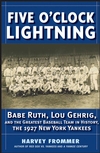
The press release on December 30, 1926 out of the offices of the New York Yankees in Manhattan on 42nd Street overlooking Bryant Park and the old Sixth Avenue El began:
"YANKEES WILL PLAY 21 SPRING BATTLES."
There would be a dozen games in Florida, seven heading north with the Cardinals, and two against the Brooklyn Robins at Ebbets Field.
The Yankee schedule was of interest to a multitude of fans and the players themselves, but to no one more than 23-year-old Tony Lazzeri.
For on a gloomy and overcast October 10, 1926 at Yankee Stadium, Cardinals versus Yankees, he came to bat for the Yankees who had loaded the bases in the seventh inning of the seventh game of the World Series with St. Louis clinging to a 3-2 lead. There were two outs.
"The bullpen in Yankee Stadium, Redbird hurler pitcher Grover Cleveland Alexander recalled "was under the bleachers then and when you're down there you can't tell what's going on out in the field only for the yells of the fans overhead. There was a telephone in the only real fancy, modern bullpen in baseball. Well, I was sitting around down there not doing much throwing. The phone rang and an excited voice said 'Send in Alexander."
Having already pitched complete game victories in Games 2 and 6, it was said that the grizzled veteran was recuperating from too much celebrating of his victory the previous day.
"So I come out from under the bleachers," Alexander continued. "I see the bases full and two out and Lazzeri standing at the box. Tony is up there all alone with everyone in that Sunday crowd watching him. So I just said to myself, 'Take your time, Lazzeri isn't feeling any too good up there and let him stew.'"
The crowd chanted: "Poosh-em-up Tony! Poosh-em-up Tony!" In four at bats the day before against the 39-year-old right-hander Alexander, Lazzeri had gone hitless.
First pitch, curve, a swinging strike.
Next pitch lined into the left-field seats. Foul ball.
"Lazzeri swung," said Alexander, "where that curve started but not where it finished. The ball got a hunk of the corner and then finished outside. If that line drive Lazzeri hit had been fair, Tony would be the hero, and I'd just be an old bum."
Then an over-anxious Lazzeri swung and missed and struck out.
Alexander breezed through the eighth inning. In the ninth ,he pitched around in his phrase "the big son of a bitch" Babe Ruth and walked him with two outs. The very dangerous Bob Meusel was next.
"If Meusel got hold of one, it could be two runs and the series," Alexander later said. "So I forgot all about Ruth and got ready to work on Meusel. On my first pitch, the Babe broke for second. I caught the blur of Ruth starting for second as I pitched and then came the whistle of the ball as catcher O'Farrell rifled it to second. I wheeled around and there was one of the grandest sights of my life. Hornsby, his foot anchored on the bag and his gloved hand outstretched, waiting for Ruth to come in."
Incredibly, the Babe had attempted to steal second base and was thrown out. The Cardinals had their first world championship.
Somehow, Babe Ruth got off the hook. On the hook was young Tony Lazzeri who spent a lot of his winter suffering the slings of "what happened?"
And that is why when he received the news that his Yankees and the Cardinals would have a series of exhibition games barnstorming north after the spring training of 1927 ended, the San Franciscan shouted out: "Vendetta," raising his fists into the air, "I shall have revenge."
Babe Ruth did not lust for any revenge. An incredible force of nature, he just kept rolling along, engaging in a tidal wave of activities after making that final out of the World Series.
Hither and yon, the great Ruth went, barnstorming vigorously for two weeks. On October 17 in Montreal the Yankee slugger slammed so many shots into a nearby river, according to a report in The South Bend Tribune, that the game was called for lack of baseballs. In South Bend, Indiana on October 23, they were ready to handle that little problem.
The local team stocked up on baseballs, costing $1.23 each. The game was called after six innings in large part because the Babe Ruth All Stars arrived two hours late. The South Bend Indians were beaten, 7-3, and the "Bammer" Ruth was 3-for-4 with a home run estimated to have traveled 600 feet.
Barnstorming completed, the Babe switched gears embarking on a 12 week Pantages circuit single act vaudeville tour for $8,333 weekly. No performer had ever made that kind of money, not Al Jolson, not Fanny Brice, not even W. C. Fields.
George Herman Ruth was everywhere doing everything in the time leading up to spring training in 1927. He was a one man endorsement machine - for pure milk, appliances for the home, housing developments, automobiles.
All told, it was estimated that the Sultan of Swat earned $250,000 in 1926 from playing baseball, movie work, barnstorming, endorsements and syndicated ghost written pieces.
And the Babe, who it was claimed needed little sleep, even had some spare time for golf, women, fishing, mingling with celebrities and common folk.
The pieces were falling into place for the 1927 Yankees. But the biggest piece, Babe Ruth, had not yet signed a new contract and seemed not likely to do so anytime soon. Hands down, he had rejected the $52,000 salary he earned in 1926. That was out of the question.
In early February, Jake Ruppert sent another in what would be a series of contract offers to Ruth. This one was for $55,000. The offer annoyed the hell out of the competitive Babe who said he had it on good authority that Ty Cobb, now with the Philadelphia Athletics, was slated to get $75,000.
The peripatetic Yankee outfielder moved on to "Hooray for Hollywood" time. He was now a star on the East Coast and the West Coast, now making his first movie, "The Babe Comes Home" for First National pictures.
In a break during shooting he said: "Reading, like picture shows is almost taboo, I've got to watch the old optics closer than anything else."
Under strict orders from his trainer Artie McGovern, the Bambino, also got his beauty sleep. He was early to bed by 9 P.M. (it wasn't clear whether he was there alone or had company), and early to rise he was on there on the movie set no later than six A.M.
On Hollywood Boulevard, running three to five miles a day, George Herman winked and smiled at folks all along the way, truly a sight for all kinds of eyes. After the up and downing on the streets, Ruth was rewarded back at his Hollywood Plaza Hotel with a comforting and stimulating rub down by McGovern who had taken leave of his New York City gymnasium on 42nd Street and Madison Avenue to press the flesh of his most illustrious client still unsigned to a Yankee contract for the 1927 season.
On February 22, six days before the first Yankees were scheduled to arrive in St. Petersburg for spring training, Babe Ruth mailed to Colonel Ruppert from Hollywood an outline of what he thought he should be paid for 1927, just another salvo in their continuing out in the public eye contract wrangling. The Babe was adamant as he spoke to reporters. He pressed the point that he would retire from baseball and organize a string of gymnasiums with Artie McGovern if his salary needs were not met.
On February 25, the day before the big man left California for New York, his salary demands were published in the New York Daily News. Two days later a letter he wrote to Colonel Ruppert appeared in The New York Times. The letter's tone was conciliatory. It was also forceful.
"You will find enclosed contract for 1927 which I am returning unsigned because of the $52,000 salary figure. I am leaving Los Angeles February 26 to see you in New York and will be prepared to report at St. Petersburg but only on the basis of $100,000 a year for two years, plus $7,700 held out of my salary in the past.. . .
"In fine physical condition today I hope to play as good as last year or better. I have exercised all winter and for the past twelve weeks have been working out of doors. At my own expense I have brought Arthur McGovern from New York to condition me.
"YANKEES WILL PLAY 21 SPRING BATTLES."
There would be a dozen games in Florida, seven heading north with the Cardinals, and two against the Brooklyn Robins at Ebbets Field.
The Yankee schedule was of interest to a multitude of fans and the players themselves, but to no one more than 23-year-old Tony Lazzeri.
For on a gloomy and overcast October 10, 1926 at Yankee Stadium, Cardinals versus Yankees, he came to bat for the Yankees who had loaded the bases in the seventh inning of the seventh game of the World Series with St. Louis clinging to a 3-2 lead. There were two outs.
"The bullpen in Yankee Stadium, Redbird hurler pitcher Grover Cleveland Alexander recalled "was under the bleachers then and when you're down there you can't tell what's going on out in the field only for the yells of the fans overhead. There was a telephone in the only real fancy, modern bullpen in baseball. Well, I was sitting around down there not doing much throwing. The phone rang and an excited voice said 'Send in Alexander."
Having already pitched complete game victories in Games 2 and 6, it was said that the grizzled veteran was recuperating from too much celebrating of his victory the previous day.
"So I come out from under the bleachers," Alexander continued. "I see the bases full and two out and Lazzeri standing at the box. Tony is up there all alone with everyone in that Sunday crowd watching him. So I just said to myself, 'Take your time, Lazzeri isn't feeling any too good up there and let him stew.'"
The crowd chanted: "Poosh-em-up Tony! Poosh-em-up Tony!" In four at bats the day before against the 39-year-old right-hander Alexander, Lazzeri had gone hitless.
First pitch, curve, a swinging strike.
Next pitch lined into the left-field seats. Foul ball.
"Lazzeri swung," said Alexander, "where that curve started but not where it finished. The ball got a hunk of the corner and then finished outside. If that line drive Lazzeri hit had been fair, Tony would be the hero, and I'd just be an old bum."
Then an over-anxious Lazzeri swung and missed and struck out.
Alexander breezed through the eighth inning. In the ninth ,he pitched around in his phrase "the big son of a bitch" Babe Ruth and walked him with two outs. The very dangerous Bob Meusel was next.
"If Meusel got hold of one, it could be two runs and the series," Alexander later said. "So I forgot all about Ruth and got ready to work on Meusel. On my first pitch, the Babe broke for second. I caught the blur of Ruth starting for second as I pitched and then came the whistle of the ball as catcher O'Farrell rifled it to second. I wheeled around and there was one of the grandest sights of my life. Hornsby, his foot anchored on the bag and his gloved hand outstretched, waiting for Ruth to come in."
Incredibly, the Babe had attempted to steal second base and was thrown out. The Cardinals had their first world championship.
Somehow, Babe Ruth got off the hook. On the hook was young Tony Lazzeri who spent a lot of his winter suffering the slings of "what happened?"
And that is why when he received the news that his Yankees and the Cardinals would have a series of exhibition games barnstorming north after the spring training of 1927 ended, the San Franciscan shouted out: "Vendetta," raising his fists into the air, "I shall have revenge."
Babe Ruth did not lust for any revenge. An incredible force of nature, he just kept rolling along, engaging in a tidal wave of activities after making that final out of the World Series.
Hither and yon, the great Ruth went, barnstorming vigorously for two weeks. On October 17 in Montreal the Yankee slugger slammed so many shots into a nearby river, according to a report in The South Bend Tribune, that the game was called for lack of baseballs. In South Bend, Indiana on October 23, they were ready to handle that little problem.
The local team stocked up on baseballs, costing $1.23 each. The game was called after six innings in large part because the Babe Ruth All Stars arrived two hours late. The South Bend Indians were beaten, 7-3, and the "Bammer" Ruth was 3-for-4 with a home run estimated to have traveled 600 feet.
Barnstorming completed, the Babe switched gears embarking on a 12 week Pantages circuit single act vaudeville tour for $8,333 weekly. No performer had ever made that kind of money, not Al Jolson, not Fanny Brice, not even W. C. Fields.
George Herman Ruth was everywhere doing everything in the time leading up to spring training in 1927. He was a one man endorsement machine - for pure milk, appliances for the home, housing developments, automobiles.
All told, it was estimated that the Sultan of Swat earned $250,000 in 1926 from playing baseball, movie work, barnstorming, endorsements and syndicated ghost written pieces.
And the Babe, who it was claimed needed little sleep, even had some spare time for golf, women, fishing, mingling with celebrities and common folk.
The pieces were falling into place for the 1927 Yankees. But the biggest piece, Babe Ruth, had not yet signed a new contract and seemed not likely to do so anytime soon. Hands down, he had rejected the $52,000 salary he earned in 1926. That was out of the question.
In early February, Jake Ruppert sent another in what would be a series of contract offers to Ruth. This one was for $55,000. The offer annoyed the hell out of the competitive Babe who said he had it on good authority that Ty Cobb, now with the Philadelphia Athletics, was slated to get $75,000.
The peripatetic Yankee outfielder moved on to "Hooray for Hollywood" time. He was now a star on the East Coast and the West Coast, now making his first movie, "The Babe Comes Home" for First National pictures.
In a break during shooting he said: "Reading, like picture shows is almost taboo, I've got to watch the old optics closer than anything else."
Under strict orders from his trainer Artie McGovern, the Bambino, also got his beauty sleep. He was early to bed by 9 P.M. (it wasn't clear whether he was there alone or had company), and early to rise he was on there on the movie set no later than six A.M.
On Hollywood Boulevard, running three to five miles a day, George Herman winked and smiled at folks all along the way, truly a sight for all kinds of eyes. After the up and downing on the streets, Ruth was rewarded back at his Hollywood Plaza Hotel with a comforting and stimulating rub down by McGovern who had taken leave of his New York City gymnasium on 42nd Street and Madison Avenue to press the flesh of his most illustrious client still unsigned to a Yankee contract for the 1927 season.
On February 22, six days before the first Yankees were scheduled to arrive in St. Petersburg for spring training, Babe Ruth mailed to Colonel Ruppert from Hollywood an outline of what he thought he should be paid for 1927, just another salvo in their continuing out in the public eye contract wrangling. The Babe was adamant as he spoke to reporters. He pressed the point that he would retire from baseball and organize a string of gymnasiums with Artie McGovern if his salary needs were not met.
On February 25, the day before the big man left California for New York, his salary demands were published in the New York Daily News. Two days later a letter he wrote to Colonel Ruppert appeared in The New York Times. The letter's tone was conciliatory. It was also forceful.
"You will find enclosed contract for 1927 which I am returning unsigned because of the $52,000 salary figure. I am leaving Los Angeles February 26 to see you in New York and will be prepared to report at St. Petersburg but only on the basis of $100,000 a year for two years, plus $7,700 held out of my salary in the past.. . .
"In fine physical condition today I hope to play as good as last year or better. I have exercised all winter and for the past twelve weeks have been working out of doors. At my own expense I have brought Arthur McGovern from New York to condition me.
Sunday, December 09, 2007
Holiday Reads, 2007: Part II
“How Bill James “Changed Our View of Baseball,” "A Well-Paid Slave,” “Harvard Boys,” “Gretzky to Lemieux,”etc.
The seasons come and go, the books on sports, likewise. Here for your reading edification and enjoyment, another batch of entries from the crowded field of tomes on sports.
“How Bill James Changed Our View of Baseball” (Acta Sports, $19.95, 144 pages hardcover) is an unabashed and mostly deserved batch of raves about the whys and wherefores about the lifetime of work by the man from Kansas who today lives in Boston and is Senior Baseball Operations Advisor for the Boston Red Sox. James and some of his friends (Alan Schwarz, John Thorn, etc.) have a go at it explaining (or at least trying to) the work of the man TIME magazine named one of the “100 Most Influential People in the World.”
“A Well-Paid Slave” by Brad Snyder (Plume, $14.00, paper) is the story of Curt Flood and his lawsuit that broke new ground and changed the face of baseball ushering in free agency. Absorbing stuff.
“Harvard Boys” by John Wolff and Rick Wolff (Skyhorse Publishing, $24.95, 336 pages, hardcover) intermingles life at Harvard, a father, a son, dreams of making it big in the big leagues of baseball. Both made it out of Harvard and into the minors. Their stories are appealing.
“Gretzky to Lemieux” by Ed Willes (McClelland & Stewart, $24.95, 256 pages, hardcover) is a one of a kind look back at the 1987 Canada Cup - three games between Canada and the former Soviet Union. Brilliantly written, jammed with stories from those who were there – this book is a hockey lover’s heaven.
Cecil Harris and Larryette Kyle-DeBose have done a creditable job in “Charging the Net” (Ivan R. Dee, $26.95, 271 pages, hardcover) a book that is as its sub-title proclaims: “A history of blacks in tennis from Althea Gibson to the Williams Sisters.”
“War Without Death” by Mark Maske (Penguin, $25.95, 400 pages, hardcover) by the Washington Post sports columnist is a no holds barred look back at the life in a year’s competition in the National Football League East. In depth, clearly and cogently presented. HIGHLY RECOMMENDED.
Sunday, November 25, 2007
Holiday Reads, 2007: Part I:
“The Best Game Ever,” “Connie Mack,” “The Ultimate Yankees Companion,” etc.
Just in time for hot stove league reading, off season entertainment, sitting before the fire, browsing and or serious reading comes a bevy of books. All have a lot to offer.
This blurb on the back cover of “The Best Game Ever,” by Jim Reisler (Carroll & Graf, $26.00, 280 pages) reads: “A home run of a book! Jim Reisler has a terrific eye for details, a wonderful way with words. He’s done the best job ever with “The Best Game Ever!” That’s a heck of a blurb and really sums up the book and Reisler. I should know. I wrote the blurb. HIGHLY RECOMMENDED!
“Connie Mack and the Early Years of Baseball” by Norman Macht (University of Nebraska Press, $39.95, 708 pages) is a mother lode of data, stories, perceptions about one of the legendary figures in the history of the national pastime. Like a fine wine, “Connie Mack and the Early Years of Baseball” brings back Mack as player, manager, owner. If you are into baseball, get into this tome.
John Grisham once was cut from his college baseball team, but that is another story. Somehow, he has managed to make a living in another field. His 19th novel “Playing For Pizza (Doubleday, $26.95, 262 pages) will delight his fans and fans in general, telling as it does a charming tale of Rick Dockery, former third string qb of the Cleveland Browns who “makes it” playing in Italy for the magnificent Parma Panthers. Read this love of a book in one sitting!
“The Ultimate Yankees Companion” edited by Gary Gillette and Pete Palmer (Maple Street Press, $24.95, 388 pages) is as its sub-title proclaims: “A Complete Statistical and Reference Encyclopedia.” Gillette and Palmer and their talented team have served up feasts
for Yankee fans having produced a book with all matter of Bronx Bomber material. This is a book to place on your bookshelf and go to often - - as Casey Stengel said: “You could look it up” and that surely goes for “The Ultimate Yankees Companion”.
One wouldn’t think that a slim paperback focused on “Haunted Baseball” by Mickey Bradley and Dan Gordon (Lyons Press, $14.95, 275 pages) would have so much appeal. But the book is nifty focusing as it does on ghosts, curses, legends and eerie events that have been a part of the national pastime. I was especially attracted to the chapter “The Ghosts of Yankee Stadium.” I wonder why.
BOOKENDS: Interesting sports paperbacks from the University of Nebraska Press include:” A Season in Purgatory by Tony Moss about Villanova and as the sub-tile notes “life in college football’s lower class; “Tricksters in the Madhouse” by John Christgau, a meticulous flashback to February 19, 1948 – Minneapolis Lakers versus Harlem Globetrotters for the “unofficial world championship” before blacks played in pro basketball; “The Poetics of Golf” by Andy Brumer is just that and if you are a golfer, a fan of the game, read this book and enjoy!
Wednesday, October 10, 2007
New Book Chronicles One of Sport’s Most Storied Teams
FOR IMMEDIATE RELEASE
Media Contact: Tony Viardo
Sourcebooks, Inc.
630-961-3900 ext 234
202-258-8287 (mbl)
Tony.viardo@sourcebooks.com
Has It Really Been a Yankee Century?
New Book Chronicles One of Sport’s Most Storied Teams
"Yankee fans who can't learn enough about their favorite team will think they died and went to heaven with all that Frommer offers on each page."
—Publishers Weekly
In the world of politics, the term is “polarizing.” It’s used for people and organizations that evoke strong feelings, both positive and negative. If you looked up that word in a sports dictionary, however, you’d find a picture of The New York Yankees. No other team in Sport is more simultaneously loved and hated than the embattled Yanks. But by the same token, no other team is more storied, more celebrated, or more woven into the fabric of American culture than the Bronx Bombers.
As far as baseball is concerned, the last hundred years have truly been a Yankee Century. So claims Harvey Frommer, author of Yankee Century and Beyond: A Celebration of the First Hundred Plus Years of Baseball’s Greatest Team (ISBN: 978-1-4022-1002-0; November, 2007; $17.00 US / $22.00 CAN).
Yankee Century captures 106 years of Yankee life in reflections, stats, facts, and historic images. From their beginning as the New York Highlanders, playing in Manhattan's Hilltop Park in 1903, to reigning over Major League Baseball as it entered a new millennium—with World Series Championships in '96, '98, '99 and 2000—the Yankees represent a century-long legacy of triumphs and defeats, legends and lore, as an enduring symbol of America's favorite pastime.
More than just an atlas of statistics, Yankee Century contains reflections, quotes and profiles from individuals who are at the heart of the Yankee Mystique. Personalities include: Mel Allen, Yogi Berra, Chris Chambliss, Don Larsen, and Bob Sheppard. It also includes tributes to the greats: From Mickey Mantle to Don Mattingly, Vic Raschi to Allie Reynolds and Joltin' Joe DiMaggio to Derek Jeter.
Destined to become the defining chronicle of the Yankees’ first hundred years, Yankee Century and Beyond is a must-have collector’s volume not only for Yankee fans, but for anyone who appreciates the history and relevance of American Sport.
ABOUT THE AUTHOR
Harvey Frommer is a noted sports journalist and historian, the author of thirty-eight books on sports, including Shoeless Joe and Ragtime Baseball and The New York Yankee Encyclopedia, as well as autobiographies of legends Nolan Ryan, Tony Dorsett and Red Holzman. He has also written, along with his wife, hundreds of articles for newspapers, magazines and on the internet.
Frommer is a sought after public speaker, and a regular on radio and television sports shows. He is a professor at Dartmouth college and a long time Yankee fan who wrote for Yankees Magazine for sixteen years.
FIVE O’CLOCK LIGHTNING
Media Contact: Mike Onorato
FOR IMMEDIATE RELEASE 201-748-6361 / monorato@wiley.com
FOR IMMEDIATE RELEASE 201-748-6361 / monorato@wiley.com
"The 1927 Yankees may or may not have been the best team ever, but surely this is the best book about that concentration of talent."–George Will
"An engrossing and entertaining look at a mythical baseball team. Ride the trains and chew the tobacco and have fun."—
Leigh Montville, author of “The Big Bam: The Life and Times of Babe Ruth”
Five O’Clock Lightning:
Babe Ruth, Lou Gehrig and the Greatest Baseball Team in History,
The 1927 New York Yankees
The 1927 New York Yankees
By Harvey Frommer
The 1927 New York Yankees are widely regarded as one of the greatest baseball teams of all-time. From the “Murderer’s Row” lineup to the near mythic status that surrounded them in Prohibition-era New York City and elsewhere, celebrated author Harvey Frommer tells the fascinating story of the greatest season of baseball’s greatest team in FIVE O’CLOCK LIGHTNING.
Based on an oral history, long-buried letters, and diary notations, FIVE O’CLOCK LIGHTNING: Babe Ruth, Lou Gehrig and the Greatest Baseball Team in History, The 1927 New York Yankees (Wiley; November 2007; $24.95; Cloth; ISBN: 9780471778127) paints a vivid portrait of the best team in baseball chasing greatness in Jazz Age New York City just before the Depression changed everything. Told in chronological order and through colorful details from the 1927 Yankees’ private and public lives, as well as the kinds of minutiae baseball fans love (salaries, batting orders, standings, stats) and stories about the complicated task of building a cohesive team from a collection of superstars, FIVE O’CLOCK LIGHTNING reveals the hidden history of America’s greatest ball club, from the team’s compilation in the 1926 off-season (only one year after the Yanks’ disastrous ’25 season) to the World Series’ final pitch.
About the Author:
Harvey Frommer (New York, NY, and Lyme, NH) is a well-known oral historian and sports author who has written 39 sports books and has appeared on numerous television and radio programs. Cited in the Congressional Record and the New York State Legislature as a sports historian, he is Professor Emeritus, City University of New York, and a professor at Dartmouth College in the Master of Arts in Liberal Studies program.
* * *
Five O’clock Lightning:
Babe Ruth, Lou Gehrig and the Greatest Baseball Team in History, The 1927 New York Yankees
By Harvey Fommer
Wiley
Publication Date: November 2007
$24.95, Cloth
ISBN: 978-0-471-77812-7
ATTENTION REVIEWERS
For the convenience of your readers, please include the following in your review: Wiley books are available at your local bookstore or by calling 1-800-225-5945. In Canada, call 1-800-567-4797.
Five O’clock Lightning:
Babe Ruth, Lou Gehrig and the Greatest Baseball Team in History, The 1927 New York Yankees
By Harvey Fommer
Wiley
Publication Date: November 2007
$24.95, Cloth
ISBN: 978-0-471-77812-7
ATTENTION REVIEWERS
For the convenience of your readers, please include the following in your review: Wiley books are available at your local bookstore or by calling 1-800-225-5945. In Canada, call 1-800-567-4797.

Tuesday, October 09, 2007
Has It Really Been a Yankee Century?
New Book Chronicles One of Sport’s Most Storied Teams
"Yankee fans who can't learn enough about their favorite team will think they died and went to heaven with all that Frommer offers on each page."
—Publishers Weekly
In the world of politics, the term is “polarizing.” It’s used for people and organizations that evoke strong feelings, both positive and negative. If you looked up that word in a sports dictionary, however, you’d find a picture of The New York Yankees. No other team in Sport is more simultaneously loved and hated than the embattled Yanks. But by the same token, no other team is more storied, more celebrated, or more woven into the fabric of American culture than the Bronx Bombers.
As far as baseball is concerned, the last hundred years have truly been a Yankee Century. So claims Harvey Frommer, author of Yankee Century and Beyond: A Celebration of the First Hundred Plus Years of Baseball’s Greatest Team (ISBN: 978-1-4022-1002-0; November, 2007; $17.00 US / $22.00 CAN).
Yankee Century captures 106 years of Yankee life in reflections, stats, facts, and historic images. From their beginning as the New York Highlanders, playing in Manhattan's Hilltop Park in 1903, to reigning over Major League Baseball as it entered a new millennium—with World Series Championships in '96, '98, '99 and 2000—the Yankees represent a century-long legacy of triumphs and defeats, legends and lore, as an enduring symbol of America's favorite pastime.
More than just an atlas of statistics, Yankee Century contains reflections, quotes and profiles from individuals who are at the heart of the Yankee Mystique. Personalities include: Mel Allen, Yogi Berra, Chris Chambliss, Don Larsen, and Bob Sheppard. It also includes tributes to the greats: From Mickey Mantle to Don Mattingly, Vic Raschi to Allie Reynolds and Joltin' Joe DiMaggio to Derek Jeter.
Destined to become the defining chronicle of the Yankees’ first hundred years, Yankee Century and Beyond is a must-have collector’s volume not only for Yankee fans, but for anyone who appreciates the history and relevance of American Sport.
"Yankee fans who can't learn enough about their favorite team will think they died and went to heaven with all that Frommer offers on each page."
—Publishers Weekly
In the world of politics, the term is “polarizing.” It’s used for people and organizations that evoke strong feelings, both positive and negative. If you looked up that word in a sports dictionary, however, you’d find a picture of The New York Yankees. No other team in Sport is more simultaneously loved and hated than the embattled Yanks. But by the same token, no other team is more storied, more celebrated, or more woven into the fabric of American culture than the Bronx Bombers.
As far as baseball is concerned, the last hundred years have truly been a Yankee Century. So claims Harvey Frommer, author of Yankee Century and Beyond: A Celebration of the First Hundred Plus Years of Baseball’s Greatest Team (ISBN: 978-1-4022-1002-0; November, 2007; $17.00 US / $22.00 CAN).
Yankee Century captures 106 years of Yankee life in reflections, stats, facts, and historic images. From their beginning as the New York Highlanders, playing in Manhattan's Hilltop Park in 1903, to reigning over Major League Baseball as it entered a new millennium—with World Series Championships in '96, '98, '99 and 2000—the Yankees represent a century-long legacy of triumphs and defeats, legends and lore, as an enduring symbol of America's favorite pastime.
More than just an atlas of statistics, Yankee Century contains reflections, quotes and profiles from individuals who are at the heart of the Yankee Mystique. Personalities include: Mel Allen, Yogi Berra, Chris Chambliss, Don Larsen, and Bob Sheppard. It also includes tributes to the greats: From Mickey Mantle to Don Mattingly, Vic Raschi to Allie Reynolds and Joltin' Joe DiMaggio to Derek Jeter.
Destined to become the defining chronicle of the Yankees’ first hundred years, Yankee Century and Beyond is a must-have collector’s volume not only for Yankee fans, but for anyone who appreciates the history and relevance of American Sport.
Subscribe to:
Posts (Atom)