Monday, September 21, 2009
Collision Course: Red Sox versus Yankees
It has been said that those who forget the past will somehow always be re-living it, or words to that effect. Here we are in 2009 - and it's 1978 all over again on the playing field of baseball's greatest rivalry - -without some of the old time sizzle.
In 1976, the New York Yankees finished the season with a 97-62 record and won the American League East title. The Red Sox of Boston finished in third place, 15 ½ games behind. In 1977, the Yankees won 100 of the 162 games they played and repeated as division title winners. Boston won 97 games and tied for second place with Baltimore. Both teams trailed the Yankees by 2 ½ games.
It was during these two seasons that more and more Yankee fans began to sport "Red Sox Suck" tee shirts. And it was during this time that Yankee principal owner George Steinbrenner kept wheeling and dealing, embellishing the Yankee image, his team's skills and the Red Sox failings.
The start of the 1978 season gave Boston fans hope. Over the winter the team engineered several key moves to strengthen itself. Mike Torrez, winner of two World Series games for the Yankees in 1977, was signed as a free agent. Dennis Eckersley, just 23, was acquired from the Cleveland Indians. It was felt that the combination of the veteran Torrez and the youthful Eckersley would shore up Sox pitching. Another key Boston acquisition was Jerry Remy, a sure-handed speedy second baseman obtained from the California Angels. Remy's promise was added speed on the base path and an effective contact hitter near the top of the Boston batting order.
With Remy at second base and Rick Burleson at shortstop, Boston fans felt their team had a double-play combination to rival if not surpass the Yankee tandem of Bucky Dent and Willie Randolph. George Scott, the Sox first baseman, had recorded 33 homers in 1977 -- almost twice the total of Yankee first baseman Chris Chambliss. Slugging Butch Hobson was a fixture at third base. Nettles of New York was peerless with a glove, but Sox fans argued that Hobson outmatched the Yankee third baseman when it came to hitting. Hobson had rapped 30 homers and driven in 112 run in 1977.
Both teams boasted top-flight catchers. Most baseball experts rated Boston's Carlton Fisk and New York's Thurman Munson among the two best backstops in all of baseball.
Both teams had powerful clutch-hitting outfielders, capable of making crucial defensive plays. Carl Yastrzemski, Dwight Evans, and Fred Lynn would be Boston's picket line, augmented by perhaps the best potential designated hitter in all of baseball -Jim Rice. The Yankees had steady Roy White, flamboyant Mickey Rivers, and dramatic Reggie Jackson, buttressed by Paul Blair, Lou Piniella, and, if needed, Cliff Johnson.
If there was a difference, it was in pitching. Over the winter George Steinbrenner had signed Rich Gossage, Rawly Eastwick, and Andy Messersmith. This trio joined Catfish Hunter, Don Gullett, Sparky Lyle, and Ed Figueroa, Ken Holtzman, Dick Tidrow, and Ron Guidry (16-7 in 1977 and getting better, much better).
Against this array of all types of pitching talent, Boston had its Latin duo of Luis Tiant and Mike Torrez, Eckersley, Bill Lee, and Bob Stanley. Bill Campbell had saved 31 games in 1977, and it was felt that he could repeat that performance in 1978.
Seven straight wins at Fenway Park launched Boston on a fine start as the season got underway. By May 18th, the Yankees (19-13) trailed the second-place Sox (23-12) who were a half-game behind the surprising first-place Detroit Tigers. On May 24th, the Sox moved into sole possession of first place. They would remain there for 113 days, to the delight of their adoring and rabid fans.
At the All-Star break, powered by a combination of good pitching and power hitting, Boston had a record of 57 wins against just 26 losses $F6 a .687 winning percentage, the best in baseball. More enjoyable to some Red Sox fans was the record of the New York Yankees. The hated rivals were mired in third place, way back off the pace.
"George came into the clubhouse one day," Reggie Jackson recalled, "and said 'I'm going to back up the truck and get rid of all you guys, everybody, if we don't get it turned around.' It was an unbelievable tirade. Whether that motivated us or not, I don't know. I think it made us mad. George yelled at us. Told us we were terrible, that he was going to break up the club and nobody was above being traded."
Emanating daily from New York was news of controversy, sore-armed pitchers, bruised infielders, battered egos, unhappy coaches. In Boston, for a change, there was relative harmony.
On July 18th, the Sox stretched their lead over the Yanks to 14 games. "Even Affirmed couldn't catch the Red Sox now," snapped Reggie Jackson, referring to the horse that had won the 1978 Triple Crown.
Affirmed is long gone and so are the motor mouthings of Reggie Jackson. And this last weekend of September 2009 on a collision course the Yankees of New York and the Red Sox of Boston meet at Yankee Stadium - - a lot is on the line.
Harvey Frommer is his 33rd consecutive year of writing sports books. The author of 40 of them including the classics: "New York City Baseball,1947-1957" and "Shoeless Joe and Ragtime Baseball," his acclaimed REMEMBERING YANKEE STADIUM, an oral/narrative history (Abrams, Stewart, Tabori and Chang) was published in 2008 as well as a reprint version of his classic "Shoeless Joe and Ragtime Baseball." The prolific Frommer is at work on REMEMBERING FENWAY PARK (2010).
Frommer sports books are available direct from the author - discounted and autographed.
FROMMER SPORTSNET (syndicated) reaches a readership in the millions and is housed on Internet search engines for extended periods of time.


Friday, September 11, 2009
Lou Gehrig (From the Vault)

“I consider myself the luckiest man on the face of the earth.”
With Derek Jeter a lock to pass the all-time Yankee hit mark set by Lou Gehrig and reams and reams of copy having been devoted to the chase, what the great first baseman was like and what he did in his career is worth recalling.
They called him “Larrupin Lou,” “Iron Horse,” “Biscuit Pants,” “Columbia Lou,” “Buster.” Whatever they called him – he was “The Pride of the Yankees.”
Born Heinrich Ludwig Gehrig II on June 19, 1903 in New York City to poor German immigrants, he was the only one of four children to survive infancy.
Labeled "the Babe Ruth of the schoolyards" after hitting a tremendous grand slam ninth inning home run over the right field fence for his Commerce High School team in a special "national championship" game at Wrigley Field in Chicago, Gehrig went on to star at Columbia University.
"I did not go there to look at Gehrig,” Yankee scout Paul Krichell said.” I did not even know what position he played, but he played in the outfield against Rutgers and socked a couple of balls a mile. I sat up and took notice. I saw a tremendous youth, with powerful arms and terrific legs. I said, here is a kid who can't miss."
Despite his mother's protestations, Gehrig signed with the Yankees for a $1,500 bonus. After brief minor league stints in 1923 and 1924; Gehrig came to stay with the Yankees in 1925 batting .295 in 126 games, his first full season. When Lou Gehrig stepped into the batter's box as a pinch hitter on June 1, 1925 for shortstop Pee Wee Wanninger, it began a string of 15 seasons of Yankee box scores with the name Gehrig always in the line-up.
In 1927, his second full season with the Yankees, he was voted the Most Valuable Player in the American League. His .363 average in 1934 gave him the batting championship. There were 13 straight seasons of 100 RBIs, seven seasons of more than 150 RBIs. His power came from his big shoulders, broad back and powerful thighs.
A two time MVP, a three time home run king, a five time RBI champ, Gehrig led the American League in batting average just once - with a .363 average in 1934 when he became the first Yankee to win the Triple Crown. Three times, however, he batted higher than .363 contributing to his .340 career batting average.
Among his records are: 184 RBI in 1931, an American League record, 23 career grand slams, a Major League record. On June 3, 1932, he became the first modern day player to hit four home runs in a game. In his 13 full seasons, Gehrig averaged 147 runs batted in. He hammered 493 career home runs - 73 were three-run homers, 166 were two-run homers. Gehrig homered once every 16.2 at bats. His home run to hit ratio was one to 5.51.
There are estimates that he earned $361,500 in salary from the Yankees. Playing in seven World Series pushed the total income above $400,000. Gehrig received $3,750 in his first season, $6,500 in his second year. This advanced $1,000 in 1927. For the next five years he received $25,000 and then he dropped to $23,000 for 1933 and 1934, after which he received $31,000 in 1935 and 1936, $36,750 in 1937, $39,000 in 1938 and $35,000 for 1939, a season when he played only eight games. Late in his career, Gehrig's hands were x-rayed and doctors spotted 17 fractures that had "healed" while he continued to play. He was worth every penny as he was a major part of seven pennant winners and six world champions.
On May 2, 1939, Wally Pipp whose place Gehrig had taken those long years ago, traveled from his home in Michigan to watch a Tigers-Yankees game. What he saw was that Gehrig, the highest paid player in all of baseball, had taken himself out of the lineup and was at home plate, a presenter of the lineup card to the umpires.
The great Gehrig would languish a while like a bowed oak, still the captain, still the Pride of the Yankees, still the bringer of the lineup card out to umpires before each game.
On June 19, 1939, in another bitter irony, the day of his 36th birthday, Lou Gehrig left the Mayo Clinic with a sealed envelope. “Mr. Gehrig is suffering from amyotrophic lateral sclerosis. This type of illness involves the motor pathways and cells of the central nervous system and in lay terms is known as a form of infantile paralysis. The nature of this trouble makes it such that Mr. Gehrig will be unable to continue his active participation as a baseball player.”
In December 1939, the Baseball Hall of Fame waived the mandatory five year waiting period for Lou Gehrig. On June 2, 1941, exactly 16 years to the day that he replaced Wally Pipp at first base, Gehrig passed away. On the Fourth of July 1941, a monument was erected in centerfield at Yankee Stadium:
HENRY LOUIS GEHRIG
June 19, 1903 –June 2, 1941. A MAN, A GENTLEMAN, AND A GREAT BALLPLAYER WHISE AMAZING RECORD OF 2,130 CONSECUTIVE GAMES SHOULD STAND FOR ALL TIME. THIS MEMORIAL IS A TRIBUTE FROM THE YANKEE PLAYERS TO THEIR BELOVED CAPTAIN AND TEAMMATE.
Harvey Frommer is his 33rd consecutive year of writing sports books. The author of 40 of them including the classics: "New York City Baseball,1947-1957" and "Shoeless Joe and Ragtime Baseball," his acclaimed REMEMBERING YANKEE STADIUM, an oral/narrative history (Abrams, Stewart, Tabori and Chang) was published in 2008 as well as a reprint version of his classic "Shoeless Joe and Ragtime Baseball." The prolific Frommer is at work on REMEMBERING FENWAY PARK (2010).
Frommer sports books are available direct from the author - discounted and autographed.
FROMMER SPORTSNET (syndicated) reaches a readership in the millions and is housed on Internet search engines for extended periods of time.
Tuesday, September 01, 2009
From New York Yankee September Pasts
Whenever the month of September comes around,
thoughts turn to BUCKY DENT'S HOME RUN – October 2, 1978 and
THE BOSTON MASSACRE, September 7, 1978. But there have been
other marker moments that linger in memory. Herewith, a few . . .
SAM JONES, NO HITTER, SEPTEMBER 4, 1923
His major league career began with the Cleveland Indians in 1914, continued with the Red Sox from 1916-21, with the Yankees (1922-26), the Browns (1927), the Senators (1928-31), and the White Sox (1932-35). Twice a 20-game winner, Samuel Pond Jones won 229 games and lost 217 in 22 seasons pitching in the American League.
A stylish right-hander, one of the first major leaguers to wear eyeglasses on the field, Jones had his ups and downs. Like most pitchers of his time, he relieved and started. His eight saves in 1922 were tops in the league.. In 1923, he won 21 games, but lost a league-high 21 in 1925 as the Yanks dropped to seventh place
Jones won 67 games as a Yankee in five seasons. No game was more dramatic for him than his September 4, 1923 no-hitter, a 2-0 gem against the Athletics. It capped his career year, a time he was the Yankee ace, hurling New York to its first World Championship.
JIM ABBOTT NO HITTER, September 4, 1993
The Yankees traded for him on December 6, 1992. He was born without a right hand, but he persevered, more than persevered. A graduate of the University of Michigan, Jim Abbott carried the United States flag during the opening ceremonies at the 1987 Pan American Games in Indianapolis and pitched for the 1988 U.S. Olympic team. In 1989, he went directly from the University of Michigan to the Angels' starting rotation. A solidly built southpaw, the intense Abbott won a dozen games and posted a 3.92 ERA in his rookie season. On the mound, he wore a right-hander's fielder's glove over the stump at the end of his right arm. After delivering a pitch and when completing his follow-through, he adroitly switched the glove to his left hand to be in a position to handle any balls batted back to him.
In 1991 he looked like one of the best young left-handers in the game after winning 18 games for the Angels while posting a 2.89 ERA. The Yankees traded their best prospect first baseman J.T. Snow and pitchers Russ Spring and Jerry Nielsen to California for Abbott. The media spotlight in New York City seemed to be on him daily. Abbott said he wanted to be like Nolan Ryan and not like Pete Gray, the one handed pitcher.
With the Yankees, Abbott had his ups and downs in two seasons in the Bronx. His record was 20-22. But he did have one especially shining moment. It came just six days after he had been touched for ten hits and seven runs in only three and a third innings against Cleveland. Facing Cleveland again, in the in the heat of the pennant race, Abbott tossed a 4-0 no-hitter against the Indians. “I remember it was a cloudy day. A day game, the kind of game I like to throw."
CAL RIPKEN: LAST YANKEE STADIUM GAME, SEPTEMBER 30, 2001
The day was drizzly and cold. The Yankees played against the Orioles for 15 innings, and the game was called finally because of rain. There were 55,351 fans around at the start and much less at the finish.
Many in the crowd had come out to see Cal Ripken, Jr. in his 126th game at Yankee Stadium, the most by an opposing player. His first game there was June 18, 1982.
There was an orange No. 8 painted on third base, as well as the Orioles' on-deck circle. Ripken was given the honor of throwing out the first pitch to Derek Jeter. Gifts presented to Ripken included a sterling silver press pin from Don Mattingly, a watch, an enlarged and framed copy of the commemorative ticket each fan was given reading “Farewell Cal Ripken.'' Black-and-white pictures of Ripken and Gehrig were on the tickets.
Ripken's pregame speech near home plate was staged near where Lou Gehrig, dying, said goodbye. “I know there will be many things that I'll miss about baseball, but coming to New York and playing in Yankee Stadium will always be at the top….
"I remember Graig Nettles making diving catches. I remember Louisiana Lightning I didn't like facing him that much. . . Willie Randolph and Dave Winfield. One of my all-time favorites at first base, Don Mattingly. It's really been a great run," Ripken said. "Let's get to the game."
The game was in Ripken’s words: “Eerie. The weather, the gray sky, the wind, the rain. I was punched out four times and went 0-for-7, but I still had a lot of fun competing."
Harvey Frommer is his 33rd consecutive year of writing sports books. The author of 40 of them including the classics: "New York City Baseball,1947-1957" and "Shoeless Joe and Ragtime Baseball," his acclaimed REMEMBERING YANKEE STADIUM, an oral/narrative history (Abrams, Stewart, Tabori and Chang) was published in 2008 as well as a reprint version of his classic "Shoeless Joe and Ragtime Baseball." The prolific Frommer is at work on REMEMBERING FENWAY PARK (2010).
Frommer sports books are available direct from the author - discounted and autographed.
FROMMER SPORTSNET (syndicated) reaches a readership in the millions and is housed on Internet search engines for extended periods of time.
thoughts turn to BUCKY DENT'S HOME RUN – October 2, 1978 and
THE BOSTON MASSACRE, September 7, 1978. But there have been
other marker moments that linger in memory. Herewith, a few . . .
SAM JONES, NO HITTER, SEPTEMBER 4, 1923
His major league career began with the Cleveland Indians in 1914, continued with the Red Sox from 1916-21, with the Yankees (1922-26), the Browns (1927), the Senators (1928-31), and the White Sox (1932-35). Twice a 20-game winner, Samuel Pond Jones won 229 games and lost 217 in 22 seasons pitching in the American League.
A stylish right-hander, one of the first major leaguers to wear eyeglasses on the field, Jones had his ups and downs. Like most pitchers of his time, he relieved and started. His eight saves in 1922 were tops in the league.. In 1923, he won 21 games, but lost a league-high 21 in 1925 as the Yanks dropped to seventh place
Jones won 67 games as a Yankee in five seasons. No game was more dramatic for him than his September 4, 1923 no-hitter, a 2-0 gem against the Athletics. It capped his career year, a time he was the Yankee ace, hurling New York to its first World Championship.
JIM ABBOTT NO HITTER, September 4, 1993
The Yankees traded for him on December 6, 1992. He was born without a right hand, but he persevered, more than persevered. A graduate of the University of Michigan, Jim Abbott carried the United States flag during the opening ceremonies at the 1987 Pan American Games in Indianapolis and pitched for the 1988 U.S. Olympic team. In 1989, he went directly from the University of Michigan to the Angels' starting rotation. A solidly built southpaw, the intense Abbott won a dozen games and posted a 3.92 ERA in his rookie season. On the mound, he wore a right-hander's fielder's glove over the stump at the end of his right arm. After delivering a pitch and when completing his follow-through, he adroitly switched the glove to his left hand to be in a position to handle any balls batted back to him.
In 1991 he looked like one of the best young left-handers in the game after winning 18 games for the Angels while posting a 2.89 ERA. The Yankees traded their best prospect first baseman J.T. Snow and pitchers Russ Spring and Jerry Nielsen to California for Abbott. The media spotlight in New York City seemed to be on him daily. Abbott said he wanted to be like Nolan Ryan and not like Pete Gray, the one handed pitcher.
With the Yankees, Abbott had his ups and downs in two seasons in the Bronx. His record was 20-22. But he did have one especially shining moment. It came just six days after he had been touched for ten hits and seven runs in only three and a third innings against Cleveland. Facing Cleveland again, in the in the heat of the pennant race, Abbott tossed a 4-0 no-hitter against the Indians. “I remember it was a cloudy day. A day game, the kind of game I like to throw."
CAL RIPKEN: LAST YANKEE STADIUM GAME, SEPTEMBER 30, 2001
The day was drizzly and cold. The Yankees played against the Orioles for 15 innings, and the game was called finally because of rain. There were 55,351 fans around at the start and much less at the finish.
Many in the crowd had come out to see Cal Ripken, Jr. in his 126th game at Yankee Stadium, the most by an opposing player. His first game there was June 18, 1982.
There was an orange No. 8 painted on third base, as well as the Orioles' on-deck circle. Ripken was given the honor of throwing out the first pitch to Derek Jeter. Gifts presented to Ripken included a sterling silver press pin from Don Mattingly, a watch, an enlarged and framed copy of the commemorative ticket each fan was given reading “Farewell Cal Ripken.'' Black-and-white pictures of Ripken and Gehrig were on the tickets.
Ripken's pregame speech near home plate was staged near where Lou Gehrig, dying, said goodbye. “I know there will be many things that I'll miss about baseball, but coming to New York and playing in Yankee Stadium will always be at the top….
"I remember Graig Nettles making diving catches. I remember Louisiana Lightning I didn't like facing him that much. . . Willie Randolph and Dave Winfield. One of my all-time favorites at first base, Don Mattingly. It's really been a great run," Ripken said. "Let's get to the game."
The game was in Ripken’s words: “Eerie. The weather, the gray sky, the wind, the rain. I was punched out four times and went 0-for-7, but I still had a lot of fun competing."
Harvey Frommer is his 33rd consecutive year of writing sports books. The author of 40 of them including the classics: "New York City Baseball,1947-1957" and "Shoeless Joe and Ragtime Baseball," his acclaimed REMEMBERING YANKEE STADIUM, an oral/narrative history (Abrams, Stewart, Tabori and Chang) was published in 2008 as well as a reprint version of his classic "Shoeless Joe and Ragtime Baseball." The prolific Frommer is at work on REMEMBERING FENWAY PARK (2010).
Frommer sports books are available direct from the author - discounted and autographed.
FROMMER SPORTSNET (syndicated) reaches a readership in the millions and is housed on Internet search engines for extended periods of time.
Monday, August 24, 2009
New York Yankees QUIZ (Part I)
Love them or hate them - the Yankees are always in the news, always on the minds of baseball fans. They get the "ink" they deserve for being the most dynamic and depending on your point of view - at times - the most detested franchise in the history of baseball. See how much you know about the Bronx Bombers - -take the Yankee quiz. (no peeking)==========================================
1. What number did Don Mattingly wear when he first came up to the Yankees?
A. 16 B. 26 C. 36 D 46
2. Who caught Dave Righetti's no-hitter on July 4, 1983?
A. Butch Wynegar B. Cliff Johnson C. Yogi Berra
3. Name the four managers who have piloted both the Yankees and the New York Mets
4. In 1977, who nick-named Reggie Jackson "Mr. October"?
A. Willie Randolph B. Thurman Munson C. Goose Gossage D. Mickey Rivers
5. Who hit two homers in one inning in 1977.
A. Cliff Johnson B. Greg Nettles C. Reggie Jackson D. Chris Chambliss
6. Name the player Derek Jeter replaced in 1996 to become the regular shortstop.
A. Andy Fox B. Pat Kelly C. Alvaro Espinoza D. Tony Fernandez
7. What former Yankee was the first pitching coach for the New York Mets in 1962?
A. Joe Page B. Red Ruffing C. Vic Raschi D Johnny Sain
8. Who was nick-named Bulldog?
A. Jim Bouton B. Ron Guidry C. Joe Page D. Monte Pearson
9. Who pitched the first no-hitter in history against the Yankees?
A. George Foster B. Cy Young C. Bob Feller D. Hoyt Wilhelm
10 Who caught Dave Righetti's no-hitter on July 4, 1983?
11. Who caught Don Larsen's Perfect Game?
12. Who was the first major leaguer to hit two grand slams in the same game?
a-Babe Ruth b-Lou Gehrig c-Mickey Mantle d- Tony Lazzeri
13. Who was the last batter Larsen faced in that perfect game?
14. Elston Howard was the first black player on the Yankees in 1955. Who was second?
15. What number was retired by both the Mets (1965) and Yankees (1966)?
a-18 b- 37 c-22 d-16.
===========
Answers (hold you left mouse button and drag it across the space below to see the answers)
(1) From 1982 to 1983 -- Don Mattingly's first two seasons with the Yankees, he wore #46, while appearing in only 98 games
(2) A
(3) Yogi Berra, Casey Stengel,Joe Torre Dallas Green
(4) B
(5) A
(6) D
(7) B
(8) A
(9) B
(10) Butch Wynegar.
(11) Yogi Berra
(12) D
(13) Dale Mitchell
(14) Harry Simpson 1957
(15) 37, Casey Stengel's number
====================
Harvey Frommer is his 33rd consecutive year of writing sports books. The author of 40 of them including the classics: "New York City Baseball,1947-1957" and "Shoeless Joe and Ragtime Baseball," his acclaimed REMEMBERING YANKEE STADIUM, an oral/narrative history (Abrams, Stewart, Tabori and Chang) was published in 2008 as well as a reprint version of his classic "Shoeless Joe and Ragtime Baseball."
The prolific Frommer is at work on REMEMBERING FENWAY PARK (2010).Frommer sports books are available direct from the author - discounted and autographed.
FROMMER SPORTSNET (syndicated) reaches a readership in the millions and is housed on Internet search engines for extended periods of time.
1. What number did Don Mattingly wear when he first came up to the Yankees?
A. 16 B. 26 C. 36 D 46
2. Who caught Dave Righetti's no-hitter on July 4, 1983?
A. Butch Wynegar B. Cliff Johnson C. Yogi Berra
3. Name the four managers who have piloted both the Yankees and the New York Mets
4. In 1977, who nick-named Reggie Jackson "Mr. October"?
A. Willie Randolph B. Thurman Munson C. Goose Gossage D. Mickey Rivers
5. Who hit two homers in one inning in 1977.
A. Cliff Johnson B. Greg Nettles C. Reggie Jackson D. Chris Chambliss
6. Name the player Derek Jeter replaced in 1996 to become the regular shortstop.
A. Andy Fox B. Pat Kelly C. Alvaro Espinoza D. Tony Fernandez
7. What former Yankee was the first pitching coach for the New York Mets in 1962?
A. Joe Page B. Red Ruffing C. Vic Raschi D Johnny Sain
8. Who was nick-named Bulldog?
A. Jim Bouton B. Ron Guidry C. Joe Page D. Monte Pearson
9. Who pitched the first no-hitter in history against the Yankees?
A. George Foster B. Cy Young C. Bob Feller D. Hoyt Wilhelm
10 Who caught Dave Righetti's no-hitter on July 4, 1983?
11. Who caught Don Larsen's Perfect Game?
12. Who was the first major leaguer to hit two grand slams in the same game?
a-Babe Ruth b-Lou Gehrig c-Mickey Mantle d- Tony Lazzeri
13. Who was the last batter Larsen faced in that perfect game?
14. Elston Howard was the first black player on the Yankees in 1955. Who was second?
15. What number was retired by both the Mets (1965) and Yankees (1966)?
a-18 b- 37 c-22 d-16.
===========
Answers (hold you left mouse button and drag it across the space below to see the answers)
(1) From 1982 to 1983 -- Don Mattingly's first two seasons with the Yankees, he wore #46, while appearing in only 98 games
(2) A
(3) Yogi Berra, Casey Stengel,Joe Torre Dallas Green
(4) B
(5) A
(6) D
(7) B
(8) A
(9) B
(10) Butch Wynegar.
(11) Yogi Berra
(12) D
(13) Dale Mitchell
(14) Harry Simpson 1957
(15) 37, Casey Stengel's number
====================
Harvey Frommer is his 33rd consecutive year of writing sports books. The author of 40 of them including the classics: "New York City Baseball,1947-1957" and "Shoeless Joe and Ragtime Baseball," his acclaimed REMEMBERING YANKEE STADIUM, an oral/narrative history (Abrams, Stewart, Tabori and Chang) was published in 2008 as well as a reprint version of his classic "Shoeless Joe and Ragtime Baseball."
The prolific Frommer is at work on REMEMBERING FENWAY PARK (2010).Frommer sports books are available direct from the author - discounted and autographed.
FROMMER SPORTSNET (syndicated) reaches a readership in the millions and is housed on Internet search engines for extended periods of time.
Monday, August 17, 2009
Babe Ruth Passes

Coming back to "the House That Ruth Built" for the final time on June 13, 1948 to have his uniform number 3 retired, to help celebrate the famed edifice's 25th anniversary and the 25th anniversary of the 1923 Yankees, he was a sad shadow of his once vigorous self. Ruth wore his old uniform which was sizes too big for him. He mingled with his teammates from the 1923 team in the clubhouse. They played a two inning exhibition game against Yankees from other teams. The Babe looked on. The day was damp and rainy and somehow a camel's hair coat wound up over his shoulders.
The "Voice of the Yankees" Mel Allen introduced each of his 1923 teammates. Yankee Stadium was filled with applause and cheers. Then Allen introduced Babe Ruth. The ovation rocked the Stadium.
The camel's hair coat was doffed. Using a bat that he had borrowed from Bob Feller as a makeshift cane, he shuffled out slowly to home plate to a thunderous ovation and the sounds of the crowd of 49,647 singing "Auld Lang Syne." The Babe mentioned how proud he was to have hit the first homer in Yankee Stadium and said: "...lord knows who'll hit the last."
"Thank you very much ladies and gentlemen," the Big Bam spoke in a raspy voice. "You know how bad my voice sounds. Well, it feels just as bad. You know this baseball game of ours comes up from the youth. That means the boys. And after you've been a boy, and grow up to know how to play ball, then you come to the boys you see representing themselves today in our national pastime."
Afterwards in the locker room with all the ceremonies completed, Joe Dugan poured a beer for the Babe.
"So, how are you?" his old buddy asked.
"Joe, I'm gone," the Babe said. And he started to cry.
All the years of smoking, chewing tobacco, dipping snuff, abusing his body finally caught up to him. Surgery and radiation treatments had done little to help him. When he had been released from the hospital on February 15, 1947, his wife Claire and his doctors did not reveal the fatal diagnosis of throat cancer to him.
Later that day back in the hospital the most famous personage in all the history of the national pastime, Babe Ruth tried to keep his sunny side up signing autographs and watching baseball on TV. Just some of the hundreds of letters that were sent to him each day were read to him by his wife. Visitors came. Visitors went. At 8:01 P.M., on August 16, 1948, after a two year battle, the Babe passed away in his sleep at age 53.
More than 200,000 over two days paid their final respects as he lay in state at Yankee Stadium. August 19th was one of those sweltering, humid New York City summer days. The funeral was held at St. Patrick's Cathedral where Francis Cardinal Spellman celebrated requiem mass before a packed house. The Babe was always a draw. Ruth's old teammates were pallbearers. In the streets, along Fifth Avenue and the funeral route tens of thousands lined up to say good bye to the man who had been Yankee baseball.
Waite Hoyt told Joe Dugan: "I'd give a hundred dollars for a cold beer."
"So would the Babe," Hoyt said.
The man many consider the greatest player in the history of baseball was laid to rest in the Gate of Heaven Cemetery in Hawthorne, New York, just about a half an hour from Yankee Stadium.
His tombstone reads: "May the Divine Spirit that motivated Babe Ruth to win the crucial game of life inspire the youth of America."
The Babe's gravesite is the most visited one of all baseball players and is always a place of notes and gifts and wishes from people from all over the world.
Harvey Frommer is his 33rd consecutive year of writing sports books. The author of 40 of them including the classics: "New York City Baseball,1947-1957" and "Shoeless Joe and Ragtime Baseball," his acclaimed REMEMBERING YANKEE STADIUM, an oral/narrative history (Abrams, Stewart, Tabori and Chang) was published in 2008 as well as a reprint version of his classic "Shoeless Joe and Ragtime Baseball." The prolific Frommer is at work on REMEMBERING FENWAY PARK (2010).
Frommer sports books are available direct from the author - discounted and autographed.
FROMMER SPORTSNET (syndicated) reaches a readership in the millions and is housed on Internet search engines for extended periods of time.
Thursday, August 13, 2009
HARVEY FROMMER ON SPORTS (from the vault) THE HARMONICA INCIDENT:
AUGUST 20,1964 (Flashback)
Despite a string of four straight pennants, the Bronx Bombers were a bust throughout much of the 1964 season. Yogi Berra had succeeded Ralph Houk as skipper; there were reports that he got more laughs than lauds from his players. It was getting to be late August ; the Yankees were in third place behind Baltimore and Chicago. The Yankees were on the team bus heading to O'Hare Airport, losers of four straight to the White Sox, winless in 10 of their last 15 games.
A 5-0 shutout at the hands of Chicago's John Buzhardt had totally demoralized them. Phil Linz, #34, reserve infielder, a career .235 hitter was a tough, aggressive player who loved being a Yankee. But he was regarded by some to be un-Yankeelike along with teammates Joe Pepitone and Jim Bouton. "I sat in the back of the bus," Linz recalled. The bus was stuck in heavy traffic.
It was a sticky humid Chicago summer day. "I was bored. I pulled out my harmonica. I had the Learner's Sheet for 'Mary Had a Little Lamb.' So I started fiddling. You blow in. You blow out."An angry Berra snapped from the front of the bus: "Knock it off!" But Linz barely heard him. When asked what their manager had said, Mickey Mantle said, "Play it louder." Linz played louder. Berra stormed to the back of the bus and told Linz to "shove that thing." "I told Yogi that I didn't lose that game," Linz related." Berra smacked the harmonica out of Linz's hands. The harmonica flew into Joe Pepitone's knee and Pepitone jokingly winced in pain.
Soon the entire bus -- except for Berra -- was in stitches.
Another version has it that Linz flipped the harmonica at the angered Berra and screamed: "What are you getting on me for? I give a hundred per cent. Why don't you get on some of the guys who don't hustle?"Linz was fined $200 -- but as the story goes received $20,000 for an endorsement from a harmonica company. "The next day," Linz gives his version, "the Hohner Company called and I got a contract for $5,000 to endorse their harmonica. The whole thing became a big joke."Actually, the whole thing changed things around for the Yankees. The summer of 1964 was Linz's most productive season.
Injuries to Tony Kubek made the "supersub" a regular: Linz started the majority of the games down the stretch, and every World Series game at short.New respect for Yogi propelled the Yanks to a 22-6 record in September and a win in a close pennant race over the White Sox. A loss in the World Series to the St. Louis Cardinals in seven games cost Berra his job. But there were those who said he was on his way out the day of the "Harmonica Incident."
Harvey Frommer is his 33rd consecutive year of writing sports books. The author of 40 of them including the classics: "New York City Baseball,1947-1957" and "Shoeless Joe and Ragtime Baseball," his acclaimed REMEMBERING YANKEE STADIUM, an oral/narrative history (Abrams, Stewart, Tabori and Chang) was published in 2008 as well as a reprint version of his classic "Shoeless Joe and Ragtime Baseball."
The prolific Frommer is at work on REMEMBERING FENWAY PARK (2010).Frommer sports books are available direct from the author - discounted and autographed.
FROMMER SPORTSNET (syndicated) reaches a readership in the millions and is housed on Internet search engines for extended periods of time.
Despite a string of four straight pennants, the Bronx Bombers were a bust throughout much of the 1964 season. Yogi Berra had succeeded Ralph Houk as skipper; there were reports that he got more laughs than lauds from his players. It was getting to be late August ; the Yankees were in third place behind Baltimore and Chicago. The Yankees were on the team bus heading to O'Hare Airport, losers of four straight to the White Sox, winless in 10 of their last 15 games.
A 5-0 shutout at the hands of Chicago's John Buzhardt had totally demoralized them. Phil Linz, #34, reserve infielder, a career .235 hitter was a tough, aggressive player who loved being a Yankee. But he was regarded by some to be un-Yankeelike along with teammates Joe Pepitone and Jim Bouton. "I sat in the back of the bus," Linz recalled. The bus was stuck in heavy traffic.
It was a sticky humid Chicago summer day. "I was bored. I pulled out my harmonica. I had the Learner's Sheet for 'Mary Had a Little Lamb.' So I started fiddling. You blow in. You blow out."An angry Berra snapped from the front of the bus: "Knock it off!" But Linz barely heard him. When asked what their manager had said, Mickey Mantle said, "Play it louder." Linz played louder. Berra stormed to the back of the bus and told Linz to "shove that thing." "I told Yogi that I didn't lose that game," Linz related." Berra smacked the harmonica out of Linz's hands. The harmonica flew into Joe Pepitone's knee and Pepitone jokingly winced in pain.
Soon the entire bus -- except for Berra -- was in stitches.
Another version has it that Linz flipped the harmonica at the angered Berra and screamed: "What are you getting on me for? I give a hundred per cent. Why don't you get on some of the guys who don't hustle?"Linz was fined $200 -- but as the story goes received $20,000 for an endorsement from a harmonica company. "The next day," Linz gives his version, "the Hohner Company called and I got a contract for $5,000 to endorse their harmonica. The whole thing became a big joke."Actually, the whole thing changed things around for the Yankees. The summer of 1964 was Linz's most productive season.
Injuries to Tony Kubek made the "supersub" a regular: Linz started the majority of the games down the stretch, and every World Series game at short.New respect for Yogi propelled the Yanks to a 22-6 record in September and a win in a close pennant race over the White Sox. A loss in the World Series to the St. Louis Cardinals in seven games cost Berra his job. But there were those who said he was on his way out the day of the "Harmonica Incident."
Harvey Frommer is his 33rd consecutive year of writing sports books. The author of 40 of them including the classics: "New York City Baseball,1947-1957" and "Shoeless Joe and Ragtime Baseball," his acclaimed REMEMBERING YANKEE STADIUM, an oral/narrative history (Abrams, Stewart, Tabori and Chang) was published in 2008 as well as a reprint version of his classic "Shoeless Joe and Ragtime Baseball."
The prolific Frommer is at work on REMEMBERING FENWAY PARK (2010).Frommer sports books are available direct from the author - discounted and autographed.
FROMMER SPORTSNET (syndicated) reaches a readership in the millions and is housed on Internet search engines for extended periods of time.
Wednesday, August 05, 2009
Redux - Red Sox Vs Yankees: the Great Rivalry:
You do remember Don Zimmer being thrown down by Pedro, A-Rod cursed, the chants of "1918" and worse.
This weekend they will be at it again.
It is perhaps the oldest and strongest rivalry in American sports history - the Yankees of New York versus the Red Sox of Boston. Part of the rivalry is the stark contrasts in the images of the two teams.
In Boston, they scream: "Yankees suck! Yankees suck! "
And even when the Yankees are not playing in Boston you can hear those words at Fenway during a Tampa Bay, Mets or a Baltimore game.
The New York Yankees are the most successful of all franchises in baseball history, in sports history. A club of leaders and legends: Babe Ruth, Lou Gehrig, Lefty Gomez, Bill Dickey, Earle Combs, Joe McCarthy, Joe DiMaggio, Whitey Ford, Yogi Berra, Thurman Munson, Allie Reynolds, Vic Raschi, Casey Stengel, Billy Martin, Mickey Mantle, Roger Maris, Reggie Jackson, Ron Guidry, Goose Gossage, Don Mattingly, Bernie Williams, Derek Jeter . . . .
Through the years winning has been as much a part of the ethos of the Yankees as the pinstriped uniforms, the monuments and plaques. It was once said: "Rooting for the New York Yankees is like rooting for General Motors."
For the Red Sox and its fans, winning at times has not seemed as important as beating the Yankees and then winning. For through the years, the success of the Sox has been measured against Yankee success.
Item: In 1925, the Yanks sought to trade a first baseman even up to the Red Sox for Phil Todt. Boston passed on the trade. The first baseman Lou Gehrig became one of the great players of all time. Todt batted .258 lifetime with 57 home runs.
Item: Since shipping Babe Ruth to the Big Apple, the Sawks have lost a Game Seven in the World Series, lost the flag in a playoff in 1948 and 1978. The Sox lost game 7 of the World Series four times since selling Ruth: 1946, 1967, 1975 and 1986.
Item: During a time of Yankee glory from 1919-1945, the Red Sox never placed first in the eight-team American League, finishing an average of thirty games behind in the standings. They came in last nine times, and had five 100-plus-loss seasons.
The Yankee-Red Sox competition involves much more than a baseball team representing Boston against a baseball team representing New York. It is, in reality, a competition between the provincial capital of New England and the mega-municipality that is New York City: the different life-styles of the residents of those areas, the different accents they speak in. The contrasting symbols are like guideposts to their cities. It's the Charles River versus the East River, Boston Common compared with Central Park.
History, style, culture, pace, dreams, self-images, bragging rights - all are mixed in, mixed up with the rivalry in one way or another. And the fact that both teams have been in the American League since the beginning of the last century doesn't hurt the competition either.
The late Bill Crowley, former Boston public relations director, said: "Red Sox fans hate the Yankees desperately. The pinstripes, the hoopla, the glamour - it is something that is very deeply resented. And when they win - especially over us - you can cast a pall over the entire area."
Red Sox territory comprises 5 states - Massachusetts Vermont, Maine., New Hampshire, Rhode Island and half of Connecticut.
The Sox give away Western Connecticut to the Mets and the Yankees, and there are pockets of resistance in Providence, Rhode Island and Worcester, Massachusetts. Most of the pockets are Italian. The people there were fans of Yankee stars like Crosetti, Lazzeri, DiMaggio, Berra, Rizzuto. And they transmitted their feelings on to their sons and grandsons.
Boston and New York attendance figures have ballooned through Yankee-Sox encounters. Historically, thousands have taken flights or motored or trained or bussed it between Boston and New York. Some have gone for a single game; others have stayed for an entire series. There have been times when the national television networks have been outdrawn in the ratings by local stations broadcasting the games between the ancient rivals.
On the field , inside the white lines, the rivalry has been characterized by some of baseball's wildest moments.
In all my years of covering the New York Yankees," notes New York Daily News sportswriter Bill Madden, "I can hardly remember a game at Fenway Park that was a normal game. I'm sure there were some but it seems like they have been low scoring, tension filled, white knuckle games or these 10-9 barn burners where no lead was safe. Players will never admit it but the intensity level is up whenever the Yankees and Red Sox meet."
In the first game ever played at Fenway Park, on April 12, 1912, the Sox trimmed the Yankees, 7-6 in 11 innings. The game was finally played after it had been rained out for two straight days.
On August 12, 1934, what was then the largest crowd in Fenway Park history, assembled to see Red Sox versus Yankees up close, going at each other. They split a doubleheader and Babe Ruth played his last game in a Yankee uniform in the Boston ballpark where he had begun his professional career.
On August 7, 1956 as 36,350 watched as the Sox defeated the Yankees, 1-0, in 11 innings. Ted Williams walked with the bases loaded to drive in the winning run. "Terrible Ted" was so infuriated, some would say, pissed off, at not being given a chance to swing his bat that he sprayed Fenway Park with saliva.
Odd, awesome and unpredictable rallies have contributed to the zany and wild mood - just part of the atmosphere in meetings between the Yanks and Sox. New York had a six-run eleventh inning in 1970, a seven-run ninth inning in 1940, an eight run ninth inning in 1937, a ten-run fourth inning in 1915, an 11-run seventh inning in 1952, a 13-run fifth inning in 1945.
In 1954, the Red Sox were up 5-1 lead over the Yankees in the first game of a doubleheader and lost. They were trailing 7-0 in the second game and won. The big Boston blow was a Jimmy Piersall home run off Johnny Sain.
On August 29, 1967, both clubs struggled through 19 innings until Boston went down to defeat in the 20th inning. The Yankees won the game, 4-3.
On September 19, 1981, Boston was able to pull out an,8-5, triumph with a seven run eighth inning rally.
Many still talk about the long summer of 1949 when the Yankees and the Red Sox battled for the pennant playing out their drama in jammed stadiums before rabid and enraptured fans. Each day was another time for the tension, the drama and the excitement to be recharged.
BoSox? Bombers?
Rivalry . . .
Let's get it on again!
-- Harvey Frommer is his 33rd consecutive year of writing sports books. The author of 40 of them including the classics: "New York City Baseball,1947-1957" and "Shoeless Joe and Ragtime Baseball," his acclaimed REMEMBERING YANKEE STADIUM, an oral/narrative history (Abrams, Stewart, Tabori and Chang) was published in 2008 as well as a reprint version of his classic "Shoeless Joe and Ragtime Baseball." The prolific Frommer is at work on REMEMBERING FENWAY PARK (2010).
Frommer sports books are available direct from the author - discounted and autographed.
FROMMER SPORTSNET (syndicated) reaches a readership in the millions and is housed on Internet search engines for extended periods of time.
Monday, July 27, 2009
Baseball Names - and How They Got That Way! Part XI
The words and phrases are spoken and written day after day, year after year - generally without any wonderment as to how they became part of the language. All have a history, a story. For those of you who liked Part I, Part II, Part III and all the others and wanted more, here is more.
As always, reactions and suggestions always welcome.
CHOO-CHOO COLEMAN A catcher for the New York Mets during their early struggling years, Coleman is a case in point of the fact that not all things can be traced back to their origins. Once during a television interview, Coleman was asked how he got his nickname. He responded, "I don't know." He followed this up some time later with another gem. Casey Stengel, a bit frustrated by the ineptitude of the Mets, decided to return to basics. He held up a baseball during a locker-room meeting and said, "This is a baseball." Coleman interrupted, "Wait, you're going too fast."
CLOWN PRINCE OF BASEBALL Al Schacht performed for only three seasons as a member of the Washington Senators (1919-21), but he still was able to make a mighty reputation on the baseball field. Schacht was a comic and his routines centered on the foibles and eccentricities of the National Pastime. It was said that nobody did it better, and that's why Schacht was dubbed the Clown Prince.
“THE COUNT" - Sparky Lyle, handlebar mustache and lordy ways contributed to his look and nickname.
CRAB, THE The middle man in the famed Tinker to Evers to Chance double-play combination, Johnny Evers was a pugnacious and combative ball player and manager. Admitted to the Hall of Fame in 1946, Evers had an 18-year playing career and managed for three other years. His ingoing personality and bench-jockeying ability gave him his nickname on merit.
Pitcher Jesse Burkett earned the name for his surly disposition and also the peculiar manner of his stride.
"CRIME DOG" Fred McGriff was given this name by ESPN sportscaster Chris Berman, a play on McGruff, a cartoon dog developed for American police to raise children's awareness on crime prevention.
CROW, THE A fairly little man with a screechy voice, Frank Crosetti fit his nickname. He played shortstop for the New York Yankees for 17 years and then had a long stint as a coach with the team.
“CY” His full name was Denton True Young. His nickname was given to him by a young catcher helping to warm him up. The backstop reported that Young pitched as fast as a "cyclone." Reporters shortened the nickname to Cy.
Young was still in great pitching shape until he was 44 years old. He credited his daily chores and farm work for giving him strength.
CY THE SECOND Irving Melrose Young pitched for six years in the major leagues concurrently with Denton True Young—the storied "Cy" Young who won 508 games in his career. Irving Young only won 62, while losing 94, but the fact that he had the same last name and pitched at the same time as the great Cy Young earned Irving his nickname (see CY YOUNG AWARD).
CY THE THIRD In 1908, a year in which Cy Young won 21 games and compiled a 1.26 earned-run average, Harley E. Young made it to the major leagues. He pitched only 752 plus innings, losing three games and winning none. But because his last name and the time he played reminded fans of the great Cy Young, Harley was called Cy the Third.
CY YOUNG AWARD Baseball's award to the top pitcher in each league originated in 1956. The rationale was that pitchers were at a disadvantage in Most Valuable Player balloting. The award gets its name from the Hall of Famer who pitched for 22 years, winning more games than any other performer in baseball history (508). Young also started more games, completed more games, pitched more innings than any other pitcher in history. He is fourth on the all-time list in strikeouts and shutouts. His career accomplishments personified the value of a pitcher to a team and underlined the reason for naming the award for the top pitcher after him.
DAFFINESS BOYS Also known as Dem Brooklyn Bums, the 1926 Brooklyn Dodgers wrought havoc on friend and foe alike. The hotshot of the team was freeswinging, slump-shouldered Babe Herman, dubbed the Incredible Hoiman, who bragged that among his stupendous feats was stealing second base with the bases loaded. Once Herman was one of a troika of Dodger base runners who found themselves all on third base at the same time. A Dodger rookie turned to Brooklyn manager "Uncle" Wilbert Robinson on the bench. "You call that playing baseball?" "Uncle" Robbie responded, "Leave them alone. That's the first time they've been together all year."
DEM BUMS When the Dodgers left Brooklyn in 1957, they left the "bums" behind. A beloved nickname in Flatbush, Gowns, Bensonhurst, and Williamsburg, "Bums" was deemed not quite appropriate for the Dodgers of Los Angeles. The nickname originated during the Depression. There was an excitable Brooklyn fan who used to scratch and claw at the chicken wire screen behind home plate at Ebbets Field. One day he was moved to anger at what he perceived as the inadequacies of the home team. "Ya, bum, ya, yez, bums, yez!" he bellowed. From that moment on, "Bums" meant Brooklyn Dodgers. The term was pictorialized by such cartoonists as Willard Mullin, used in newspaper headlines and stories, and capitalized on by the Dodger organization in its image-making for the Brooklyn team.
DIZZY and DAFFY DEAN Perhaps the most famous of all brother acts in the history of sports was "Me and Paul," the dazzling Dean brothers of the St. Louis Cardinals. Jerome Hannah Dean, also known as Jay Hannah Dean and best known as Dizzy, and his kid brother Paul, also known as Daffy, beguiled National League batters in the 1930's and at times drove their own teammates to despair with their madcap antics.
The brothers were born in a rickety shack on a plot of Arkansas ground that their destitute sharecropper parents worked. Dizzy picked cotton for 50 cents a day, and although he later bragged that he learned how to pitch while attending Oklahoma State Teachers College, he only went as far as the second grade in school. In Dizzy, and to a lesser extent Paul, was the sadness and brashness of the American Depression experience. "Some of the things I seen in this here life," Dizzy recalled, "almost cause my ol' heart to bust right through my sweatshirt."
Dizzy grew to be a 6'2", slope-shouldered right hander, a little bigger than his younger brother. Both of them had arms and hands toughened and shaped by the cotton fields. "I never bothered what those guys could hit and couldn't hit," he said. "All I knowed is that they weren't gonna get a-holt of that ball ol' Diz was throwin'."
In 1934, Dizzy and Daffy won 49 games between them. Dizzy won 30—more than any Cardinal pitcher ever. In a doubleheader against Brooklyn, Diz one-hit the Dodgers in the first game and Paul no-hit them in the second game. "If I'd a knowed Paul was gonna do that," Diz said, "I'd a done the same."
Dizzy was actually the zanier brother. Paul went along with his antics and thus was labeled Daffy. Dizzy once wrapped himself in a blanket and made a fire in front of the Cardinal dugout on a day when the temperature was over 100 degrees. Dizzy once led Daffy and a couple of other Cardinals into a staid hotel and announced to the manager that he was under orders to redecorate the place. Armed with ladders, buckets of paint, and brushes, the baseball players proceeded to splash red paint with wild abandon all over the walls of the hotel lobby. Dizzy also once made more than a mild commotion when he told scouts and newspapermen that there was a third Dean "who was throwin' real good at Tulsa." When the tip was checked out, it turned out that the third Dean brother who was "throwing real good" was throwing bags of peanuts—he was a peanut vendor at the Tulsa ball park.
The Deans had bright but relatively brief careers.
Paul won 19 games in both 1934 and 1935 and then lapsed into a journeyman pitcher role, the victim of arm trouble. In the 1937 All-Star Game, Dizzy had a line shot off the bat of Earl Averill carom off his right foot. They found out later that his toe was broken. Diz pitched again and again during the 1937 season, but he was not what he was; the fluid, cotton picking pitching motion was gone. He finished the year with a 13-10 record, and in 1938 he was sent to the Cubs for two pitchers and $200,000. He won seven, lost one, and had an ERA of 1.81, but that was his last year of pitching effectiveness. They were Dizzy and Daffy, but in their time they beguiled baseball fans and intimidated National League hitters.
Harvey Frommer is his 33rd consecutive year of writing sports books. The author of 40 of them including the classics: "New York City Baseball,1947-1957" and "Shoeless Joe and Ragtime Baseball," his acclaimed REMEMBERING YANKEE STADIUM, an oral/narrative history (Abrams, Stewart, Tabori and Chang) was published in 2008 as well as a reprint version of his classic "Shoeless Joe and Ragtime Baseball." The prolific Frommer is at work on REMEMBERING FENWAY PARK (2010).
Frommer sports books are available direct from the author - discounted and autographed.
FROMMER SPORTSNET (syndicated) reaches a readership in the millions and is housed on Internet search engines for extended periods of time.
As always, reactions and suggestions always welcome.
CHOO-CHOO COLEMAN A catcher for the New York Mets during their early struggling years, Coleman is a case in point of the fact that not all things can be traced back to their origins. Once during a television interview, Coleman was asked how he got his nickname. He responded, "I don't know." He followed this up some time later with another gem. Casey Stengel, a bit frustrated by the ineptitude of the Mets, decided to return to basics. He held up a baseball during a locker-room meeting and said, "This is a baseball." Coleman interrupted, "Wait, you're going too fast."
CLOWN PRINCE OF BASEBALL Al Schacht performed for only three seasons as a member of the Washington Senators (1919-21), but he still was able to make a mighty reputation on the baseball field. Schacht was a comic and his routines centered on the foibles and eccentricities of the National Pastime. It was said that nobody did it better, and that's why Schacht was dubbed the Clown Prince.
“THE COUNT" - Sparky Lyle, handlebar mustache and lordy ways contributed to his look and nickname.
CRAB, THE The middle man in the famed Tinker to Evers to Chance double-play combination, Johnny Evers was a pugnacious and combative ball player and manager. Admitted to the Hall of Fame in 1946, Evers had an 18-year playing career and managed for three other years. His ingoing personality and bench-jockeying ability gave him his nickname on merit.
Pitcher Jesse Burkett earned the name for his surly disposition and also the peculiar manner of his stride.
"CRIME DOG" Fred McGriff was given this name by ESPN sportscaster Chris Berman, a play on McGruff, a cartoon dog developed for American police to raise children's awareness on crime prevention.
CROW, THE A fairly little man with a screechy voice, Frank Crosetti fit his nickname. He played shortstop for the New York Yankees for 17 years and then had a long stint as a coach with the team.
“CY” His full name was Denton True Young. His nickname was given to him by a young catcher helping to warm him up. The backstop reported that Young pitched as fast as a "cyclone." Reporters shortened the nickname to Cy.
Young was still in great pitching shape until he was 44 years old. He credited his daily chores and farm work for giving him strength.
CY THE SECOND Irving Melrose Young pitched for six years in the major leagues concurrently with Denton True Young—the storied "Cy" Young who won 508 games in his career. Irving Young only won 62, while losing 94, but the fact that he had the same last name and pitched at the same time as the great Cy Young earned Irving his nickname (see CY YOUNG AWARD).
CY THE THIRD In 1908, a year in which Cy Young won 21 games and compiled a 1.26 earned-run average, Harley E. Young made it to the major leagues. He pitched only 752 plus innings, losing three games and winning none. But because his last name and the time he played reminded fans of the great Cy Young, Harley was called Cy the Third.
CY YOUNG AWARD Baseball's award to the top pitcher in each league originated in 1956. The rationale was that pitchers were at a disadvantage in Most Valuable Player balloting. The award gets its name from the Hall of Famer who pitched for 22 years, winning more games than any other performer in baseball history (508). Young also started more games, completed more games, pitched more innings than any other pitcher in history. He is fourth on the all-time list in strikeouts and shutouts. His career accomplishments personified the value of a pitcher to a team and underlined the reason for naming the award for the top pitcher after him.
DAFFINESS BOYS Also known as Dem Brooklyn Bums, the 1926 Brooklyn Dodgers wrought havoc on friend and foe alike. The hotshot of the team was freeswinging, slump-shouldered Babe Herman, dubbed the Incredible Hoiman, who bragged that among his stupendous feats was stealing second base with the bases loaded. Once Herman was one of a troika of Dodger base runners who found themselves all on third base at the same time. A Dodger rookie turned to Brooklyn manager "Uncle" Wilbert Robinson on the bench. "You call that playing baseball?" "Uncle" Robbie responded, "Leave them alone. That's the first time they've been together all year."
DEM BUMS When the Dodgers left Brooklyn in 1957, they left the "bums" behind. A beloved nickname in Flatbush, Gowns, Bensonhurst, and Williamsburg, "Bums" was deemed not quite appropriate for the Dodgers of Los Angeles. The nickname originated during the Depression. There was an excitable Brooklyn fan who used to scratch and claw at the chicken wire screen behind home plate at Ebbets Field. One day he was moved to anger at what he perceived as the inadequacies of the home team. "Ya, bum, ya, yez, bums, yez!" he bellowed. From that moment on, "Bums" meant Brooklyn Dodgers. The term was pictorialized by such cartoonists as Willard Mullin, used in newspaper headlines and stories, and capitalized on by the Dodger organization in its image-making for the Brooklyn team.
DIZZY and DAFFY DEAN Perhaps the most famous of all brother acts in the history of sports was "Me and Paul," the dazzling Dean brothers of the St. Louis Cardinals. Jerome Hannah Dean, also known as Jay Hannah Dean and best known as Dizzy, and his kid brother Paul, also known as Daffy, beguiled National League batters in the 1930's and at times drove their own teammates to despair with their madcap antics.
The brothers were born in a rickety shack on a plot of Arkansas ground that their destitute sharecropper parents worked. Dizzy picked cotton for 50 cents a day, and although he later bragged that he learned how to pitch while attending Oklahoma State Teachers College, he only went as far as the second grade in school. In Dizzy, and to a lesser extent Paul, was the sadness and brashness of the American Depression experience. "Some of the things I seen in this here life," Dizzy recalled, "almost cause my ol' heart to bust right through my sweatshirt."
Dizzy grew to be a 6'2", slope-shouldered right hander, a little bigger than his younger brother. Both of them had arms and hands toughened and shaped by the cotton fields. "I never bothered what those guys could hit and couldn't hit," he said. "All I knowed is that they weren't gonna get a-holt of that ball ol' Diz was throwin'."
In 1934, Dizzy and Daffy won 49 games between them. Dizzy won 30—more than any Cardinal pitcher ever. In a doubleheader against Brooklyn, Diz one-hit the Dodgers in the first game and Paul no-hit them in the second game. "If I'd a knowed Paul was gonna do that," Diz said, "I'd a done the same."
Dizzy was actually the zanier brother. Paul went along with his antics and thus was labeled Daffy. Dizzy once wrapped himself in a blanket and made a fire in front of the Cardinal dugout on a day when the temperature was over 100 degrees. Dizzy once led Daffy and a couple of other Cardinals into a staid hotel and announced to the manager that he was under orders to redecorate the place. Armed with ladders, buckets of paint, and brushes, the baseball players proceeded to splash red paint with wild abandon all over the walls of the hotel lobby. Dizzy also once made more than a mild commotion when he told scouts and newspapermen that there was a third Dean "who was throwin' real good at Tulsa." When the tip was checked out, it turned out that the third Dean brother who was "throwing real good" was throwing bags of peanuts—he was a peanut vendor at the Tulsa ball park.
The Deans had bright but relatively brief careers.
Paul won 19 games in both 1934 and 1935 and then lapsed into a journeyman pitcher role, the victim of arm trouble. In the 1937 All-Star Game, Dizzy had a line shot off the bat of Earl Averill carom off his right foot. They found out later that his toe was broken. Diz pitched again and again during the 1937 season, but he was not what he was; the fluid, cotton picking pitching motion was gone. He finished the year with a 13-10 record, and in 1938 he was sent to the Cubs for two pitchers and $200,000. He won seven, lost one, and had an ERA of 1.81, but that was his last year of pitching effectiveness. They were Dizzy and Daffy, but in their time they beguiled baseball fans and intimidated National League hitters.
Harvey Frommer is his 33rd consecutive year of writing sports books. The author of 40 of them including the classics: "New York City Baseball,1947-1957" and "Shoeless Joe and Ragtime Baseball," his acclaimed REMEMBERING YANKEE STADIUM, an oral/narrative history (Abrams, Stewart, Tabori and Chang) was published in 2008 as well as a reprint version of his classic "Shoeless Joe and Ragtime Baseball." The prolific Frommer is at work on REMEMBERING FENWAY PARK (2010).
Frommer sports books are available direct from the author - discounted and autographed.
FROMMER SPORTSNET (syndicated) reaches a readership in the millions and is housed on Internet search engines for extended periods of time.
Thursday, July 16, 2009
The Book Review: “Cooperstown Confidential,” “Fighting Words”
It never fails to amaze me as a reviewer now of thousands of baseball books to my credit how many different takes, slants, insights into the world of games and sports can exist. Case in point are the new books - - “Cooperstown Confidential,” “Fighting Words.”
“Cooperstown Confidential” by Zev Chafets (Bloomsbury, USA, $25.00, 240 pages) is an up close and personal and also a behind the scenes look at the Baseball Hall of Fame and its inhabitants – living and dead. Part encyclopedia, part expose, part consciousness raiser, “Cooperstown Confidential” goes where few have even ventured - - -giving us a look as its subtitle proclaims at “Heroes, Rogues, and then Inside Story of the Baseball Hall of Fame.”
“Fighting Words” by Jerry Beach (Rounder, $24.95, 232 pages) probes and explains the sometimes sour and sordid relationship between the Boston media and the Old Towne Team. Ted Williams referred to the press in Boston as “the knights of the keyboard” and also used saltier phrases to characterize the sometimes over-reaching and unfair scribes around him. “Fighting Words” hits a home run going into depth about the media, the Boston Red Sox, and the always worth talking about relationship between them. Solid research, no punches pulled, crisply written – this one is a winner.
“Live All You Can” by Jay Martin (Columbia University Press, $22.95, 155 pages) is all about that well told story that Alexander Joy Cartwright and not Abner Doubleday was the true inventor of baseball. If you are into an academic treatise and are into the topic this is the book for you. If you are into spending almost 23 bucks for a book that actually runs about 122 pages when one discounts the appendices, notes, bibliography and index – this, too, is the book for you.
HIGHLY RECOMMENDED: With a quartette of Jewish players on the All Star rosters this season, especially attractive and timely is the 5th edition of “Jewish Major Leaguers: 2009.” The set contains photos and stats of all current players, Jewish Baseball “record-setters” and “firsts” along with updated cards of “Career Leaders” and a complete all-time roster of Jewish players. Should make a great gift for someone you know.
Harvey Frommer is his 33rd consecutive year of writing sports books. The author of 40 of them including the classics: "New York City Baseball,1947-1957" and "Shoeless Joe and Ragtime Baseball," his acclaimed REMEMBERING YANKEE STADIUM, an oral/narrative history (Abrams, Stewart, Tabori and Chang) was published in 2008 as well as a reprint version of his classic "Shoeless Joe and Ragtime Baseball." The prolific Frommer is at work on REMEMBERING FENWAY PARK (2010).
Frommer sports books are available direct from the author - discounted and autographed.
FROMMER SPORTSNET (syndicated) reaches a readership in the millions and is housed on Internet search engines for extended periods of time.
Tuesday, July 07, 2009
Amazing "Acela Club" at Citi Field, New Home of the NY Mets
 Acela Club Tiers 1 (cr. Marc Levine)
If there were a Hall of Fame for ball park restaurants, Acela Club at Citi Field located down the left field line would be a lock for admission.
Multi-tiered, with gigantic plate-glass windows overlooking the field featuring uninterrupted and exceptional looks at the action on the field, an outdoor patio with seating overlooking left field, and welcoming climate-controlled, Acela is a 350-seat home run of a restaurant that lets you have your cake and eat it, too with Mets baseball and dining akin to that of Tribeca Grill.
And why not? Acela's executive chef is Michael Sobelman, previously of Tribeca Grill, and the entire operation is managed by Myriad Restaurant Group, in collaboration with Aramark, the food service company.
"The model is our Tribeca Grill, with good, solid American food," said James Beard Foundation 2009 Restaurateur of the Year Drew Nieporent of Myriad, who is also an owner of Nobu and Corton.
Branded rights to the name "Acela Club" come from sponsor Amtrak.
But all the ample, tasty, mouth-watering, gourmet items on the menu come courtesy of Myriad Restaurant Group's upscale and creative management team headed by Nieporent, Tribeca Grill’s Executive Chef Stephen Lewandowski, and Sobelman.
Innovative features at Acela's $41 price fixe lunch menu include four "Market Table Selections" stations which brings to mind an over-the-top wedding where you go from location to location, bringing back all kinds of tempting morsels to your table: Salads & Such, "Antipasti," "Butcher Block" and "Al Forno" And that is just the beginning.
Entrees, served at your table, range from Italian fennel sausage to grilled swordfish to a grilled "Kobe Flat-Iron Steak." And of course the jumbo lump crab cakes. Served with tomato, caper and cauliflower chutney, rumor has it they are incomparable. Rumor is correct.
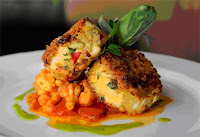 Crab Cake (cr. Marc Levine)
At dinnertime, a $48 prix fixe menu gives you unlimited access to the Market Table Buffet, enhanced by a selection of soups, and an expanded choice of entrées -- the Rosemary Rubbed Prime Ribs will even tempt one who has sworn off beef.
With wine available by the glass as well as the bottle, the entire Acela operation is suitable for a king, a queen, a baseball fan, and especially a Mets fan -- who deserves nothing but the best. Dining at Acela equals dining at a quality Manhattan restaurant with the bonus of seeing the Mets play and hopefully win.
Anyone with field box and premium seating has access to the Acela Club, which opens two hours and forty five minutes before game time. Reservations are strongly suggested (718-565-4333). Go for it.
Anyone with field box and premium seating has access to the Acela Club, which opens two hours and forty five minutes before game time. Reservations are strongly suggested (718-565-4333). Go for it.
Wednesday, July 01, 2009
From The Trunk "Lou Gehrig Appreciation Day, The Farewell Speech"
It was Yankees versus Senators on July 4, 1939, a doubleheader at Yankee Stadium. Those in attendance numbered 61,808, and most of them had showed up to honor Lou Gehrig in a ceremony between games.
Players, officials, writers and employees at the park out-did themselves with gifts for the Iron Horse. A parade launched the 40-minute ceremony as the Seventh Regiment Band escorted Babe Ruth, Waite Hoyt, Bob Meusel, Herb Pennock, Joe Dugan, Tony Lazzeri, Mark Koenig, Benny Bengough, Wally Schang, Everett Scott, Wally Pipp, George Pipgras and Bob Shawkey to the center field flagpole. A banner was hoisted saluting the 1927 Yankees. Then the group of former stars, all in street clothes, assembled shoulder to shoulder near the pitcher's mound. Yankees and Senators formed a semicircle around a microphone at home plate. "We want Lou, we want Lou," the chant began. Led out of the dugout by Yankees president Ed Barrow, Gehrig doffed his cap and fought back tears as the crowd roared.
Sid Mercer, the Master of ceremonies, announced, "Ladies and gentlemen, Lou Gehrig has asked me to thank you all for him. He is too moved to speak."
"We want Lou! We want Lou!" the chant was a plea for Gehrig to speak.Coaxed by manager Joe McCarthy, Gehrig wiped his eyes, blew his nose. On unsteady feet, he moved towards the microphone to speak the speech he had written the night before. "Fans, for the past two weeks you have been reading about a bad break I got. Yet today, I consider myself the luckiest man on the face of the earth. I have been in ballparks for seventeen years and I have never received anything but kindness and encouragement from you fans. "Look at these grand men. Which of you wouldn't consider it the highlight of his career just to associate with them for even one day? Sure I'm lucky. Who wouldn't have considered it an honor to have known Jacob Ruppert? Also, the builder of baseball's greatest empire, Ed Barrows? To have spent six years with that wonderful little fellow, Miller Huggins? Then to have spent the next nine years with that outstanding leader, that smart student of psychology, the best manager in baseball today, Joe McCarthy? Sure, I'm lucky. When the New York Giants, a team you would give your right arm to beat and vice versa, sends you a gift, that's something. When everybody down to the groundskeeper and those boys in white coats remember you with trophies, that's something. When you have a father and mother work all their lives so that you can have an education and build your body, it's a blessing. When you have a wife who has been a tower of strength and shown more courage than you dreamed existed, that's the finest I know. So I close in saying that I might have had a bad break, but I have an awful lot to live for." Until season's end "The Pride of the Yankees" was there with and for his team. He spent every day on the bench and traveled with the Yankees on road trips. He sat through all four of the 1939 World Series games. On June 3, 1941 Lou Gehrig died at his home, 5204 Delafield Avenue, in the Fieldston section of the Bronx He would have been 38 years old on June 19.
Confined to his home for the last month of his life, he lost weight steadily during his final weeks. It was reported that he was twenty-five pounds under weight shortly before he died.
Harvey Frommer is his 33rd consecutive year of writing sports books. The author of 40 of them including the classics: "New York City Baseball,1947-1957" and "Shoeless Joe and Ragtime Baseball," his acclaimed REMEMBERING YANKEE STADIUM, an oral/narrative history (Abrams, Stewart, Tabori and Chang) was published in 2008 as well as a reprint version of his classic "Shoeless Joe and Ragtime Baseball."
The prolific Frommer is at work on REMEMBERING FENWAY PARK (2010).Frommer sports books are available direct from the author - discounted and autographed.FROMMER SPORTSNET (syndicated) reaches a readership in the millions and is housed on Internet search engines for extended periods of time.
Players, officials, writers and employees at the park out-did themselves with gifts for the Iron Horse. A parade launched the 40-minute ceremony as the Seventh Regiment Band escorted Babe Ruth, Waite Hoyt, Bob Meusel, Herb Pennock, Joe Dugan, Tony Lazzeri, Mark Koenig, Benny Bengough, Wally Schang, Everett Scott, Wally Pipp, George Pipgras and Bob Shawkey to the center field flagpole. A banner was hoisted saluting the 1927 Yankees. Then the group of former stars, all in street clothes, assembled shoulder to shoulder near the pitcher's mound. Yankees and Senators formed a semicircle around a microphone at home plate. "We want Lou, we want Lou," the chant began. Led out of the dugout by Yankees president Ed Barrow, Gehrig doffed his cap and fought back tears as the crowd roared.
Sid Mercer, the Master of ceremonies, announced, "Ladies and gentlemen, Lou Gehrig has asked me to thank you all for him. He is too moved to speak."
"We want Lou! We want Lou!" the chant was a plea for Gehrig to speak.Coaxed by manager Joe McCarthy, Gehrig wiped his eyes, blew his nose. On unsteady feet, he moved towards the microphone to speak the speech he had written the night before. "Fans, for the past two weeks you have been reading about a bad break I got. Yet today, I consider myself the luckiest man on the face of the earth. I have been in ballparks for seventeen years and I have never received anything but kindness and encouragement from you fans. "Look at these grand men. Which of you wouldn't consider it the highlight of his career just to associate with them for even one day? Sure I'm lucky. Who wouldn't have considered it an honor to have known Jacob Ruppert? Also, the builder of baseball's greatest empire, Ed Barrows? To have spent six years with that wonderful little fellow, Miller Huggins? Then to have spent the next nine years with that outstanding leader, that smart student of psychology, the best manager in baseball today, Joe McCarthy? Sure, I'm lucky. When the New York Giants, a team you would give your right arm to beat and vice versa, sends you a gift, that's something. When everybody down to the groundskeeper and those boys in white coats remember you with trophies, that's something. When you have a father and mother work all their lives so that you can have an education and build your body, it's a blessing. When you have a wife who has been a tower of strength and shown more courage than you dreamed existed, that's the finest I know. So I close in saying that I might have had a bad break, but I have an awful lot to live for." Until season's end "The Pride of the Yankees" was there with and for his team. He spent every day on the bench and traveled with the Yankees on road trips. He sat through all four of the 1939 World Series games. On June 3, 1941 Lou Gehrig died at his home, 5204 Delafield Avenue, in the Fieldston section of the Bronx He would have been 38 years old on June 19.
Confined to his home for the last month of his life, he lost weight steadily during his final weeks. It was reported that he was twenty-five pounds under weight shortly before he died.
Harvey Frommer is his 33rd consecutive year of writing sports books. The author of 40 of them including the classics: "New York City Baseball,1947-1957" and "Shoeless Joe and Ragtime Baseball," his acclaimed REMEMBERING YANKEE STADIUM, an oral/narrative history (Abrams, Stewart, Tabori and Chang) was published in 2008 as well as a reprint version of his classic "Shoeless Joe and Ragtime Baseball."
The prolific Frommer is at work on REMEMBERING FENWAY PARK (2010).Frommer sports books are available direct from the author - discounted and autographed.FROMMER SPORTSNET (syndicated) reaches a readership in the millions and is housed on Internet search engines for extended periods of time.
Sunday, June 21, 2009
FROM THE TRUNK: Tales from NBA Draft history
The NBA draft is all the rage. Prospects are dissected, analyzed, and compared to heroes of yesteryear. There is the pre-draft camp, the endless talk show hustle as well as fantasy drafts. Preceded by hype, hope and hoopla, the NBA Draft finally arrives with a cast of hundreds of personalities, nationally televised hour after hour. And then there is the endless post-draft commentary.
Once upon a time things were quite different in a simpler world and a smaller NBA. The first draft in 1947 saw first-round selections made by Pittsburgh, Boston, Providence, New York, Philadelphia, St. Louis, Chicago, Washington and Baltimore. No name from that first-round faraway time (aside from Knicks draftee Walt Dropo, who went on to a distinguished Major League baseball career) had any kind of real basketball impact.
The records from that primitive time are so shrouded in a time warp that a couple of the players drafted in '47 like Bob Alemeida and George Petrovick have a question mark next to their name signifying a lack of information as to the college they played for.
A few non-first-round players went on to make a name for themselves in pro ball like Andy Phillip out of Illinois, Jim Pollard from Stanford, Bob Kurland of Oklahoma A&M, and Red Rocha who had played at Oregon State.
A footnote to NBA history is Tony Lavelli of Yale, taken by Boston in the 1949 Draft. He went on to play the accordion for the Celtics at half time, sometimes. But contrary to rumors, his musical skill was not one of the reasons for Boston drafting him.
The 1950 Draft went 10 rounds for some teams and 12 for others, as a few teams lost interest. Territorial picks were sometimes much fought over and debated. The exclusive right to draft a player who came from a team's geographical region gave Philadelphia the legendary Paul Arizin in 1950.
A couple of others who went on to fame and glory were picked in that draft: Bud Grant (NFL) by Minneapolis and Bob Cousy by Tri-Cities.
The 1951 NBA Draft lasted 12 rounds, but most teams stopped picking by then.
The First Round went this way:
(Team) Player, College
1 (Baltimore) Gene Melchiorre, Bradley
2 (TriCities) Mel Hutchins, Brigham Young
3 (Indianapolis) Marcus Freiberger, Oklahoma
4 (Ft Wayne) Zeke Sinicola, Niagara
5 (Syracuse) John McConathy, NW Louisiana
6 (NY Knicks) Ed Smith, Harvard
7 (Boston) Ernie Barrett, Kansas State
8 (Rochester) Sam Ranzino, North Carolina State
9 (Philadelphia) Don Sunderlage, Illinois
10 (Minneapolis) Whitey Skoog, Minnesota*
*The pick of Skoog was a Territorial one.
Thursday, June 18, 2009
The Book Review: “Torre,” “A-Rod,” “Yogi” and “Munson”
Yankee legends past and present are well represented by publishers this spring. For somewhat more than a hundred dollars a quartette of works focused on Joe Torre, Alex Rodriguez ,Yogi Berra and Thurman Munson are there for the buying and taking away. If you are a die-hard fan of the Bronx Bombers – these books will have a fatal attraction.
“The Yankee Years” by Torre and Tom Verducci (Doubleday, $26.95, 502 pages) is a mother lode of info - a lot of it previously in newspapers, magazines, other books and on the internet. The book’s major focus is on the time Joe Torre took over as manager until he was given an offer he could refuse and moved on to pilot the LA Dodgers. Gossip, glory, grievance all intermingle.
“A – Rod” by Selena Roberts (Harper,$26.99, 272 pages) has a bit more finesse and full disclosure to it than Torre’s tome and all credit goes to the author for that whether or not Alex Rodriguez was amused or bemused by what she has written. But we walk away after reading about the multi--talented athlete and tortured human being, after reading about his over the top hedonism, his on and off again drug use, his foibles and fakery - - asking do we really care? Just another greedy and disjointed talent afflicted by too much, too soon!
Allen Barra’s “Yogi Berra Eternal Yankee” (Norton, $27.95, 98 photographs, 451 pages) is a page turner. Filled with anecdotes and insights, filled with the long run of Lawrence Peter Berra from the hill in St. Louis to the top of the world as Yankee icon and baseball fable, “Yogi Berra Eternal Yankee” written by no relation Allen Barra -- is the guy to turn around a Mickey Mantle phrase - -who makes Berra more than human. We see him warts and all in this carefully crafted treatment. HIGHLY RECOMMENDED
“Munson:The Life and Death of a Yankee Captain” by Marty Appel (Doubleday, $26.00, 375 pages) is a labor of love and a love of labor, creating as it does an intimate portrait of one of the most under-rated and complex of Yankees. It was thirty years ago that the multi-talented Appel teamed with the Yankee catcher on his autobiography. Now “Munson:The Life and Death of a Yankee Captain” offers closure and climax to that tome and loads of insights and tales.
Harvey Frommer is his 33rd consecutive year of writing sports books. The author of 40 of them including the classics: "New York City Baseball,1947-1957" and "Shoeless Joe and Ragtime Baseball," his acclaimed REMEMBERING YANKEE STADIUM, an oral/narrative history (Abrams, Stewart, Tabori and Chang) was published in 2008 as well as a reprint version of his classic "Shoeless Joe and Ragtime Baseball." The prolific Frommer is at work on REMEMBERING FENWAY PARK (2010).
Frommer sports books are available direct from the author - discounted and autographed.
FROMMER SPORTSNET (syndicated) reaches a readership in the millions and is housed on Internet search engines for extended periods of time.
Friday, June 12, 2009
"Lucky Lindy" and the '27 Yankees
The 13th of June , 1927, was one of the great testimonial days in the history of New York City. Millions cheered as a ticker-tape parade welcomed Charles A. Lindbergh who had defied death and gained immortality flying "The Spirit of St. Louis" solo across the Atlantic Ocean to Paris and back.
Once an unknown, the 25-year-old "Lucky Lindy" was now too well known for some tastes. It was claimed in some quarters that the young aviator was a bigger star than Babe Ruth, if one could believe that.
Mark Koenig did not. The Babe, the Yankee second baseman argued, was larger than Charles Lindbergh, larger than life. "My God, the way people would come from all over to see him. You had to be there to believe it."
You had to be in New York City that day to believe the fuss made about the peerless pilot. "Col Lindbergh, New York City is yours," Mayor Jimmy Walker, told him at the City Hall lovefest. "I don't give it to you. You won it."
Lindbergh rode bare-headed in an open automobile in what in later times was to be called the "Canyon of Heroes." There were estimates that 4 million people were there to see him and that tons and tons of confetti were showered down upon him.
At the Stadium that day the Yankees were pitted against Cleveland. Lou Gehrig with a .394 batting average, 14 homers and an incredible 60 RBIs torqued the Yankee dynamo. The 20,000 die-hard fans who definitely cared more about their team than Lindbergh had a good time seeing New York pulverize the Indians, 14-6. Native Alabaman Ben Paschal had one of his greatest days in baseball, probably his greatest, ripping two homers (he had but 24 in his career), a triple and double and scored five times. Lazzeri and Dugan also homered while Collins contributed a grand slam. The victory triggered the longest Yankee winning streak of the season - nine games, June 13th through July 23rd.
June 14 was a rainy day and the Yankees did not play. Their lead over the second place White Sox was five games. At this mid point in their sensational season the Yankee lineup caused extreme stress to any pitcher who had the misfortune to face it. It was truly Murderers Row, a killing squad with thunder aplenty. As the admiring members of the New York press kept pointing out day after day if one of the Yankees sluggers didn't hurt the opposing team, another one would. You could count on it.
Harvey Frommer is his 33rd consecutive year of writing sports books. The author of 40 of them including the classics: "New York City Baseball,1947-1957" and "Shoeless Joe and Ragtime Baseball," his acclaimed REMEMBERING YANKEE STADIUM, an oral/narrative history (Abrams, Stewart, Tabori and Chang) was published in 2008 as well as a reprint version of his classic "Shoeless Joe and Ragtime Baseball." The prolific Frommer is at work on REMEMBERING FENWAY PARK (2010).
Frommer sports books are available direct from the author - discounted and autographed.
FROMMER SPORTSNET (syndicated) reaches a readership in the millions and is housed on Internet search engines for extended periods of time.
Once an unknown, the 25-year-old "Lucky Lindy" was now too well known for some tastes. It was claimed in some quarters that the young aviator was a bigger star than Babe Ruth, if one could believe that.
Mark Koenig did not. The Babe, the Yankee second baseman argued, was larger than Charles Lindbergh, larger than life. "My God, the way people would come from all over to see him. You had to be there to believe it."
You had to be in New York City that day to believe the fuss made about the peerless pilot. "Col Lindbergh, New York City is yours," Mayor Jimmy Walker, told him at the City Hall lovefest. "I don't give it to you. You won it."
Lindbergh rode bare-headed in an open automobile in what in later times was to be called the "Canyon of Heroes." There were estimates that 4 million people were there to see him and that tons and tons of confetti were showered down upon him.
At the Stadium that day the Yankees were pitted against Cleveland. Lou Gehrig with a .394 batting average, 14 homers and an incredible 60 RBIs torqued the Yankee dynamo. The 20,000 die-hard fans who definitely cared more about their team than Lindbergh had a good time seeing New York pulverize the Indians, 14-6. Native Alabaman Ben Paschal had one of his greatest days in baseball, probably his greatest, ripping two homers (he had but 24 in his career), a triple and double and scored five times. Lazzeri and Dugan also homered while Collins contributed a grand slam. The victory triggered the longest Yankee winning streak of the season - nine games, June 13th through July 23rd.
June 14 was a rainy day and the Yankees did not play. Their lead over the second place White Sox was five games. At this mid point in their sensational season the Yankee lineup caused extreme stress to any pitcher who had the misfortune to face it. It was truly Murderers Row, a killing squad with thunder aplenty. As the admiring members of the New York press kept pointing out day after day if one of the Yankees sluggers didn't hurt the opposing team, another one would. You could count on it.
Harvey Frommer is his 33rd consecutive year of writing sports books. The author of 40 of them including the classics: "New York City Baseball,1947-1957" and "Shoeless Joe and Ragtime Baseball," his acclaimed REMEMBERING YANKEE STADIUM, an oral/narrative history (Abrams, Stewart, Tabori and Chang) was published in 2008 as well as a reprint version of his classic "Shoeless Joe and Ragtime Baseball." The prolific Frommer is at work on REMEMBERING FENWAY PARK (2010).
Frommer sports books are available direct from the author - discounted and autographed.
FROMMER SPORTSNET (syndicated) reaches a readership in the millions and is housed on Internet search engines for extended periods of time.
Monday, June 08, 2009
Baseball Names - and How They Got That Way! Part X
The words and phrases are spoken and written day after day, year after year - generally without any wonderment as to how they became part of the language. All have a history, a story. For those of you who liked Part I, Part II, Part III and all the others and wanted more, here is more. As always, reactions and suggestions always welcome.
MAN, THE (STAN THE MAN) Stanley Frank Musial, St. Louis Cardinal baseball immortal, batted .315 as a rookie in 1942, when he was 21 years old. In 1962, at the age of 41, he hit .330-one point under his lifetime batting average. Musial is the all-time Cardinal leader in games played, runs, hits, doubles, triples, homers, and total bases. His twisted, crouched, coiled stance at the plate enabled him to slash the ball with power or stroke it with finesse to any part of the playing field. Musial was an especially successful hitter in the small confines of Ebbets Field. His specialty was slamming frozen rope doubles off the outfield walls. Dodger fans had difficulty pronouncing his name, sometimes calling him "Musical." Many of the black Dodger fans simply referred to Musial as "the Man" in tribute to the power and style he displayed. Eventually fans all over the league used this nickname-a reference not only to Musial but to the respect due his power and authority.
MAN IN THE IRON HAT Yankee owner Captain Tillinghast L'Hommedieu Hutson wore the same squished derby hat over and over again.
MAN NOBODY KNOWS Catcher Bill Dickey, Yankee immortal, because of his blandness.
MAN OF A THOUSAND CURVES His nickname was a bit hyperbolic, but the major league batters who swung at his stuff and came up empty might not disagree with it. For Johnny Sain, talented star of the Boston Braves and other teams, curveball pitches were a trademark and the reason for his nickname. He allegedly had such pitching skill that his curves dropped, darted, hesitated, broke wide, broke fast, broke slow, broke twice. There may not have been a thousand curves, but there were enough variations on these curves Sain possessed that the effect on batters was the same (see "SPAHN AND SAIN AND PRAY FOR RAIN").
MAN O' WAR Sam Rice was a fleet-footed outfielder and was called Man O' War" after the famous racehorse of his era.
MANDRAKE THE MAGICIAN During the late 1 940's and into the 1950's, Don Mueller of the New York Giants appeared to have a special gift with a bat in his hands. His lifetime batting average was a respectable .296, yet he never led the league in any hitting category. His nickname came from his expert bat-manipulation and his ability to hit the ball where he wanted it to go.
MAJOR Ralph Houk, for rank held in the Armed Forces and demeanor MARSE JOE Hall of Fame Manager Joe McCarthy, , for his commanding style.
MARVELOUS MARV Marvin Eugene Throneberry was perhaps born to be a New York Met. His initials spelled out the name and his personality and limited skills underscored the characteristics of the 1962 New York expansion team. Throneberry, who looked like Mickey Mantle batting but did not get the same results, labored through a seven-year, four-different-team major league career- the Mets were his last team. He is a gentle, fine humored man, and sportswriters hung the nickname on him in good-natured jest. Throneberry loved it and went along with their efforts to depict him as a clown. Once a teammate dropped an easy fly ball. Marvelous Marv smiled and shouted, "What are you trying to do anyway, steal my fans?" "MASTER Builder IN BASEBALL Jacob Ruppert, and that he was.
MASTER MELVIN Mel Ott was a power-armed right fielder for 22 years with the New York Giants. He smashed 511 home runs in a fabled career that saw him average better than a hit a game while compiling a lifetime batting average of .304. Ott became a Giant at the age of 16-and that's how his nickname came about. Ott's Hollywood-type beginning was recalled by Eddie Logan, Giants equipment manager, who was about the same age as Ott at the time and was sent to pick up the youth: "We had the 9th Avenue El at the time. Mr. McGraw had told him to ride the El to the last stop, which was the Polo Grounds. He took the El the wrong way and wound up at the Battery. I looked for the straw suitcase. I found him. I said, 'C'mon boy, let's go.' He got the biggest thrill riding back on the train." Labeled "McGraw's baby," Ott was in only 35 games in 1926, then 82 in 1927. "He's too young to play big-league ball," McGraw said, "but I am afraid to send him to the minors and have a manager there tinker with his unorthodox batting style. The style is natural with him. He'll get results as soon as he learns about big-league pitching." And he did.
Harvey Frommer is his 33rd consecutive year of writing sports books. The author of 40 of them including the classics: "New York City Baseball,1947-1957" and "Shoeless Joe and Ragtime Baseball," his acclaimed REMEMBERING YANKEE STADIUM, an oral/narrative history (Abrams, Stewart, Tabori and Chang) was published in 2008 as well as a reprint version of his classic "Shoeless Joe and Ragtime Baseball."
The prolific Frommer is at work on REMEMBERING FENWAY PARK (2010).Frommer sports books are available direct from the author - discounted and autographed.FROMMER SPORTSNET (syndicated) reaches a readership in the millions and is housed on Internet search engines for extended periods of time.
MAN, THE (STAN THE MAN) Stanley Frank Musial, St. Louis Cardinal baseball immortal, batted .315 as a rookie in 1942, when he was 21 years old. In 1962, at the age of 41, he hit .330-one point under his lifetime batting average. Musial is the all-time Cardinal leader in games played, runs, hits, doubles, triples, homers, and total bases. His twisted, crouched, coiled stance at the plate enabled him to slash the ball with power or stroke it with finesse to any part of the playing field. Musial was an especially successful hitter in the small confines of Ebbets Field. His specialty was slamming frozen rope doubles off the outfield walls. Dodger fans had difficulty pronouncing his name, sometimes calling him "Musical." Many of the black Dodger fans simply referred to Musial as "the Man" in tribute to the power and style he displayed. Eventually fans all over the league used this nickname-a reference not only to Musial but to the respect due his power and authority.
MAN IN THE IRON HAT Yankee owner Captain Tillinghast L'Hommedieu Hutson wore the same squished derby hat over and over again.
MAN NOBODY KNOWS Catcher Bill Dickey, Yankee immortal, because of his blandness.
MAN OF A THOUSAND CURVES His nickname was a bit hyperbolic, but the major league batters who swung at his stuff and came up empty might not disagree with it. For Johnny Sain, talented star of the Boston Braves and other teams, curveball pitches were a trademark and the reason for his nickname. He allegedly had such pitching skill that his curves dropped, darted, hesitated, broke wide, broke fast, broke slow, broke twice. There may not have been a thousand curves, but there were enough variations on these curves Sain possessed that the effect on batters was the same (see "SPAHN AND SAIN AND PRAY FOR RAIN").
MAN O' WAR Sam Rice was a fleet-footed outfielder and was called Man O' War" after the famous racehorse of his era.
MANDRAKE THE MAGICIAN During the late 1 940's and into the 1950's, Don Mueller of the New York Giants appeared to have a special gift with a bat in his hands. His lifetime batting average was a respectable .296, yet he never led the league in any hitting category. His nickname came from his expert bat-manipulation and his ability to hit the ball where he wanted it to go.
MAJOR Ralph Houk, for rank held in the Armed Forces and demeanor MARSE JOE Hall of Fame Manager Joe McCarthy, , for his commanding style.
MARVELOUS MARV Marvin Eugene Throneberry was perhaps born to be a New York Met. His initials spelled out the name and his personality and limited skills underscored the characteristics of the 1962 New York expansion team. Throneberry, who looked like Mickey Mantle batting but did not get the same results, labored through a seven-year, four-different-team major league career- the Mets were his last team. He is a gentle, fine humored man, and sportswriters hung the nickname on him in good-natured jest. Throneberry loved it and went along with their efforts to depict him as a clown. Once a teammate dropped an easy fly ball. Marvelous Marv smiled and shouted, "What are you trying to do anyway, steal my fans?" "MASTER Builder IN BASEBALL Jacob Ruppert, and that he was.
MASTER MELVIN Mel Ott was a power-armed right fielder for 22 years with the New York Giants. He smashed 511 home runs in a fabled career that saw him average better than a hit a game while compiling a lifetime batting average of .304. Ott became a Giant at the age of 16-and that's how his nickname came about. Ott's Hollywood-type beginning was recalled by Eddie Logan, Giants equipment manager, who was about the same age as Ott at the time and was sent to pick up the youth: "We had the 9th Avenue El at the time. Mr. McGraw had told him to ride the El to the last stop, which was the Polo Grounds. He took the El the wrong way and wound up at the Battery. I looked for the straw suitcase. I found him. I said, 'C'mon boy, let's go.' He got the biggest thrill riding back on the train." Labeled "McGraw's baby," Ott was in only 35 games in 1926, then 82 in 1927. "He's too young to play big-league ball," McGraw said, "but I am afraid to send him to the minors and have a manager there tinker with his unorthodox batting style. The style is natural with him. He'll get results as soon as he learns about big-league pitching." And he did.
Harvey Frommer is his 33rd consecutive year of writing sports books. The author of 40 of them including the classics: "New York City Baseball,1947-1957" and "Shoeless Joe and Ragtime Baseball," his acclaimed REMEMBERING YANKEE STADIUM, an oral/narrative history (Abrams, Stewart, Tabori and Chang) was published in 2008 as well as a reprint version of his classic "Shoeless Joe and Ragtime Baseball."
The prolific Frommer is at work on REMEMBERING FENWAY PARK (2010).Frommer sports books are available direct from the author - discounted and autographed.FROMMER SPORTSNET (syndicated) reaches a readership in the millions and is housed on Internet search engines for extended periods of time.
Friday, May 29, 2009
The Book Review: “Straw” and “’78”

Oh, how many times did I watch Darryl Strawberry do his thing especially as a member of the New York Mets. In so many ways he was the most talented of players I had ever seen. And in so many ways he was the biggest disappointment.
Now in “Straw” with John Strausbaugh (Ecco/HarperCollins, $26.99, 240 pages) Strawberry explains how the wheels came off his wagon, how and why he got violent, into drugs and alcohol, how being a celebrity got to be too much, how he overcame colon cancer. If you are into inspirational memoir – this is for you.
“’78: The Boston Red Sox, a Historic game, and a Divided City” by Bill Reynolds (New American Library, $24.95, 305 pages) is recommended reading for Red Sox fans delving as it does into that tale told many times about that special season and the sociological pressures that afflicted the city of Boston. Tighter editing might have made it a better read and an index would have been useful as a road map for what at times becomes a maze of material not totally sorted out.
For the younger sporting fans - - and there are so many of them – two books especially belong on the bookshelf - “Baseball Great” & “The Prince of Fenway Park”
“Baseball Great" by Tim Green (HarperCollins Children’s Books, $16.99, 250 pages) is geared to ages 8 and up. It is compelling, a thriller, a book that places its 12-year-old central character Ty Lewis is a precarious position in this football and pro gambling subject matter centered to me.
“The Prince of Fenway Park” by Julianna Baggott HarperCollins Children’s Books, $16.99, 322 pages) is aimed at ages 8-12. The book is especially appealing to me in the midst of writing REMEMBERING FENWAY PARK. Part fantasy, part legend, part reversing the curse, part baseball novel - - “The Prince of Fenway Park” is all about Oscar Egg, aged twelve. Potter-ish reading!
Harvey Frommer is his 33rd consecutive year of writing sports books. The author of 40 of them including the classics: "New York City Baseball,1947-1957" and "Shoeless Joe and Ragtime Baseball," his acclaimed REMEMBERING YANKEE STADIUM, an oral/narrative history (Abrams, Stewart, Tabori and Chang) was published in 2008 as well as a reprint version of his classic "Shoeless Joe and Ragtime Baseball." The prolific Frommer is at work on REMEMBERING FENWAY PARK (2010).
Frommer sports books are available direct from the author - discounted and autographed.
FROMMER SPORTSNET (syndicated) reaches a readership in the millions and is housed on Internet search engines for extended periods of time.
Now in “Straw” with John Strausbaugh (Ecco/HarperCollins, $26.99, 240 pages) Strawberry explains how the wheels came off his wagon, how and why he got violent, into drugs and alcohol, how being a celebrity got to be too much, how he overcame colon cancer. If you are into inspirational memoir – this is for you.
“’78: The Boston Red Sox, a Historic game, and a Divided City” by Bill Reynolds (New American Library, $24.95, 305 pages) is recommended reading for Red Sox fans delving as it does into that tale told many times about that special season and the sociological pressures that afflicted the city of Boston. Tighter editing might have made it a better read and an index would have been useful as a road map for what at times becomes a maze of material not totally sorted out.
For the younger sporting fans - - and there are so many of them – two books especially belong on the bookshelf - “Baseball Great” & “The Prince of Fenway Park”
“Baseball Great" by Tim Green (HarperCollins Children’s Books, $16.99, 250 pages) is geared to ages 8 and up. It is compelling, a thriller, a book that places its 12-year-old central character Ty Lewis is a precarious position in this football and pro gambling subject matter centered to me.
“The Prince of Fenway Park” by Julianna Baggott HarperCollins Children’s Books, $16.99, 322 pages) is aimed at ages 8-12. The book is especially appealing to me in the midst of writing REMEMBERING FENWAY PARK. Part fantasy, part legend, part reversing the curse, part baseball novel - - “The Prince of Fenway Park” is all about Oscar Egg, aged twelve. Potter-ish reading!
Harvey Frommer is his 33rd consecutive year of writing sports books. The author of 40 of them including the classics: "New York City Baseball,1947-1957" and "Shoeless Joe and Ragtime Baseball," his acclaimed REMEMBERING YANKEE STADIUM, an oral/narrative history (Abrams, Stewart, Tabori and Chang) was published in 2008 as well as a reprint version of his classic "Shoeless Joe and Ragtime Baseball." The prolific Frommer is at work on REMEMBERING FENWAY PARK (2010).
Frommer sports books are available direct from the author - discounted and autographed.
FROMMER SPORTSNET (syndicated) reaches a readership in the millions and is housed on Internet search engines for extended periods of time.
Monday, May 18, 2009
The Book Review: “Bases Loaded,” “The Baseball Hall of Fame” and more . . .
Kirk Radomski was employed in the clubhouse of the New York Mets for a decade. Now in his first book “Bases Loaded” (co-authored by David Fisher (Hudson Street Press, $25.95, 246 pages) the chief figure inn the Mitchell Reports takes the reader behind the scenes for some little tolds stories of the steroid scandal in baseball. It is an eye raising book, a story whose end is not yet in sight, a book as timely as today’s headlines. Controversy and conflict dogged Radmoski who became the main clubhouse supplier of performance enhancing drugs to nearly 300 major leaguers.
“The Baseball Hall of Fame” by Bert Randolph Sugar” (Running Press, $35.00, 272 pages, more than 500 photos) is the mother of all books on the shrine in Cooperstown, New York. Page after page of items from the Hall’s collection intermingle with the text of Sugar, an old hand at the sports book game – he has written more than 50 books. Recommended
From Clerisy press in Cincinnati comes a quartette of baseball books aimed at all kinds of readers and for all types of tastes. “365 Oddball Days in Boston Red Sox History” by John Snyder ($12.95, 372 pages, paper) is an almanac style tome that picks up a lot of eccentric nuances of Sox history through the years. “Rollie’s Follies” by Rollie Fingers ($14.95, 228 pages, paper) is a collection of stats, lists and lore – all very illuminating and entertaining. “Cincinnati’s Crosley Field” by Greg Rhodes and John Eradi ($25.00, 216 pages, paper) is a perfect book for fans of the Reds and others into baseball history showcasing as it does the old ballpark in words and picture. And finally “Dodgers Journal” by John Snyder ($29.95, 800 pages, paper) is a fountainhead of all kinds of information about the franchise since its inception in 1884.
For the golfers for getting or giving there is Homer Kelley’s “Golfing Machine” by Scott Gummer (Gotham Books/Penguin, $26.00, 267 pages) an illuminating look at nuances of the game and the genius whose theories revolutionized it.
Harvey Frommer is his 33rd consecutive year of writing sports books. The author of 40 of them including the classics: "New York City Baseball,1947-1957" and "Shoeless Joe and Ragtime Baseball," his acclaimed REMEMBERING YANKEE STADIUM, an oral/narrative history (Abrams, Stewart, Tabori and Chang) was published in 2008 as well as a reprint version of his classic "Shoeless Joe and Ragtime Baseball." The prolific Frommer is at work on REMEMBERING FENWAY PARK (2010).
Frommer sports books are available direct from the author - discounted and autographed.
FROMMER SPORTSNET (syndicated) reaches a readership in the millions and is housed on Internet search engines for extended periods of time.
HarveyFrommerSports.com http://frommerluxurytravel-arts.com/
......................................................................
http://www.sunypress.edu/details.asp?id=61871 (IT HAPPENED IN THE CATSKILLS, new edition)
http://www.sunypress.edu/details.asp?id=61872 (IT HAPPENED IN BROOKLYN, new edition)
“The Baseball Hall of Fame” by Bert Randolph Sugar” (Running Press, $35.00, 272 pages, more than 500 photos) is the mother of all books on the shrine in Cooperstown, New York. Page after page of items from the Hall’s collection intermingle with the text of Sugar, an old hand at the sports book game – he has written more than 50 books. Recommended
From Clerisy press in Cincinnati comes a quartette of baseball books aimed at all kinds of readers and for all types of tastes. “365 Oddball Days in Boston Red Sox History” by John Snyder ($12.95, 372 pages, paper) is an almanac style tome that picks up a lot of eccentric nuances of Sox history through the years. “Rollie’s Follies” by Rollie Fingers ($14.95, 228 pages, paper) is a collection of stats, lists and lore – all very illuminating and entertaining. “Cincinnati’s Crosley Field” by Greg Rhodes and John Eradi ($25.00, 216 pages, paper) is a perfect book for fans of the Reds and others into baseball history showcasing as it does the old ballpark in words and picture. And finally “Dodgers Journal” by John Snyder ($29.95, 800 pages, paper) is a fountainhead of all kinds of information about the franchise since its inception in 1884.
For the golfers for getting or giving there is Homer Kelley’s “Golfing Machine” by Scott Gummer (Gotham Books/Penguin, $26.00, 267 pages) an illuminating look at nuances of the game and the genius whose theories revolutionized it.
Harvey Frommer is his 33rd consecutive year of writing sports books. The author of 40 of them including the classics: "New York City Baseball,1947-1957" and "Shoeless Joe and Ragtime Baseball," his acclaimed REMEMBERING YANKEE STADIUM, an oral/narrative history (Abrams, Stewart, Tabori and Chang) was published in 2008 as well as a reprint version of his classic "Shoeless Joe and Ragtime Baseball." The prolific Frommer is at work on REMEMBERING FENWAY PARK (2010).
Frommer sports books are available direct from the author - discounted and autographed.
FROMMER SPORTSNET (syndicated) reaches a readership in the millions and is housed on Internet search engines for extended periods of time.
HarveyFrommerSports.com http://frommerluxurytravel-arts.com/
......................................................................
http://www.sunypress.edu/details.asp?id=61871 (IT HAPPENED IN THE CATSKILLS, new edition)
http://www.sunypress.edu/details.asp?id=61872 (IT HAPPENED IN BROOKLYN, new edition)
Saturday, May 09, 2009
Remembering Dom DiMaggio

Sicilian immigrants Giuseppe -- the fisherman -- and Rosalie lived in the North Beach section of San Francisco and raised nine children. Three of the five boys became big league ball players. The last one, Dominic Paul DiMaggio, passed away a couple of days ago at the age of 92.
I was probably the last one to interview him. He is my 130th voice for the opus I am working on - - REMEMBERING FENWAY PARK: AN ORAL AND NARRATIVE HISTORY, slated for 2010 publication.
The man they dubbed the "Little Professor" because of his spectacles and 5-foot-9, 168-pound frame was a hell of a ballplayer even though he played in the gigantic shadows of Ted Williams and brother Joseph. He hit in 34 straight games in 1949, a streak snapped when big brother Joe snared a sinking line drive in a 6-3 Red Sox win over the Yankees.
I reached Dominic Paul DiMaggio on the phone not too long after he passed his 92nd birthday.
“How much time do you need?” he asked. “Thirty minutes.”
“Too much. How about five minutes”
We settled on 20 minutes, and I was told to talk louder throughout. What follows are some of the more moving and interesting aspects of the oral history that should make their way into the book. The words reveal a confident and intelligent man, who had a little tartness to him.
DOM DIMAGGIO: The first time I walked into Fenway Park was April 1940 before the season started, and there was ice on the field. It was a bit of a shock for me having been in California all my life. I was wondering how we were going to start on time. I do believe we did.
The weather wasn’t that bad. But there were cold days. I loved Fenway Park because it was cozy. Playing baseball there was a pleasure and a joy. It was close to the public and the whole thing was a perfect picture in my mind.
The atmosphere was increased when the Red Sox and Yankees played and you could feel that and so I enjoyed playing against New York.
In 1941, when my brother Joe had the hitting streak going, Ted would be talking to the guy in the scoreboard and the guy would keep him posted when Joe got a hit. You couldn’t do that at any other park.
There were times at Fenway when Joe would be coming in from centerfield and I would be coming out. I said very little to him on those occasions. What the hell was I going to do, stop in centerfield and have a conversation?
Sam Mele wasn’t a bad outfielder. Ted Williams wasn’t a bad outfielder either especially at Fenway Park - he played that wall nicely.
I enjoyed a challenge and Fenway Park did offer a challenge because of its structure and that was something but other than that it was a pleasure to play in. Having played there so often for so many years and so many games I felt I mastered the ballpark and got along beautifully with the fences. They didn’t hurt me and I didn’t hurt them.
I did not shoot for the Green Monster. No. I was an all-around hitter, a line-drive hitter, a damn good one too. I loved to hit in Fenway.
Harvey Frommer is his 33rd consecutive year of writing sports books. The author of 40 of them including the classics: "New York City Baseball,1947-1957" and "Shoeless Joe and Ragtime Baseball," his acclaimed REMEMBERING YANKEE STADIUM, an oral/narrative history (Abrams, Stewart, Tabori and Chang) was published in 2008 as well as a reprint version of his classic "Shoeless Joe and Ragtime Baseball." The prolific Frommer is at work on REMEMBERING FENWAY PARK (2010).
Frommer sports books are available direct from the author - discounted and autographed.
FROMMER SPORTSNET (syndicated) reaches a readership in the millions and is housed on Internet search engines for extended periods of time.
I was probably the last one to interview him. He is my 130th voice for the opus I am working on - - REMEMBERING FENWAY PARK: AN ORAL AND NARRATIVE HISTORY, slated for 2010 publication.
The man they dubbed the "Little Professor" because of his spectacles and 5-foot-9, 168-pound frame was a hell of a ballplayer even though he played in the gigantic shadows of Ted Williams and brother Joseph. He hit in 34 straight games in 1949, a streak snapped when big brother Joe snared a sinking line drive in a 6-3 Red Sox win over the Yankees.
I reached Dominic Paul DiMaggio on the phone not too long after he passed his 92nd birthday.
“How much time do you need?” he asked. “Thirty minutes.”
“Too much. How about five minutes”
We settled on 20 minutes, and I was told to talk louder throughout. What follows are some of the more moving and interesting aspects of the oral history that should make their way into the book. The words reveal a confident and intelligent man, who had a little tartness to him.
DOM DIMAGGIO: The first time I walked into Fenway Park was April 1940 before the season started, and there was ice on the field. It was a bit of a shock for me having been in California all my life. I was wondering how we were going to start on time. I do believe we did.
The weather wasn’t that bad. But there were cold days. I loved Fenway Park because it was cozy. Playing baseball there was a pleasure and a joy. It was close to the public and the whole thing was a perfect picture in my mind.
The atmosphere was increased when the Red Sox and Yankees played and you could feel that and so I enjoyed playing against New York.
In 1941, when my brother Joe had the hitting streak going, Ted would be talking to the guy in the scoreboard and the guy would keep him posted when Joe got a hit. You couldn’t do that at any other park.
There were times at Fenway when Joe would be coming in from centerfield and I would be coming out. I said very little to him on those occasions. What the hell was I going to do, stop in centerfield and have a conversation?
Sam Mele wasn’t a bad outfielder. Ted Williams wasn’t a bad outfielder either especially at Fenway Park - he played that wall nicely.
I enjoyed a challenge and Fenway Park did offer a challenge because of its structure and that was something but other than that it was a pleasure to play in. Having played there so often for so many years and so many games I felt I mastered the ballpark and got along beautifully with the fences. They didn’t hurt me and I didn’t hurt them.
I did not shoot for the Green Monster. No. I was an all-around hitter, a line-drive hitter, a damn good one too. I loved to hit in Fenway.
Harvey Frommer is his 33rd consecutive year of writing sports books. The author of 40 of them including the classics: "New York City Baseball,1947-1957" and "Shoeless Joe and Ragtime Baseball," his acclaimed REMEMBERING YANKEE STADIUM, an oral/narrative history (Abrams, Stewart, Tabori and Chang) was published in 2008 as well as a reprint version of his classic "Shoeless Joe and Ragtime Baseball." The prolific Frommer is at work on REMEMBERING FENWAY PARK (2010).
Frommer sports books are available direct from the author - discounted and autographed.
FROMMER SPORTSNET (syndicated) reaches a readership in the millions and is housed on Internet search engines for extended periods of time.
Saturday, May 02, 2009
The Book Review: "Yankee Colors” by Al Silverman and Other Notable Reads
The avalanche of quality sports books keeps on coming. They arrive in all sizes and shapes, from major publishers and pretenders to the throne, from first time authors and veterans of the trade. There is room for all in the frenzied, fabulous and fulfilling world of sports books.
“Yankee Colors” with text by Al Silverman and photographs by Marvin E. Newman with a foreword by Yogi Berra who not only seems to be everywhere but is (Abrams, $35.00, 200 full-color and 35 black and white photographs) is a paean to times past, specifically as the sub-title proclaims the glory years of the Mantle era. If you are a fan of lush, lovely, likable photo books with pleasing prose or a Yankee fan of a certain age the book is a must. For others it is highly recommended reading and browsing in a remarkable trip down Yankee memory lane from 1949 to 1963 with the legendary figures in Bronx Bomber history. Newman was a long time contributor to Sports Illustrated and Silverman was at the top of the game as a sportswriter in that time period. `
“Jerry Remy’s Red Sox Heroes” by the one and only Jerry Remy, former Sox star and current winning broadcaster, plus Corey Sandler (Globe Pequot, $24.95, 227 pages) is an up close and personal look at 44 players ranked as the best of all time in BoSox history. You may argue with some of the choices but you will probably lose. The RemDawg knows his stuff and you will too after reading this book.
Continuing in an olde towne team frame of mind there is “The Boston Red Sox From Cy to the Kid” by Mark Rucker and Bernard M. Corbett (Arcadia Publishers, $19.99, 128 pages, paper). A bit pricey especially in these down economic times, the slim product is nevertheless Boston Red Sox illustrated history at a glance.
“Baseball and the Baby Boomer” by Talmage Boston (Bright Sky Press, $24.95, 288 pages) is part history, part commentary, part memoir – all worthwhile. Talmage Boston, a trial lawyer and baseball historian, is at the top of his game in this terrific tome that has detailed essays and strong opinions on such as Jackie Robinson, Mickey Mantle, Jimmy Piersall, Roger Maris, Bart Giamatti, Nolan Ryan. A lot of the book in Boston’s words “defends the feats of Maris and Ryan from the ravages of the steroid era.” And that alone (although there are many other reasons) is a strong argument for one to buy this thoughtful book.
For those trivia buffs among you comes a series of books just up your alley - -THE GREAT BOOK OF SPORTS LISTS series. Cities included are Philadelphia, Denver, Washington, DC, Cleveland, Detroit, Seattle, Los Angeles and San Francisco. Prices at $14.94, published by Running Press, all paperbacks, the books are geared to fans of specific teams and written by different authors. `
BOOKENDS: “Breaking the Slump” by Jimmy Roberts (HarperCollins, $24.99 249 pages) is all about lessons learned by great players who went on from their worst moments in golf. There are all kinds of highly interesting personal stories from some of the greats.
Harvey Frommer is his 33rd consecutive year of writing sports books. The author of 40 of them including the classics: "New York City Baseball,1947-1957" and "Shoeless Joe and Ragtime Baseball," his acclaimed REMEMBERING YANKEE STADIUM, an oral/narrative history (Abrams, Stewart, Tabori and Chang) was published in 2008 as well as a reprint version of his classic "Shoeless Joe and Ragtime Baseball." The prolific Frommer is at work on REMEMBERING FENWAY PARK (2010).
Frommer sports books are available direct from the author - discounted and autographed.
FROMMER SPORTSNET (syndicated) reaches a readership in the millions and is housed on Internet search engines for extended periods of time.
Tuesday, April 21, 2009
The Book Review: “Bottom of the Ninth” by Michael Shapiro and other Reads
If you like an untold story, and who of us does not, and if you are even a little bit of a sports junky than “Bottom of the Ninth” by Michael Shapiro ( Times Books, $26.00, 303 pages) belongs on your reading list. It is as its sub-title proclaims about Branch Rickey, Casey Stengel and the Daring Scheme to Save Baseball From Itself.
Shapiro, author of “The Last Good Season,” is in top form breaking new ground and providing new awarenesses of a little reported on chapter in American sports history – the aborted attempt by Branch Rickey to create the Continental League and Casey Stengel’s yen to remake the ways in which the national pastime was played. A good read.
“Crystal Clear” by Eric Le Marque with Davin Seay (Delacorte, $24.00, 256 pages) is the remarkable story of the author’s attempt to snowboard California’s Mammoth Mountain. Trapped by an approaching storm, he survived in sub freezing temperatures for 8 days but at a cost – he would lose both legs below the knees through frostbite. This is the story of a true “Miracle Man.”
“The Unwritten Rules of Baseball” by Paul Dickson (Harper, 256 pages, $14.95, paper) is an interesting reference read on the sub-text of the national pastime.
“The Baltimore Elite Giants” by Bob Luke (Johns Hopkins University Press, 192 pages) is a raising of consciousness about one of the legendary teams from the old Negro Leagues.
From “MR. RED SOX BOOKS” - Bill Nowlin - comes another couple of winners edited by him - - “The Ultimate Red Sox Home Run Guide” (Rounder Books, $18.95, 192 pages, paper) and “Lefty, Double-X and The Kid,” (Rounder Books, $18.95, 165 pages, paper). The former book is chock full of relevant, irreverent and very informative data on circuit clouts and their place in BoSox legend, lore and fact. The latter book is all one would want to know (and some things one might not want to know) about the Boston Red Sox of 1939. Both books HIGHLY RECOMMENDED for Red Sox fans.
Harvey Frommer is his 33rd consecutive year of writing sports books. The author of 40 of them including the classics: "New York City Baseball,1947-1957" and "Shoeless Joe and Ragtime Baseball," his acclaimed REMEMBERING YANKEE STADIUM, an oral/narrative history (Abrams, Stewart, Tabori and Chang) was published in 2008 as well as a reprint version of his classic "Shoeless Joe and Ragtime Baseball." The prolific Frommer is at work on REMEMBERING FENWAY PARK (2010).
Frommer sports books are available direct from the author - discounted and autographed.
FROMMER SPORTSNET (syndicated) reaches a readership in the millions and is housed on Internet search engines for extended periods of time.
Subscribe to:
Posts (Atom)