Friday, August 10, 2012

Boston Red Sox (Sort Of) Ultimate Quiz for Diehard Fans (II)


       For all of you out there who think you know your baseball especially Boston Red Sox baseball—this is the quiz for you. With a tip of the BoSox cap to John Quinn and Dave Martin who know the score.
        Fifteen questions. Answers follow the questions, so no peeking. A score of nine or more correct makes you a major leaguer. Below that you are in the minors but on your way up.
        Warning: there is one trick question.
        Have fun.
        And if you want to really participate, there will be Red Sox Quiz III - send in some questions and answers and perhaps they will make it into print.
1. Five Red Sox players have won the batting title two or more times. Four of them are Ted Williams, Wade Boggs, Pete Runnels and Nomar Garciaparra. Who is the fifth?
a. Dom DiMaggio  b. Jim Rice c. Carl Yastrzemski d. Fred Lynn
2. Who was the first Red Sox player to officially have his number retired?  a. Babe Ruth  b. Ted Williams c. Joe Cronin d. Bobby Doerr
3. Which onetime Red Sox player is 1 of 2 players to play for a record six different playoff teams?
a. David Wells b. Bill Mueller c. Dennis Eckersley d. Rickey Henderson
4. Which Red Sox pitcher holds the record for most home runs allowed in a season, with 38?
a. Roger Clemens b. Tim Wakefield c. Josh Beckett d. Mel Parnell
5. Who is the only Red Sox player to have two 20 home run/20 stolen base seasons?
a. Nomar Garciaparra b. Dom DiMaggio c. Jackie Jensen
d. Jim Rice
6. Who was the first man to manage both the Pawtucket Red Sox and Boston Red Sox?
a. Dick Williams b. Butch Hobson c. Jimy Williams d. Darrell Johnson
7. Who was Harry Frazee?
a. third baseman in the 1920s  b. manager in the 40s
c. pitcher in the 60s d. owner in the teens of 20th century
8. What was the highest uniform number ever worn by a Red Sox player?
a. 40  b.56    c. 82    d. 100
9.  Whose retired number is 6?
a. Johnny Pesky b. Bobby Doerr c. Dom DiMaggio d. Walt Dropo
10.Who was an eight-time gold glove outfielder who played 19 of his 20 Major League seasons with the Boston Red Sox.
a. Ted Williams b. Jackie Jensen c. Sam Mele d. Jimmy Piersall
11  Who pitched the First no-hitter in Red Sox history?
a. Lefty Grove  b. Rube Foster  c. Boo Ferris d. Smoky Joe Wood
12    Who were the “Golden Outfielders”?
13  Who was the “Golden Greek” ?
14  Who were the “Gold Dust” twins?
15  Who were the “Gold Sox” ?
**************************************************
ANSWERS
1  c
2  b
3  a
4  b
5 c
6 d
7 d
8 c  (worn by Johnny Lazor)
9 a
10 d
11  a Rube Foster vs. NY, 2-0, 6/21/1916.
12  Duffy Lewis, Tris Speaker and Harry Hooper
13 Harry Agganis
14  Jim Rice and Fred Lynn
15  In the 1950s, Tom Yawkey spent a lot to create a winner.

Monday, July 30, 2012

Harvey Frommer’s Sports Book Reviews: August Sporting Reads – Enjoy!


          Dog days are upon us in August, most of the time. In publishing however there is always a curious mix of recently published baseball books and just published football tomes. This new edition of my ongoing sports books reviews, almost four decades and counting, is a case very much in point.
          The biggest and also the most expensive of the lot is “The Pro Football Hall of Fame 50th Anniversary Book,” by Joe Horrigan and John Thorn (Grand Central Publishing, $34.99, 320 pages). If you are any kind of football fan, this marvelous looking effort is just for you. Horrigan, veep  of the HOF’s for Communications/Exhibits and Thorn, a legend in anyone’s book in the field of sports publishing, make a terrific team. They have produced a gem.  Chronologically organized, this anniversary book boasts hundreds of images, all kinds of memorabilia, superb writing. HIGHLY RECOMMENDED.

From Abrams comes “Yankee Greats” and “Baseball Fantography.”The former  by Bob Woods ($19.95, 224 pages) is a compendium of 206 full color photographs of Bronx Bomber legends. The latter by Andy Strasberg, is almost 200 jam packed pages of images and stories. And finally from Abrams there is “The Classic Palmer” with text by John Feinstein with photos by Walter Loos. Priced at $19.95, this 140 page volume is a buy or gift for the legion of Arnold Palmer fans out there.
          From Globe Pequot Press comes “Hack’s 191”by Bill Chastain and “The Baseball Hall of Shame” by Bruce Nash and Allan Zullo. The Chastain work focuses on Hack Wilson and his incomparable 191 RBI’s in 1930. The Nash and Zullo’s effort  is an ongoing look at what they call “the most outrageous moments of all time” in baseball. Oddball antics get the royal treatment.
          “The Most Memorable Games in Patriots History”  by Jim Baker and Bernard M. Corbett ($25.00, 360 pages) is a book told in the words of those who made the history. Tighter editing would have made the whole tighter but there are parts that truly sing especially to New England Pats faithful. 
          “Stillpower” by Garret Kramer (Atria, $22.00, 191 pages) is a slim product with a big message. It examines how to achieve excellence in sports and life through an inner source. Simply written, yet packing complex ideas, this Kramer quietly explains how all of us in this razzle dazzle world can obtain a clear and quiet state of mind.                                                 

Sunday, July 22, 2012

Remembering Jake Ruppert: the Man Who Built the Yankee Empire


The Yankees roll on, top of the heap, more stars, more world championships, more hype and hoopla. They are New York. They are big time baseball.
Lest we forget, the roots go all the way back to the son and grandson of Bavarian beer tycoons who founded the Ruppert Breweries. Heir to the family millions, young Jacob Ruppert was born on August 5, 1867. He lived with his family in a commodious and luxurious Manhattan Fifth Avenue apartment. He attended the prestigious Columbia Grammar School. Although he was accepted to the School of Mines of Columbia University, his father insisted he become  part of the brewery business.
      By the turn of the century, the Rupperts in a time before income tax, were reaping huge profits and had become fabulously wealthy.  The Ruppert Brewery, one of the most modern beer producing plants in the world, was a complex of thirty-five fortress-like red brick buildings located from East 90th to East 94th Street between Second and Third Avenues in the Yorkville section of Manhattan's upper East side.
The brewery chimneys spewed smoke carrying the sulfurous smell of malt from the boiling vats into the air. On windy days the smell was especially foul and noxious. Maids in the area even in the summertime, closed windows, pulled down drapes, did what they could to keep the stench out of their employer’s dwellings.
     At 19, Jacob Ruppert began work at the brewery - - washing barrels.  Four years later he was general manager. At 29, he was president of the Jacob Ruppert Brewing Company succeeding his father who had retired.  Under the young Ruppert’s direction, the brewery increased its 1893 output of 350,000 barrels to 1,300,000 barrels just prior to prohibition. In his tenure Ruppert would create and head a gigantic and modern plant for 62 years -  home to the finest brewery in the world. At one point, valued at over $30 million, the Ruppert brand (“Make Mine Ruppert”)  employed more than a thousand workers and was an integral component of the entire New York economy.
        A vast fortune and Tammany Hall connections eased Ruppert into a congressional seat. He was elected as a Democrat in a normally Republican district. The ambitious Ruppert served as a four-time member of the House of Representatives from 1899 to 1907  representing the "Silk Stocking" district of Manhattan.
After the death of his father in 1915, Ruppert continued to live with his mother in the family's red brick Victorian house at 1115 Fifth Avenue on "Millionaire's Row" along Central Park. When his mother died in 1924, Ruppert stayed on in the family mansion for another year. He then sold to a developer and moved across the street into a 12-room apartment in a 15-story luxury building at 1120 Fifth Avenue. His apartment faced Fifth Avenue and looked out onto the Central Park Reservoir directly across the street.  Five full-time servants catered to every whim of the Teutonic, punctilious millionaire. Throughout his life, Ruppert lived within easy walking distance of his brewery.
He was appointed an honorary Colonel in the New York State 7th National Guard Regiment, and it pleased him very much when people used "Colonel" in addressing him.
         A heavily invested real estate toomler as well as the head of the most powerful brewery in the world, “Colonel” Ruppert’s wealth kept increasing making him one of the world’s richest men with an estimated fortune of nearly $50-million.
Called “Congressman” by some, “Colonel” by most, "Jake," by his closest friends, Ruppert had the world on a string. A confirmed bachelor, he always had one beautiful woman, sometimes two, on his arm. But his true love had always been baseball. He was always a rabid fan.     
Back in 1880 when he was just 13, Jacob Ruppert owned,  managed, captained and played second base for a local Manhattan baseball club. The snobbish, some would say cruel, rich boy, insisted that his players clean the cages of his private menagerie before he would bring his bat and ball down to the vacant lot where the team played.  Making it perfectly clear to all that he could not abide losing, Ruppert also made it very uncomfortable for any of his players who struck out – he fired them. The highly privileged youngster was a passionate rooter for the New York Giants. As a teenager he tried out but could not make the club. No matter, he would accomplish much more in baseball than that.
North of the city at his large estate in Garrison, New York, Ruppert kept  St. Bernards and Boston terriers. He owned a dozen varieties of doves, two dozen varieties of monkey. He had a collection of Percherons, the large horses that had pulled the big beer trucks. He was a collector of trotting horses and thoroughbred race horses, yachts, Chinese porcelains, jades. His country place was a repository of one of the largest personal art galleries and libraries in the United States.
His office was devoid of curtains. Close by his desk were marble pedestals, a goldfish aquarium, two bronzes of American Indian collectibles.
Ruppert’s shoes were made to order. Changing his clothes several times a day, he dressed in the latest and most expensive fashions and was attended to by a valet.       He traveled in style with his secretary Al Brennan in his own private railroad car. It was known that the “Colonel” enjoyed the comforts of his own drawing room and sleeping in a silk brocade nightshirt.
 Always interested in baseball, always acquiring, Ruppert was very much interested in purchasing the New York Giants but was told by manager John J. McGraw that they were not for sale but that the sad sack New York Yankees might be.
"It was an orphan club," Ruppert said, "without a home of its own, without players of outstanding ability, without prestige." It was a team whose average annual attendance was 345,000, and dozen year record was a mediocre 861 wins and 937 defeats. But Jake Ruppert, the man they would later call "Master Builder in Baseball," would change all that.
On January 11, 1915, Jake Ruppert teamed with a real Colonel, Tillinghast L'Hommedieu Huston, and purchased the Yankees of New York for $460,000 from the original owners  - -professional gambler Frank Farrell and ex-police commissioner William S. Devery. Huston impressed everyone by peeling off 230 thousand dollar bills – his share of the purchase price.   
Players and sportswriters referred to Hutson as "Cap." There were others who called him "the Man in the Iron Hat" because of the derby hat, generally crumpled, that he wore. The hat matched his suits, always crumpled and rumpled.
The Farrell-Devery duo had milked and mismanaged the franchise for years. So owning the Yankees, who had a 12 year record of 861-937 and average attendance of 345,000 a season, would be a challenge for the new owners.
Ruppert and Huston, however, were up to the challenge. They had  deep pockets and a great deal of  business acumen.  Huston was a successful entrepreneur engineer, a rich contractor.  Ruppert always knew his way around a buck. 
 All kinds of intrigue surrounded the purchase of the Yankees involving Tammany Hall wheeler dealers, other owners, and the American League President. All of them were very anxious to put in place new Yankee ownership and a successful franchise in New York City. To close the deal, American League owners and the League kicked in the rest of the half million dollars that Farrell and Devery insisted on before they would sell out.
"I never saw such a mixed up business in my life,” Ruppert complained right off the bat. “Contracts, liabilities, notes, obligations of all sorts. There were times when it looked so bad no man would want to put a penny into it. It is an orphan ball club without a home of its own, without players of outstanding ability, without prestige."
All of that would change. The “Prince of Beer” wanted to re-name the Yankees to “Knickerbockers” after his best-selling beer, but the marketing ploy failed. Besides, it was said, the name was too long for newspaper headlines. Years later it would be short enough for basketball’s New York Knickerbockers.
          Ruppert pressed on. As a beer baron, he was hands on for every aspect of his business. That same behavior pattern existed for him with the Yankees.  He knew them all and was always up to date on their capabilities, shortcomings, foibles and performances.
         In his early ownership years Ruppert lost almost as much money as was paid to purchase the Yankees. But on the field there was some progress.  The team finished fifth in 1915, fourth in 1916,  their first time out of the second division since 1910.
The Yankee owner rarely hung out with "with the boys," Rud Rennie wrote in the New York Herald-Tribune. "For the most part, he was aloof and brusque.... He never used profanity. 'By gad' was his only expletive."
       A fixture at his Stadium, which he insisted on keeping so fanatically clean that sometimes he even swept it himself, Ruppert had a private box  to which he invited the celebrities of the day. He was not an owner, though, who came to the park to be seen. His interest was in seeing his tea, excel.
The Colonel’s idea of a wonderful day at the ball park was any time the Yankees scored 11 runs in the first inning, and then slowly pulled away. The Colonel was fond of saying, “There is no charity in baseball, I want to win every year.” 
“Close games make me nervous.” he said. “A great day is when the Yankees score a lot of runs early and then just pull away.”
He created the “Ruppert effect.” Those who worked for him at the brewer on the ball club knew he was around and about and very interested in all that was going on.
Members of his team received first class treatment. For the Yankees this showed itself in the sleeping accommodations he arranged on trains. Most other teams had players, dependent on seniority, given berths, upper or lower. The players on the New York Yankees all slept in upper births
        While the Yankees were high flying, Ruppert’s other business – his brewery was hurting.     Prohibition cut his brewery's annual production of 1.25 million barrels of real beer to 350,000 barrels of half-percent near-beer that nobody wanted to drink. In effect, the brewery treaded water  producing, bottling and selling "near beer".


BABE RUTH

In a move that would change the course of Yankee and Red Sox history, indeed, baseball history, Jake Ruppert on January 3, 1920 purchased George Herman “Babe” Ruth, 25, from Boston. The deal was a very smart business move – the young Ruth had talent and would become one of the greatest drawing cards in baseball history.  In his first season as a Yankee , he blasted 54 homers.
        Ruth bragged “They’re coming out to see me in droves.” From 1920 to 1922, the Yankees with G.H. Ruth on board drew more three million fans into the Polo Grounds. Never had the New York Giants drawn a million fans in a season.
The Colonel was the only one to conduct salary negotiations with the “Sultan of Swat.”Ruth was a valuable commodity and the Yankee owner treated him as such. The pair disagreed at times privately and publicly about contracts; nevertheless, Ruppert and Ruth were personal friends.        Frugal to a fault, Colonel gave orders that the Yankee front office should always keep an eye out for any out of line Ruthian expenses. Thus, a $3.80 train ticket for Mrs. Ruth and a $30 "uniform deposit" were not honored extracted for the greatest single gate attraction of all time.
            Angered and annoyed at the gate success of Babe Ruth & Company, the Giants told the Yankees to look around for other baseball lodgings. The Yankees had been playing in the shadow of the Giants at the Polo Grounds since 1913, tenants of the National League team.  It was a very unsatisfactory arrangement; now with the Yankees outdrawing the Giants in their in their own ballpark, it was an embarrassment.         
The forward looking Ruppert and Hutson suggested the Polo Grounds be demolished and replaced by a 100,000 seat stadium to be used by both teams and for other sporting events. The Giants were not interested. So the search was on to create a new ballpark, not just a new ballpark but the  greatest and grandest edifice of its time, one shaped along the lines of the Roman Coliseum. The Colonel dreamed big dreams and had the power and money to back them up.
Babe Ruth became a Yankee through the dream and efforts of the Colonel.   Yankee Stadium was really “the house that Jake Ruppert built.”  And all credit goes to Ruppert as the man who truly built the Yankee empire.


Monday, July 02, 2012

Yankees vs. Red Sox: Baseball's Absolutely Amazing and Greatest Rivalry


They are at it again this second weekend of July 2012, just as they have been at it all through the decades the two franchises have been part of Major League Baseball, since the beginning of the last century.

Researching, writing and interviewing for my books Remembering Yankee Stadium: An Oral and Narrative History of the House That Ruth Built and Remembering Fenway Park: An Oral and Narrative History of the Home of the Boston Red Sox, I had as back story and front story the narrative of the oldest and strongest rivalry in American baseball history - the Yankees of New York versus the Red Sox of Boston. I wanted the more than 200 people I interviewed to talk ballparks. Most did. But many wanted to also talk Sox-Yanks rivalry. And why not?

It is not only a competition of teams, cities, styles, ballparks, fans and, at times, writers. It is a rivalry of contrasting images. The New York Yankees represent the most successful franchise in baseball history. It's a club of legends with Ruth, Gehrig, Combs, Dickey, Ford, Berra, Munson, Raschi, Reynolds, Mantle, Maris, Jackson, Jeter, Bernie Williams, Mattingly, Clemens and many others. Through the years, winning has been as much a part of Yankee baseball as the pinstriped uniforms, and the monuments and plaques. The New York Yankees are the most successful of all franchises in baseball history, in sports history.

Through the years winning has been as much a part of the ethos of the Yankees as the pinstriped uniforms, the monuments and plaques in deep centerfield. It was once said: "Rooting for the New York Yankees is like rooting for General Motors." Unlike General Motors, the Yankees roll on.

The Red Sox - less successful, more human, more vulnerable - have most of the time seemed like the rest of us. For the team and its fans, winning at times has not seemed as important as beating the Yankees and then winning. For the fans of the old Brooklyn Dodgers, the slogan used to be "Wait 'til Next Year." For Boston fans it has been -"When are they going to fold this year?"

The competition is the Charles River versus the East River; Boston Common compared to Central Park. History, culture, style, pace, dreams, and self-images. All are mixed up in the competition in one way or another.

Don Zimmer: I didn't even know there was a big rivalry until I came to the Red Sox. But I found out soon enough. I was coaching at third base in 1974 at Yankee Stadium, and the fans were throwing so much crap on the field that I had to put on a helmet for protection.

The rivalry is violence. It is also the Babe and Bucky and Butch. It is Carl Yastrzemski trotting out to left field at Fenway with cotton sticking out of his ears to muffle the boos of disheartened Sox fans. It is the Scooter, the Green Monster, and the Hawk. It is Rich McKinney on April 22, 1972 making four errors on ground balls to third base that figured in Boston's scoring of nine runs to defeat the Yankees, 11-7. It is Joe Dee versus the Thumper, Yaz and the Commerce Comet, Mombo and King Kong.

The rivalry is Mickey Mantle slugging a 440-foot double at Yankee Stadium in 1958 and tipping his cap to the Red Sox bench. It's Williams spitting, Jackson gesturing and Martin punching. Fisk's headaches from the tension he felt coming into Yankee Stadium. It is also the Yankees' Mickey Rivers jumping out of the way of an exploding firecracker thrown into the visitors' dugout at Fenway.

The rivalry consists of signs: ‘I LOVE NEW YORK, TOO, IT IS THE YANKEES I HATE,' or 'BOSTON CHOKES. BOSTON SUCKS. BOSTON DOES IT IN STYLE. ‘


Baseball’s Greatest Rivalry – the Boston Red Sox vs. the New York Yankees just kept on going at fever pitch as through the 1949 season. On June 28th after missing the first 69 games of the season because of an ailing heel‚ Joe DiMaggio finally returned to the Yankee lineup. His single and home run helped the Bombers beat the Red Sox 6-4 in a night game at Fenway before 36‚228‚ the largest night crowd in Fenway history to that point.


The next day the Yankees came back from seven runs down. DiMag torqued the charge with a 3-run homer in the 5th and another home run in the 8th inning.

"You can hate the Yankees," one sign read, "but you've got to love Joe DiMaggio!"

In the final game of the series, after seven innings before another SRO crowd, the Yankees were in front,3-2. Then the great Joe DiMaggio put the game and the series away for the Yankees with a three-run smash off the light tower giving his team a 6-3 win and a sweep of the

In 1967, the Sox finished 20 games ahead of the 9th-place Yankees. Boston was going into the World Series. People started tearing apart the scoreboard, ripping the sod off of the field, just trashing the place.

DICK BRESCIANI: (Sox historian) 1985. We're opening the season against the Yankees. Terrible weather. Teams were going to work out the best they could. Joe Mooney, head groundskeeper, had covered the mound. Ron Guidry wanted to throw off it and removed the tarp. A bellowing voice screamed: “Get the hell off my mound!”

"I’m a Yankee pitcher," Guidry said.

“I don’t care who the hell you are.” Joe had a hose and he was spraying water. “If you don’t get off there, you’re going to get the full force," he said. Guidry left.

DAN SHAUGHNESSY: (top shelf baseball columnist) 2004 in my view is still the greatest sports story ever told. The idea that you would have the Red Sox win their first World Series in 86 years, to do it at the expense of the Yankees and to do it in something that hadn’t been done in 140 years in a seven-game series in baseball. The World Series was clearly anticlimactic.

In Boston, they scream: "Yankees suck! Yankees suck! " And even when the Yankees are not playing in Boston you can hear those words at Fenway during a Tampa Bay, Mets or a Baltimore game.

In New York, they still sometimes chant: "1918! 1918!"

Item: In 1925, the Yanks sought to trade a first baseman even up to the Red Sox for Phil Todt. Boston passed on the trade. The first baseman Lou Gehrig became one of the great players of all time. Todt batted .258 lifetime with 57 home runs.

Item: During a time of Yankee glory from 1919-1945, the Red Sox never placed first in the eight-team American League, finishing an average of thirty games behind in the standings. They came in last nine times, and had five 100-plus-loss seasons.

I could go on and on, have even written a book on the subject of the great rivalry with my son Fred: ttp://www.dartmouth.edu/~frommer/REDSOXvYANKEES.htm.

You pays your money and takes your choice –Yankees, Red Sox, neither. Just enjoy the rivalry. There’s always something new to it.

About the Author


Dr. Harvey Frommer received his Ph.D. from New York University. Professor Emeritus, Distinguished Professor nominee, Recipient of the "Salute to Scholars Award" at CUNY where he taught writing for many years, the prolific author was cited by the Congressional Record and the New York State Legislature as a sports historian and journalist.


His sports books include autobiographies of sports legends Nolan Ryan, Red Holzman and Tony Dorsett, the classics "Shoeless Joe and Ragtime Baseball," "New York City Baseball: 1947-1957." The 1927 Yankees." His "Remembering Yankee Stadium" was published to acclaim in 2008. His latest book, a Boston Globe Best Seller, is "Remembering Fenway Park." Autographed and discounted copies of all Harvey Frommer books are available direct from the author. Please consult his home page: http://harveyfrommersports.com/remembering_fenway/

Saturday, June 23, 2012

The Storied and Sensational Subway Series: Battle of New York City Baseball

|                     
        There are many in New York City and elsewhere just drooling at the thought of another  World Series matchup: the New York Yankees versus the New York Mets. It would be the ultimate battle for Big Apple bragging rights.
       Only this time around it would not be Brooklyn versus the Bronx - it would be Queens versus the Bronx - travel distance eight miles.
         The only question is will how many players and fans will travel by subway as they once did which was how the term "Subway Series" came to be.
       Back in 1889 the New York Times observed: "The competition between Brooklyn and New York as regards baseball is unparalleled in the history of the national game."
      The competition may have been unparalleled but it was also unequal. Throughout most of their history the Dodgers of Brooklyn were a sad sack team. The Yankees were the royalty of baseball.
       It was not until 1941 that the rivalry between the two franchises reached fever pitch in the first Subway Series. The results were predictable. The Yankees won. There was another Brooklyn-New York Subway Series in 1947 - same result. In 1949 - same result. In 1952, in 1953 - same results.
     "Dem Bums" of Brooklyn won the National League pennant in 1916, 1920, 1941, 1947, 1949, 1952 and 1953. But the team had never won the World Series. Going into the 1955 Fall Classic, their last five defeats were at the hands of the Yankees.
       Whitey Ford bested Don Newcombe as the Yankee won Game One of the series. That was the game with the controversial "steal" of home by Jackie Robinson. Brilliant pitching by 35-year-old Tommy Byrne gave the Yanks a victory in Game Two.  Brooklyn fans took heart in the fact their team dropped the first two contests by a combined three runs.  But the history was that no team had ever won a seven-game World Series after losing the first two games.
       In Game Three, Johnny Podres came up big, holding the Yankees to seven hits. The Brooks won 8-3. They won Game Four, 8-5, to tie the series.
      The largest crowd to ever see a World Series game at Ebbets Field showed up on October 2nd.  Sophomore manager Walt Alston started slim rookie Roger Craig in Game Five.  Stengel tabbed 1954 Rookie of the Year Bob Grim.''  Incredibly, the Dodgers won again, 5-3. One more win and the mighty Yanks would be World Series losers.
       It was southpaw Karl Spooner against southpaw Whitey Ford at Yankee Stadium. Spooner lasted only through the first inning. He walked two, yielded singles to Berra and Bauer and a two run dinger by Hank Bauer. Five runs. Spooner would never pitch in the major leagues again.
       Ford, at the top of his game, in the fourth year of his 16 year Hall of Fame career, was having fun. He gave up just four hits as the Yankees stayed alive with a 5-1 win.
     After giving up one of the four hits, Yogi Berra told him: "Your slider ain't workin' good, Whitey. Don't throw no more."
      "Aw, Yog'," Ford said, "Don't be a spoil sport. I need the practice. Let me throw it to this guy."
    "No more," Berra insisted. "...The World Series ain't the right time to horse around."
       On October 4, 1955, 23-year-old Johnny Podres took the mound for the most important game of his life. He was opposed by Tommy Byrne, a dozen years his senior. Each pitcher had won a game in the series. There were 62,465 in attendance at Yankee Stadium.
    Hits by Gil Hodges in the fourth and sixth innings gave the Dodgers a 2-0 lead. In the bottom of the sixth, Junior Gilliam came in from left field to play second base and Sandy Amoros took his place.
     Mantle walked to start the Yankee sixth.  McDougald bunted for a single. Berra was next. Mel Allen's call brings back the time:
   "Johnny Podres on the mound. Dodgers leading 2-0 . . . The outfield swung away toward right. Sandy Amoros is playing way into left-center. Berra is basically a pull hitter.
      Here's the pitch. Berra swings and he does hit one to the opposite field, down the left field line . . . Sandy Amoros races over toward the foul line . . . and he makes a sensational, running, one-handed catch! He turns, whirls, fires to Pee Wee Reese. Reese fires to Gil Hodges at first base in time to double up McDougald. And the Yankees' rally is stymied!"
      "I run and run and run" was how Amoros characterized one of the most dramatic moments in baseball history. After all these years Jerry Coleman is not as impressed with what happened as others: "It wasn't so much that Amoros made a great catch. It was the way he went after it in the sun. A better fielder would have made it easier. . . the circumstance was that we may have had a tie ball game...as it turned out, that was out last chance."
        With two outs in the bottom of  the ninth inning, Mel Allen, loyal to a fault, turned the microphone over to Vin Scully. "Howard hits a ground ball to Reese. He throws to Hodges... the Brooklyn Dodgers are World Champions."
    The precise moment was 3:43 P.M. on October 4, 1955. Brooklyn streets were clogged with celebrating fans. Honking car horns, clanging pots and pans, and shredded newspaper all punctuated that one singular moment.
      In the borough-wide party that night, there were 50 complaints of noise and 10 false fire alarms. Some one billion flakes of tickertape, shredded newspapers and torn telephone books were swept off Court Street the following morning.
     "It was the first and only world championship the Brooklyn Dodgers ever had," their storied centerfielder Duke Snider said. "You had to pinch yourself. We finally had done it."
          However, all the celebrating was short-lived and bittersweet.  In 1956, it was Yanks over Dodgers in seven games. And in 1957 the Dodgers of Brooklyn moved to Los Angeles.
        Pretenders to the throne of "Subway Series" have sprung up since then - - Yankees versus Los Angeles Dodgers in transcoastal World Series. Even the "Shuttle Series" - - the World Series of 1986 between the Boston Red Sox and New York Mets. The name derived from the two cities that were linked by commuter air-shuttle routes and shameless commercialism by shuttle operators Eastern and Pan American.
         There are also all the past "Subway Series" footnotes and sub-plots: Casey Stengel whose glory days were with the Yankees becoming the first manager of the New York Metropolitans. Joe Torre, who grew up in Brooklyn, managing the Mets from 1977-1981 then going on to  his wondrous run as Yankee skipper. Yogi Berra piloting the Yankees in 1964, the Mets from 1972-1975, and the Yankees from 1984-1985. He now is a kind of symbol of the Bronx Bombers after making up with George Steinbrenner after years of estrangement.
       And Daryl Strawberry, one time great star for the Mets, now a Yankee, is another sub-plot. "I'm on this side now, a Yankee, but I know lots of Mets fans back from the old days.  Another  meeting in October, the Subway Series in New York City - now that would be something else."
     It sure would.


      Dr. Harvey Frommer received his Ph.D. from New York University. Professor Emeritus, Distinguished Professor nominee, Recipient of the "Salute to Scholars Award" at CUNY where he taught writing for many years, the prolific author was cited by the Congressional Record and the New York State Legislature as a sports historian and journalist.
   His sports books include autobiographies of sports legends Nolan Ryan, Red Holzman and Tony Dorsett, the classics "Shoeless Joe and Ragtime Baseball," "New York City Baseball: 1947-1957." The 1927 Yankees." His "Remembering Yankee Stadium" was published to acclaim in 2008. His latest book, a  Boston Globe Best Seller, is  "Remembering  Fenway Park."  Autographed and discounted copies of all Harvey Frommer books are available direct from the author. Please consult his home page:

Saturday, June 16, 2012

Harvey Frommer's Sports Book Reviews:


       The Weather is Heating Up and so is the Baseball Reading about "Ozzie's School of Management," John Smoltz and more . . .
 
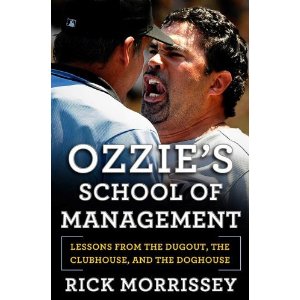
     "Ozzie's School of Management" by  Rick Morrissey ( Times Books,  $26.00, 288 pages) is a book that is way out there. Peppered with profanity, irreverent, outrageous, sometimes ringing true,  and other times out there ­ this is a work for fan's of Ozzie Gillen late of the White Sox now prime time with Miami. Morrissey covered Ozzie and his antics  for eight years in Chicago as sports columnist for the Sun-Times. He has done a good job presenting seamless stories, entertaining and outlandish. Ozzie's ten commandments are a must read. One can hear the thick Venezuelan accent speaking about strategy, dust ups, memorable moments.
     Sub-titled "Lessons from the Dugout, the Clubhouse and the Doghouse, this tome should be required reading for fans of its subject who says if he had it to do all over it would be as a bull fighter in his native Venezuela.
    "Starting and Closing" by Don Smoltz with Don Yaeger (William Morrow, $26.00, 304 pages) is a look inside the man who was one of baseball's most enduring and endearing characters on and off the playing fields. Shown through the filter of Smoltzy's final season, "Starting and Closing" is much more than that. Faith, flexibility, sticking to a task, "starting and closing" as the book's sub-title announces, all of this is part of a terrific reading experience. Just as Smoltz was an all purpose pitcher, a guy who had the goods, the same can be said about this highly readable work.
    From the University of Illinois Press comes "A People's History of Baseball" by Mitchell Nathanson ($29.95, 272 pages). A professor of legal writing at Villanova, Nathanson peppers his actual 219 pages of heavy prose with notes, a bibliography and a lengthy index to reach the book's announced 272 pages. There are some take aways here, but overall these ruminations are more than twice told stories told better the first time around.
    For those who did not get enough about Penn State, Joe Paterno, Jerry Sandusky with all the hype and hoopla and dissection in the media ­ there is "Game Over" by Bill Moushey and Bob Dvorchak (William Morrow, $26.99, 224 pages). Veteran authors, guys who  know their way around a story, Bill Moushey and Bob Dvorchak have done due diligence here. If you are interested in more frontstage and backstage on the horrific narrative of "JoePa's" once little piece of paradise ­ this is the volume for you.
    "Fenway Park Trivia" by Bill Nowlin (Rounder Books) is an effort created by a man who knows more about the park than most and he struts his stuff all over the place in this tiny terrific tome. Fact and fancy intermingle nicely. GO FOR IT
    "You Stink!" by Eric J. Wittenberg and Michael Aubrecht (Black Squirrel Books, paper, 332 pages) has an off-putting title but it describes a tome that clearly and cleverly focuses on terrible big league teams and pathetic players. Nicely done!


Sunday, May 27, 2012

BOOK REVIEWS


“Ozzie's School of Management” by Rick Morrissey ( Times Books, $26.00, 288 pages) is a book that is way out there. Peppered with profanity, irreverent, outrageous, sometimes ringing true, and other times out there – this is a book for fan’s of Ozzie Gillen late of the White Sox now prime time with Miami. Morrissey covered Ozzie and his antics for eight years in Chicago as sports columnist for the Sun-Times. He has done a good job presenting seamless stories, entertaining and outlandish. Ozzie's Ten Commandments are a must read. One can you can hear the thick Venezuelan accent speaking about strategy, dust ups, memorable moments. sub-Sub-titled "Lessons from the Dugout, the Clubhouse and the Doghouse, this tome should be required reading for fans of its subject who says if he had it to do all over it would be as a bull fighter in his native Venezuela.
          “Starting and Closing” by Don Smoltz with Don Yaeger (William Morrow, $26.00, 304 pages) is a look inside the man who was one of baseball’s most enduring and endearing characters on and off the playing fields. This is a book shown through the filter of Smoltzy’s final season but it is much more than that. Faith, flexibility, sticking to a task, “starting and closing” as the book’s sub-title announces, all of this is part of a terrific reading experience. Just as Smoltz was an all purpose pitcher, a guy who had the goods, the same can be said about this highly readable work.
          From the University of Illinois Press comes “A People’s History of Baseball” by Mitchell Nathanson ($29.95, 272 pages). A professor of legal writing at Villanova, Nathanson peppers his actual 219 pages of heavy prose with notes, a bibliography and a lengthy index to reach the book’s announced 272 pages. There are some take aways here, but overall these ruminations are more than twice told stories told better the first time around.
          For those who did not get enough about Penn State, Joe Paterno, Jerry Sandusky with all the hype and hoopla and dissection in the media – there is “Game Over” by Bill Moushey and Bob Dvorchak (William Morrow, $26.99, 224 pages). Veteran authors, guys who know their way around a story, Bill Moushey and Bob Dvorchak have done due diligence here. If you are interested in more frontstage and backstage on the horrific narrative of “JoePa’s” once little piece of paradise – this is the volume for you.
          “Fenway Park Trivia” by Bill Nowlin (Rounder Books) is an effort created by a man who knows more about the park than most and he struts his stuff all over the place in this tiny terrific tome. Fact and fancy intermingle nicely. GO FOR IT
          “You Stink!” by Eric J. Wittenberg and Michael Aubrecht (Black Squirrel Books, paper, 332 pages) has an off-putting title but it describes a tone that clearly and cleverly focuses on terrible big league teams and pathetic players. Nicely done!

Saturday, May 26, 2012

TALKIN' YANKEES: Quips, Quotes, Asides, Philosophy and More (Part I)

Mickey Mantle and Roger Maris
    They are baseball's greatest franchise, a team of legends, ghosts, marker moments, odd characters. So much has been written about them and the talk stream stretches out through many decades. Herewith, a small sampling of some of the more memorable observations, enjoy.
        On the Yankees
    "I would rather beat the Yankees regularly than pitch a no-hit game." - Bob Feller
    "It was a death struggle every day being a Yankee ­ you either won or you lost. There was no second place. Half of us were nuts by the end of a season." - Jerry Coleman
    "When I was a player and we would play the Yankees in spring training, even though the game didn't mean anything, it was a special day." - Joe Torre
    "I wish I'd never see them again. I wish they'd disappear from the league." Pedro Martinez, Boston Red Sox 
    "Hating the Yankees is as American as pizza pie and cheating on your income tax." - Columnist Mike Royko
    "Hating the Yankees isn't part of my act. It is one of those exquisite times when life and art are in perfect conjunction." -  Bill Veeck
     "Going north from spring training, we'd pass through small towns and people would be out there early in the morning as the train went by, waving to us. I don't know how they got the word ­ but we'd be having our breakfast in the diner and they'd be there." - Jerry Coleman
    "You kind of took it for granted around the Yankees that there was always going to be baseball in October." -  Whitey Ford
     "This isn't just a ball club! This is Murderers Row!" ­ sportswriter Arthur Robinson, 1927
    "There has never been anything like it. Even as these lines are batted out on the office typewriter, youths dash out of the AP and UP ticker room every two or three minutes shouting, 'Ruth hit one! Gehrig hit another one!' "   - sportswriter Paul Gallico
    "I was known as a Yankee killer. My best year against them was 1953.  I beat them five times and shut them out four times.  You just played a little harder against them." - Mel Parnell
    "Rooting for the Yankees is like rooting for U.S. Steel." - Joe E. Lewis
    "Rooting for the Yankees is like owning a yacht." - Jimmy Cannon
    "The majority of American males put themselves to sleep by striking out the batting order of the New York Yankees." - James Thurber
    "They have, what, 26 World Series titles? But that doesn't mean they are going to beat us. We deserve to be here as much as they do. I'm not trying to get Babe Ruth or Lou Gehrig or Mickey Mantle out. I'm trying to get the Yankees' lineup out today." - Curt Schilling of Arizona, before Game One, 2001 World Series
    "Somebody told me that we beat the Yankees in the bottom of the ninth! I still don't believe it!" - Mark Grace, 2001 World Series
    "When my Yankee career is over I'll play anywhere, but I'm positive that I'll never find a team quite like the Yankees." -Bernie Williams
    "These are your Yankees. They leave their hearts on the field for you."  - Joe Torre


            Yankee Stadium
    "When I come here, it's like standing on hallowed ground." ­Cal   Ripken
     "It was so large and the fans there were so rabid. It was amazing for me to go out there and stand on the mound and look around and realize that was the place that Ruth built." -Bob Feller
    "Most guys won't admit it, but it can be an intimidating thing your first few times there. All the lore of the stadium and the mystique can be difficult to deal with."  -   Al Leiter
    "It is the most magical ballpark ever built. Playing there as a Yankee was like being in the Marines, the feeling that you were in a special ballpark, special town, special uniform, special history." ­ Phil Linz
    "When I went to the American League as an umpire, I had never been to a major league ballpark . This was 1963. You went out of the umpire's dressing room and down the hallway and up the ramp and stepped out onto the field. Here's this kid from Little Rock, Arkansas standing in New York City in Yankee Stadium. It was a pretty incredible thing."  - Bill Valentine
     "I loved Yankee Stadium because I was left-handed. I usually faced mostly right-handed hitting teams there. The fence in centerfield was 461 feet away, and left centerfield was 457 feet. As long as you kept the hitters from hitting the ball down the line, it was a great park to pitch in." - Whitey Ford
    "Being from New York, it meant a lot for me to play in my hometown. I knew every nook and cranny there, and we had the fans behind us. Back then, you had the monuments in the outfield and that was unbelievable." - Phil Rizzuto
    "The cathedral of baseball." - David Cone
    "Baseball heaven." - Randy Johnson
    "The stadium is a part of the Yankees and the Yankees are a part of the stadium. That will never change." - Chuck Knoblauch

    "I was in the right place at the right time." -- Mel Allen

           
                Ed Barrow
     "You ought to know that you're making a mistake." ­ to Red Sox owner Harry Frazee on the sale of Babe Ruth to the Yankees
                Yogi Berra   
    "Congratulations on breaking my record last night. I always thought the record would stand until it was broken." ­to Johnny Bench who broke his record for career home runs by a catcher.
    "I didn't say the things I said "
    "The other teams could make trouble for us if they win."
    "If you don't know where you are going, you will wind up somewhere else."
    "If you come to a fork in the road, take it."
     "He must have made that before he died." --on a Steve McQueen movie, 1982
    "A nickel ain't worth a dime anymore."
    "It's tough to make predictions, especially about the future."
    "The future ain't what it used to be."
    "A home opener is always exciting, no matter if it's home or on the road."
    "I take a two hour nap between 1PM and 3PM."
    "90% of the putts that are short don't go in."
    "Baseball is 90-percent mental. The other half is physical."
    "You have to give 100 percent in the first half of the game. If that isn't enough, in the second half, you have to give what is left."
    "Nobody goes there any more. It's too crowded."
    "It gets late out there early," referring to the bad sun conditions in left field at the stadium.
    "He is a big clog in their machine."
    "I've been with the Yankees 17 years, watching games and learning. You can see a lot by observing."
    "Baseball is the champ of them all. Like somebody said, the pay is good and the hours are short."
    "All pitchers are liars and crybabies."
    "Bill Dickey learned me all his experience."
    "I want to thank you for making this day necessary." -- to fans in hometown St. Louis for giving him a day in 1947 at Sportsmen's Park.
    "I've known this guy so long. Can't he spell my name right?" -- after receiving a check that said "Pay to the order of Bearer"
    "I think Little League is wonderful. It keeps the kids out of the house."
      "If the people don't want to come out to the ballpark, nobody's going to stop them."
    "Pair off in threes."
         "The other teams could make trouble for us if they win." -- as Yankee manager
    "Always go to other people's funerals, otherwise they won't come to yours."
    "We have very deep depth!"
    "It was impossible to get a conversation going, everybody was talking too much."
    When asked what time it is -- "Do you mean now?"
    When asked what he would do if he found a million dollars - "If the guy was poor, I'd give it back"
    When asked by a waitress how many pieces she should cut his pizza into -- "Four. I don't think I could eat eight."
    When asked why the Yankees lost the 1960 series to Pittsburgh-- "We made too many wrong mistakes."
    When told by Yankee manager Bucky Harris to think about what was being pitched to him  -- "Think? How the hell are you gonna think and hit at the same time?"
    When told Ernest Hemmingway was a great writer -- "Yeah, for what paper?"
    When asked what his cap size was at the beginning of spring training -- "I don't know, I'm not in shape.""
    "It's deja vu all over again."
    "It ain't over until it's over."

                On Yogi Berra
    "You can't compare me to my father, our similarities are different." - Dale Berra
    "They say he's funny. Well, he has a lovely wife and family, a beautiful home, money in the bank, and he plays golf with millionaires. What's funny about that?" - Casey Stengel
    "He'd fall in a sewer and come up with a gold watch." - Casey Stengel
    "Where he was especially dangerous was in the final two innings. You couldn't pitch to him. He had no weaknesses. He was the most dangerous hitter ever." ­Jerry Coleman
    "Not only was he lucky, he was never wrong." ­ Whitey Ford
    "Yogi's face is his fortune." Mike Stanley