Sunday, March 24, 2013

Inside Baseball Lingo – the Sometimes Untold, Fairly Fascinating, Oddly Amazing, Stories of How They Came to Be That Way! (Part 2, from the vault)


            (HARVEY FROMMER IS AT WORK ON A BOOK ON THE FIRST SUPER BOWL (1967). ANYONE WITH CONTACTS, STORIES, SUGGESTIONS, PLEASE CONTACT HIM)    

 
          With the start of a new baseball season, baseball lingo is in the air. The words and phrases are spoken and written day after day, year after year - generally without any wonderment as to how they became part of the language. All have a history, a story.         A brief sampler follows with more to come . . .    


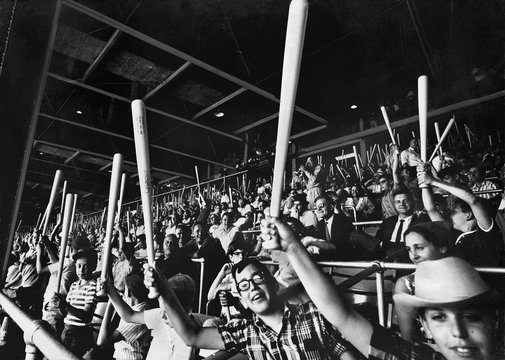
BAT DAY In 1951 Bill Veeck ("as in wreck") owned the St. Louis Browns, a team that was not the greatest gate attraction in the world. (It's rumored that one day a fan called up Veeck and asked, "What time does the game start?" Veeck's alleged reply was, " What time can you get here?") Veeck was offered six thousand bats at a nominal fee by a company that was going bankrupt. He took the bats and announced that a free bat would be given to each youngster attending a game accompanied by an adult. That was the beginning of Bat Day. Veeck followed this promotion with Ball Day and Jacket Day and other giveaways. Bat Day, Ball Day, and Jacket Day have all become virtually standard major league baseball promotions.

"CAN'T ANYBODY HERE PLAY THIS GAME?" In 1960 Casey Stengel managed the New York Yankees to a first-place finish, on the strength of a .630 percentage compiled by winning 97 games and losing 57. By 1962  he was the manager of the New York Mets, a team that finished tenth in a ten-team league. They finished 601/: games out of first place, losing more games ( 120) than any other team in the 20th century. Richie Ashburn, who batted .306 for the Mets that season and then retired, remembers those days: "It was the only time I went to a ball
park in the major leagues and nobody expected you to win."

A bumbling collection of castoffs, not-quite-ready for-prime-time major league ball players, paycheck collectors, and callow youth, the Mets underwhelmed the opposition. They had Jay Hook, who could talk for hours about why a curve ball curved (he had a Masters degree in engineering) but couldn't throw one consistently. They had" Choo-Choo" Coleman, an excellent low-ball catcher, but the team had very few low-ball pitchers. They had "Marvelous Marv" Throneberry, a Mickey Mantle look-a-like in the batter's box-and that's where the resemblance ended. Stengel had been spoiled with the likes of Mantle, Maris, Ford, Berra, etc. Day after day he would watch the Mets and be amazed at how they could find newer and more original ways to beat themselves. In desperation-some declare it was on the day he witnessed pitcher A1 Jackson go 15 innings yielding but three hits, only to lose the game on two errors committed by Marvelous Marv-Casey bellowed out his plaintive query, "Can't anybody here play this game?"


DUGOUT  An area on each side of home plate where players stay while their team is at bat. There is a visitor's dugout and a home-team dugout.  They were originally dug out trenches at the first and third base lines allowing players and coaches to be at field level and not blocking the view of the choice seats behind them. 

JUNK MAN  Eddie Lopat was the premier left-handed pitcher for the New York Yankees in the late 1940's and through most of the 1950's. He recalls how he obtained his nickname: "Ben Epstein was a writer for the now defunct New York Daily Mirror and a friend of mine from my Little Rock minor league baseball days. He told me in 1948 that he wanted to give me a name that would stay with me forever. 'I want to see what you think of it-the junk man?' In those days the writers had more consideration. They checked with players before they called them names. I told him I didn't care what they called me just as long as I could get the batters out and get paid for it." Epstein then wrote an article called "The Junkman Cometh," and as Lopat says, "The rest was history." The nickname derived from Lopat's ability to be a successful pitcher by tantalizing the hitters with an assortment of offspeed pitches. This writer and thousands of other baseball fans who saw Lopat pitch bragged more than once that if given a chance, they could hit the "junk" he threw.


ONE-ARMED PETE GRAY Born Peter J. Wyshner (a.k.a. Pete Gray) on March 6, 1917, Gray was a longtime New York City semipro star who played in 77 games for the St. Louis Browns in 1945. He actually had only one arm and played center field with an unpadded glove. He had an intricate and well developed routine for catching the ball, removing the ball from his glove, and throwing the ball to the infield.

POLO GROUNDS  During the 1880's, the National League baseball team was known as the New Yorkers. There was another team in town, the New York Metropolitans of the fledgling American Association. Both teams played their season-opening games on a field across from Central Park's northeastern corner at 110th Street and Fifth Avenue. The land on which they played was owned by New York Herald Tribune publisher James Gordon Bennett. Bennett and his society friends had played polo on that field and that's how the baseball field came to be known as the Polo Grounds. In 1889 the New York National League team moved its games to a new location at 157th Street and Eighth Avenue. The site was dubbed the new Polo Grounds and eventually was simply called the Polo Grounds. Polo was never played there.
Harvey Frommer is now in his  38th  year of writing books. A noted oral historian and sports journalist, the author of 41 sports books including the classics: "New York City Baseball 1947-1957," "Shoeless Joe and Ragtime Baseball," “Remembering Yankee Stadium” and Remembering Fenway Park,” his book on the first Super Bowl will be published fall 2014.

The prolific Frommer’s work has appeared in such outlets as the
New York Times, Los Angeles Times, Washington Post, New York Daily News, Newsday, USA Today, Men's Heath, The Sporting News,Bleacher Report.

FROMMER SPORTSNET (syndicated) reaches a readership in the millions and is housed on Internet search engines for extended periods of time.

*
Autographed copies of Frommer books are available direct from the author.  
This Article is Copyright © 1995 - 2013 by Harvey Frommer.  All rights reserved worldwide.
 

Monday, March 18, 2013

Inside Baseball Lingo – the Sometimes Untold, Fairly Fascinating, Oddly Amazing, Stories of How They Came to Be That Way! (Part 1, from the vault)

 
            (HARVEY FROMMER IS AT WORK ON A BOOK ON THE FIRST SUPER BOWL (1967). ANYONE WITH CONTACTS, STORIES, SUGGESTIONS, PLEASE CONTACT HIM)   

 Withthe start of a new baseball season almost upon on, baseball lingo is in the air. The words and phrases are spoken and written day after day, year after year - generally without any wonderment as to how they became part of the language. All have a history, a story.
         
A brief sampler follows with more to come . . . 
 
AMAZIN' METS The first run they ever scored came in on a balk. They lost the first nine games they ever played. They finished last their first four seasons. Once they were losing a game, 12-1, and there were two outs in the bottom of the ninth inning. A fan held up a sign that said "PRAY!" There was a walk, and ever hopeful, thousands of voices chanted, "Let's go Mets." They were 100-l underdogs to win the pennant in 1969 and incredibly came on to finish the year as World Champions. They picked the name of the best pitcher in their history (Tom Seaver) out of a hat on April Fools' Day. They were supposed to be the replacement for the Brooklyn Dodgers and the New York Giants. They could have been the New York Continentals or Burros or Skyliners or Skyscrapers or Bees or Rebels or NYB's or Avengers or even Jets (all  runner-up names in a contest to tab the National League New York team that began playing ball in 1962). They've never been anything to their fans but amazing-the Amazin' New York Mets.

BIG POISON and LITTLE POISON Paul Waner's rookie year with the Pittsburgh Pirates was 1926, when he batted .336 and led the league in triples. In one game he cracked out six hits using six different bats. In 1927 the second Waner arrived, brother Lloyd. For 14 years, the Waners formed a potent brother combination in the Pittsburgh lineup. Paul was 5'8l/2'' and weighed 153 pounds. Lloyd was 5'9" and weighed 150 pounds.

Paul was dubbed Big Poison even though he was smaller than Lloyd, who was called Little Poison. An older brother even then had privileges. But both players were pure poison for National League pitchers. Slashing left-handed line-drive hitters, the Waners collected 5,611 hits between them. Paul's lifetime batting average was .333, and he recorded three batting titles. Lloyd posted a career average of .316. They played a combined total of 38 years in the major leagues.


BONEHEAD MERKLE The phrase "pulling a bonehead play," or "pulling a boner," is not only part of the language of baseball, but of all sports and in fact, of the language in general. Its most dramatic derivation goes back to September 9, 1908. Frederick Charles Merkle, a.k.a. George Merkle, was playing his first full game at first base for the New York Giants. It was his second season in the majors; the year before, he had appeared in 15 games. The Giants were in first place and the Cubs were challenging them. The two teams were tied, 1-1, in the bottom of the ninth inning. With two outs, the Giants' Moose McCormick was on third base and Merkle was on first. Al Bridwell slashed a single to center field, and McCormick crossed the plate with what was apparently the winning run. Merkle, eager to avoid the Polo Grounds crowd that surged onto the playing field, raced directly to the clubhouse instead of following through on the play and touching second base. Amid the pandemonium, Johnny Evers of the Cubs screamed for the baseball, obtained it somehow, stepped on second base, and claimed a forceout on Merkle. When things subsided, umpire Hank O'Day agreed with Evers. The National League upheld O'Day, Evers and the Cubs, so the run was nullified and the game not counted. Both teams played out their schedules and completed the season tied for first place with 98 wins and 55 losses. A replay of the game was scheduled, and Christy Mathewson, seeking his 38th victory of the season, lost, 4-2, to Three-Finger Brown (q.v.). The Cubs won the pennant. Although Merkle played 16 years in the majors and had a lifetime batting average of .273, he will forever be rooted in sports lore as the man who made the "bonehead" play that lost the 1908 pennant for the Giants, for had he touched second base there would have been no replayed game and the Giants would have won the pennant by one game.
 

"BOO" Name for a day in 1979 of Giants shortstop Johnnie LeMaster, who heard the boo-birds in San Fran. He took his field position wearing "Boo" on his back.  LeMaster switched back to his regular jersey after one game.

"CHILI"  When he was about 12 years old, Charles Davis was given a not too attractive haircut which led to his getting the nickname "Chili Bowl," later shortened to "Chili" as the boy became the man and the baseball player "Chili" Davis. 

GIANTS  One sultry summer's day in 1885, Jim Mutrie, the saber-mustached manager of the New York Gothams, was enjoying himself watching his team winning an important game. Mutrie screamed out with affection, "My big fellows, my giants." Many of his players were big fellows, and they came to be Giants. For that was how the nickname Giants came to be. And when the New York team left for San Francisco in 1958, Giants, Mutrie's endearing nickname, went along with it.

SPLENDID SPLINTER He was also nicknamed the Thumper, because of the power with which he hit the ball, and the Kid, because of his tempestuous attitude-but his main nickname was perhaps the most appropriate. Ted Williams was one of the most splendid players who ever lived, and he could really "splinter" the ball. The handsome slugger compiled a lifetime batting average of .344 and a slugging percentage of .634.

Williams blasted 521 career home runs, scored nearly 1,800 runs, and drove in over 1,800 runs. So keen was his batting eye that he walked over 2,000 times while striking out only 709 times. In 1941 he batted .406 - the last time any player hit .400 or better. One of the most celebrated moments in the career of the Boston Red Sox slugger took place in the 1946 All-Star Game. Williams came to bat against Rip Sewell and his celebrated "eephus" (blooper) pitch. Williams had already walked in the game and hit a home run. Sewell's pitch came to the plate in a high arc, and Williams actually trotted out to the pitch, bashing it into the right-field bullpen for a home run. "That was the first homer ever hit off the pitch," Sewell said later.

"The ball came to the plate in a twenty-foot arc," recalled Williams. "I didn't know whether I'd be able to get enough power into that kind of a pitch for a  home run." There was no kind of pitch Williams couldn't hit for a home run.

                          (to be continued) . . .

Tuesday, March 12, 2013

Sports Book Reviews “FRANCONA: The Red Sox Years” and other spring tomes


            (HARVEY FROMMER IS AT WORK ON A BOOK ON THE FIRST SUPER BOWL (1967). ANYONE WITH CONTACTS, STORIES, SUGGESTIONS, PLEASE CONTACT HIM)   

           A few years back when I was at Ft. Meyers interviewing for my “Remembering Fenway Park” two targets were Sox manager Terry Francona and sports writer Dan Shaughnessy. In my opinion they were at the top of their game and could provide many insights about Fenway.          
          Both guys were busy. Both guys had better things to do then pass the time of day with me. Nevertheless, both guys gave me as much time as I needed and their stories and insights added immeasurably to my book.
          So I knew   “FRANCONA: The Red Sox Years” (Houghton Mifflin Harcourt, $28.00, 360 pages) would not be just another baseball book --and it isn’t. This is one for you to read and keep on your book shelf.  The book covers eight years, 2 world championships and frontstage and backstage Sox stories.
          We are there with the affable, outspoken and thoughtful Francona though his successes and failures, There are candid insights into Theo Epstein, players like David Ortiz, Josh Beckett, Manny Ramirez, Pedro Martinez, three owners. Francona ends this anecdote-filled and honest book with: “Managing the Red Sox was the hardest job I ever had. And it was the best job I ever had. Now it’s time to try it somewhere else.” 
          Try this book - -a notable reading experience.
          “Closer” by Kevin Neary (Running Press, $15.00, 288 pages, paper) has a collection of major league pitchers – past and present – revealing inside tricks of saving games. Lots of inside baseball.
          From Norton comes “So You Think You Know Baseball” by Peter E. Meltzer( $16.95, paper) is sub-titled “a fan’s guide to the original rules” and that is what this small tome tackles.
          “Summer of ‘68” by Tim Wendel (Da Capo, $14.99, 272 pages, paper) focuses on a season that he makes the case for  - -as changing baseball.
          For the golfers among you comes a duo of terrific books from Gotham Books  - - “An American Caddie in St. Andrews” by Oliver Horovsitz ($26.00, 322 pages) and “Drive Like the Pros”  by Michael Neff ($30.00, 128 pages). One is a burly volume and the other is slim but both pack much to be loved by sports fans and golfers everywhere. The “American Caddie” is part growing up, part memoir, all good reading by Horowitz, 26, who has been on the course for the past seven years and has lots to talk about.
          “Any Given Monday” by Dr. James R. Andrews (Scribner, $25.00, 270 pages) is a primer on sports injuries and how to prevent them told by a man who has spent a lifetime in sports medicine.
          “The Official NASCAR 2013 Preview and Press Guide (Random House, $19.99, 336 pages, paper) is an annual publication that provides all the needed inside info for fans of the sport.

    (HARVEY FROMMER IS AT WORK ON A BOOK ON THE FIRST SUPER BOWL (1967). ANYONE WITH CONTACTS, STORIES, SUGGESTIONS, PLEASE CONTACT HIM)

Thursday, January 31, 2013

From the Frommer Vaults: Jackie Robinson Remembered


Jackie and Mr Rickey making history.
He was born in Cairo, Georgia on the last day of January in 1919, and died on October 24, 1972 in Stamford, Connecticut. A chilly April 15, 1947 was the day he broke baseball's color barrier at  Ebbets Field, the lone black man wearing the ice cream white uniform of the Brooklyn Dodgers.

The man they called "Robby" attended UCLA, where he won letters in three sports. He was in the Army during World War II and then played briefly in the Negro Leagues when the war ended. He was signed to a minor league contract with the Montreal Royals in 1946 by Branch Rickey, and the following year came up to the Brooklyn Dodgers and broke baseball's age-old color line.

He played in the major leagues for a decade. He won the inaugural Rookie of the Year Award in 1947, the National League Most Valuable Player Award in 1949, and he helped the Dodgers win six pennants and one world championship.

Despite all the pressure he played under, he was still able to record a lifetime batting average of .311. His base-stealing ability and hustle won many games for the Dodgers. He set several records for fielding for second basemen.

His influence on sports is immeasurable. His breaking of baseball's color line against the greatest of odds is still one of the most dramatic stories in all of sports history. And there are those who still have special memories of the man and the legend. Here is how one from that time still remembers the great player Brooklyn Dodger fans called "Robby".

When school was out, I sometimes went with my father in his taxi. One summer morning, we were driving in East Flatbush in Brooklyn down Snyder Avenue. My father pointed to a dark red brick house with a high porch.

"I think Jackie Robinson lives there," my father said. He parked across the street and we got out of the cab, stood on the sidewalk and looked at the house. Suddenly, the front door opened. A black man in a short-sleeved shirt stepped out. I didn't believe it. Here we were on a quiet street on a summer morning with no one else around.

The man was not wearing the baggy, ice-cream-white-uniform of the Brooklyn Dodgers that accentuated his blackness. He was dressed in regular clothes, coming out of a regular house in a regular Brooklyn neighborhood, a guy like anyone else going out for a bottle of milk and a newspaper.

Then, incredibly, he crossed the street and came right toward me. Seeing that unmistakable pigeon-toed walk, the rock of the shoulders and hips that I had seen so many times before on the baseball field, I had no doubt who it was.

"Hi Jackie, I'm one of your biggest fans," I said self-consciously. "Do you think the Dodgers are going to win the pennant this year?"

"His handsome face looked sternly down at me.  "We'll try our best," he said.

"Good luck," I said."

"Thanks," he replied."

He put his big hand out, and I took it. We shook hands and I felt the strength and firmness of his grip. I was a nervy kid, but I didn't ask for an autograph or try to prolong the conversation. I just watched as he walked away down the street.   That kid was me.

Monday, January 28, 2013

REMEMBERING THE FIRST SUPER BOWL (Part 2)


          Soon Super Bowl XLVII will be upon us all.       
          The date: February 3, 2013. 
          The place: Mercedes-Benz Super Dome, New Orleans.     
          The U.S. TV audience to surpass 100 million.
          An advertising slot during the break (30 seconds), a pricey almost $4 million.
          All of the above boggles the mind.  All of the above is true. And all of the above is a far, far, cry from January 15, 1967 - - the date of the first Super Bowl which was not even officially called “the Super Bowl.” 
          That first game had a TV viewership of 51 million Americans.  A 30-second ad sold for just $42,000. Each winning player received $15,000,each loser $7,500.
            In June 1966, the National Football League and the American Football League announced a merger ending for all intents and purposes a half dozen years of bickering and bad blood. The leagues also agreed to play a post-season game for pro football’s championship. The official name of the game was "World Championship Game, American Football League vs. National Football League."  It was wordy and dull. Some fans and media members were already calling it “Super Bowl.”
          Jackie Gleason, one of the celebrated comedians of that era, the evening before the big game ended his TV variety show the “Honeymooners” on CBS the usual way giving acknowledgment to his fellow stars Audrey Meadows, Art Carney and Joyce Randolph. Then the chubby comic exhorted his loyal and massive audience to be sure and tune in the next day and watch Green Bay and Kansas City compete in a championship gridiron game.
          Gleason bellowed: “It’s gonna be murder!”
          There were those who thought “the Great One” went a bit too far, that he was in the bag for his CBS network that carried the NFL broadcasts.
          The game was staged at the gigantic Los Angeles Memorial Coliseum on a sunny and beautiful southern Californian smog-free day. Top tickets were priced at $12.00 but could be gotten for two bucks on the street. More than 30,000 seats were empty as “just” 63,000 showed up. This, despite a 75-mile TV blackout in the Los Angeles area. NBC and CBS paid $9.5 million to televise the game.
          The field’s west end zone had the word “Packers” spelled out in green on a gold background. On each side was the NFL insignia. The east zone showcased “Chiefs” in red on a gold background. On each side was the AFL insignia.   A large brown football was painted at the 50-yard line. Capped with a gold crown, it sported the NFL insignia in blue and the AFL in red on each side.
          Six officials, three representing the NFL and three from the AFL, were on hand. They were backed by six alternates.  Two different footballs were used – an AFL model and an NFL one.
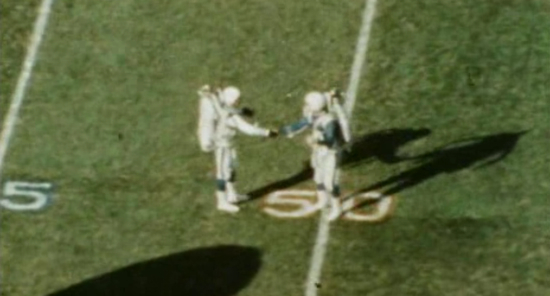
           The entertainment was billed as “Super Sights and Sounds.” An icon of that era, jazz trumpeter Al Hirt, did his thing. In step were the University of Arizona and Grambling State University marching bands, the Anaheim High School Drill Team. A pair of "rocket men" sporting James Bond jet packs and the insignia of each league, flew a bit and landed at midfield. Halftime saw the release of 10,000 helium-filled balloons and 4,000 pigeons.
          For the record, the favored (12-2) Packers coached by Vince Lombardi had bragging rights to four NFL titles in six years and 10 future Pro Football Hall of Famers on the roster. The (11-2-1) 18-point underdog Chiefs, led by Hank Stram, made a game of it in the first half. However, the “Pack” took over in the second half, winning big, 35-10. Bart Starr tossed two touchdown passes to Max McGee and won the MVP award and a trip to New York City to claim his red Corvette Sting Ray from Sport Magazine
          That was many long years ago - -the “grand-daddy of them all”-- Super Bowl One. "Our goal,” former NFL Commisioner Pete Rozelle said,
“from the first was to make this more than a game, to make it an event."           
                              (to be continued)
***Harvey Frommer is at work on REMEMBERING SUPER BOWL ONE: AN ORAL AND NARRATIVE HISTORY. He welcomes hearing from anyone with memories, perceptions, leads, memorabilia  for his newest book. ****

Saturday, January 19, 2013

“Just Win Baby” and Other Notable Tomes


          From acclaimed and deservedly so sports journalist and author Murray Olderman comes “Just Win Baby” (Triumph Books, $24.95, 203 pages). It is a deftly detailed account of the life and times of Al Davis of Oakland Raider fame. We are there for the inside look at this mercurial football maven from his growing up days in Brooklyn all the way through his triumphs with the silver and black.
          Initially Olderman who knew Davis for more than 50 years was commissioned by the electric executive to write his biography. Somehow, that book never made it into print.  “Just Win Baby” is Olderman’s third person account  - -and what an account it is. It uiilizes a great deal of the material given to Olderman and is enhanced by the prize winning author’s perspective, writing and organizational skills.  HIGHLY NOTABLE
          “The Muhammad Ali Reader” edited by Gerald Early(Ecco, $17.99, 336 pages) has bragging rights to over 30 pieces on “the Greatest” organized by decades. The 16 page photo insights showcase Ali in all his ways.
          “Yacht Clubs of the World” text by Bruno Cianci and Nicolo Reggio (Rizzoli, $100,00, 270 pages) is one of the most beautiful books ever produced by a company that has produced many beautiful books. Page after page in brilliant, bold, color unfolds as one turns the pages of this opulent opus. We are there with twenty storied venues like the New York Yacht Club, the Hong Kong Yacht Club, the Yacht Club de France and on and on. Yachting’s culture is on display and the reader (viewer) is all the better for it. MOST NOTABLE
 

Monday, January 14, 2013

REMEMBERING SUPER BOWL ONE


                   ''The most fun thing was watching the development of the Super Bowl because the game is what it's all about. I really felt a high at every Super Bowl with all the glitz and the spectacular halftime shows.'' – Pete Rozelle
                “The Super Bowl is an invention of American business.  It is American business.”  -  Roger Angell

        The merger of the American Football League and the National Football League led to the need for a championship game. The first contest was played on January 15, 1967. The NFL’s Vince Lombardi Green Bay Packers squared off against the AFL’s underdog Kansas City Chiefs coached by Hank Stram.

        That first Super Bowl was played at the Memorial Coliseum in Los Angeles before 61,946. Yes, there were empty seats – the first and only time the legendary event failed to sell out even with ticket prices that topped out at $12.

        The contest was officially known as the AFL-NFL World Championship;however, its unofficial name - the Super Bowl - was used by media, fans and players. The  name stuck.

        One theory for how the high flying name came about is that at an owner's meeting centered on what to call the game, one of the moguls had a "super ball" in his pocket that he had appropriated from his youngster earlier in the day. Not too taken with the long and ordinary sounding suggestions for what would become professional football's ultimate game, Lamar Hunt suggested the name Super Bowl. His suggestion was not greeted with much enthusiasm by the assembled group. Nevertheless, he mentioned the name to a reporter who loved it and, as they say, the rest is history.

        The first Super Bowl witnessed the first dual-network, color-coverage simulcast of a sports event in history, and attracted the largest viewership to ever see a sporting event up to that time. The Nielsen rating indicated that 73 million fans watched all or part of the game on one of the two networks, CBS or NBC.

        In actuality, the game was a contest between the two leagues and the two networks. CBS' allegiance was to the NFL. NBC's loyalty was to the AFL - a league it had virtually created with its network dollars.

          The networks charged $42,000 for a 30 second commercial. Frank Gifford was a sidelines reporter for CBS. Ray Scott handled the CBS play-by play for the first half while Jack Whitaker took over in the second half.  Curt Gowdy and Paul Christman handled the NBC telecast.

        There were many oddities and talking points about that first game.  Two jetpack pilots shook hands at the 50 yard line after landing there. Commercials for McDonald's (then boasting of "Over Two Billion Served") and Muriel cigars ("So much more cigar for just 10 cents") were all the rage.

         According to NFL Films President Steve Sabol, Commissioner Pete Rozelle had wanted to call the game "The Big One."  That never came to be. Neither did “Pro Bowl, another name the NFL head man favored.

         From the start (but not in that first game) there were unique  features to the Super Bowl including its designation with a Roman numeral rather than by a year - a move attributed to NFL Commissioner Pete Rozelle to give the game class and continuity.

        Max McGee of the Packers became an interesting footnote to Super Bowl history.

        "I knew I wouldn't play unless (Boyd) Dowler got hurt," he said later.  So McGee went out on the town the days (and nights) prior to the game. Curfews, it seems, were there for him to break.  Then, the unimaginable happened. Dowler suffered a separated shoulder throwing a block on the opening series.

        In came McGee who had caught only four passes all season. He snared 7 passes for 138 yards, hauling in the first touchdown in Super Bowl history—a 37-yard pass from Green Bay's Bart Starr. He caught another at the end of the third quarter for a 13-yard touchdown. Elijah Pitts ran for two other scores. The Chiefs' 10 points came in the second quarter, their only touchdown on a 7-yard pass from Len Dawson to Curtis McClinton.

        McGee stole the show and set a pattern that would be part of the ultimate game's history of unlikely heroes, strange twists of fate, footballs taking a wrong bounce for some teams, the right bounce for others.

        Quarterback Bart Starr was the first Most Valuable Player  leading the Packers to a 35-10 victory over KC. Starr completed 16-of-23 passes for 250 yards and three touchdowns.

         Today more Americans watch the Super Bowl than vote in presidential elections. Municipalities vigorously and ruthlessly compete for the rights to host a game and then work with the NFL, advertising and talent agencies, merchandisers, security personnel, and celebrity party planners more than a year in advance fine tuning myriad details.  A couple of million large-screen TVs are purchased weeks before the game.

        The grandest and gaudiest  annual one-day spectacle in American sports, Super Bowl Sunday has become an unofficial American holiday  with bragging rights to millions of  parties, betting pools, excessive consumption of food and drink.  TV networks charge as much as $2.5 million for a 30-second spot. Many viewers do not even watch the game itself, content to partake of the elaborate pre-game or halftime entertainment. The 2012 Super Bowl drew a television viewership of 111.3 million.

       It is all a mind boggling situation very different from 1967 when the Chiefs and the Packers clashed. And soon Super Bowl XLVII in New Orleans will be upon us. Watch out.

                       (to be continued)

***Harvey Frommer is at work on REMEMBERING SUPER BOWL ONE: AN ORAL AND NARRATIVE HISTORY. He welcomes hearing from anyone with memories, perceptions, leads, memorabilia  for his newest book. ****

Tuesday, January 01, 2013

Harvey Frommer's SPORTS BOOK REVIEW


          Read all about Len Berman’s “The Greatest Moments in Sports” and sporting fare books

          Famed and Emmy-Winning sportscaster Len Berman never seems to take a break and we are all the better for it. His newest effort is a rundown of 25 of the most thrilling upsets and underdogs in sports. The moments range from the Bobby Thomson home run that gave the old New York Giants the pennant to the U.S. Hockey team’s Miracle on Ice, to “A Horse Named Upset” who was the only horse to ever beat Man O’ War, to Althea Gibson, the female Jackie Robinson. All these and many more give insights, new awareness to classic sports moments. HIGHLY RECOMMENDED.

          In a hockey frame of mind there is “Wayne Gretsky’s Ghost” by Roy MacGregor (Vintage Canada, $19.95, 369 pages, paper). This is a book that will appeal to all generations and all fans of the sport covering as it does stars of the game from Jean Beliveau to Steve Yzerman.

          From Kent State University Press comes “The ’63 Steelers” by Rudy  Dicks, paper). Detailed, definitive in its scope, this terrific tome is a must read for football fans but especially those who root for the Steel City franchise.

          “Notre Dame’s Happy Returns” by Brian O’Conchubhair and Susan Mullen Guibert with photos by Matt Cashore (University of Notre Dame Press, $38.00, 184 pages, 174 color photos) is a winning photographic essay, a travel book, a sports guide. It is all about what makes Ireland special for fans of the Fighting Irish and contains an exploration of the intro of American football in Ireland and the role of Notre Dame enhancing the sport’s existence there.