Thursday, January 31, 2013

From the Frommer Vaults: Jackie Robinson Remembered


Jackie and Mr Rickey making history.
He was born in Cairo, Georgia on the last day of January in 1919, and died on October 24, 1972 in Stamford, Connecticut. A chilly April 15, 1947 was the day he broke baseball's color barrier at  Ebbets Field, the lone black man wearing the ice cream white uniform of the Brooklyn Dodgers.

The man they called "Robby" attended UCLA, where he won letters in three sports. He was in the Army during World War II and then played briefly in the Negro Leagues when the war ended. He was signed to a minor league contract with the Montreal Royals in 1946 by Branch Rickey, and the following year came up to the Brooklyn Dodgers and broke baseball's age-old color line.

He played in the major leagues for a decade. He won the inaugural Rookie of the Year Award in 1947, the National League Most Valuable Player Award in 1949, and he helped the Dodgers win six pennants and one world championship.

Despite all the pressure he played under, he was still able to record a lifetime batting average of .311. His base-stealing ability and hustle won many games for the Dodgers. He set several records for fielding for second basemen.

His influence on sports is immeasurable. His breaking of baseball's color line against the greatest of odds is still one of the most dramatic stories in all of sports history. And there are those who still have special memories of the man and the legend. Here is how one from that time still remembers the great player Brooklyn Dodger fans called "Robby".

When school was out, I sometimes went with my father in his taxi. One summer morning, we were driving in East Flatbush in Brooklyn down Snyder Avenue. My father pointed to a dark red brick house with a high porch.

"I think Jackie Robinson lives there," my father said. He parked across the street and we got out of the cab, stood on the sidewalk and looked at the house. Suddenly, the front door opened. A black man in a short-sleeved shirt stepped out. I didn't believe it. Here we were on a quiet street on a summer morning with no one else around.

The man was not wearing the baggy, ice-cream-white-uniform of the Brooklyn Dodgers that accentuated his blackness. He was dressed in regular clothes, coming out of a regular house in a regular Brooklyn neighborhood, a guy like anyone else going out for a bottle of milk and a newspaper.

Then, incredibly, he crossed the street and came right toward me. Seeing that unmistakable pigeon-toed walk, the rock of the shoulders and hips that I had seen so many times before on the baseball field, I had no doubt who it was.

"Hi Jackie, I'm one of your biggest fans," I said self-consciously. "Do you think the Dodgers are going to win the pennant this year?"

"His handsome face looked sternly down at me.  "We'll try our best," he said.

"Good luck," I said."

"Thanks," he replied."

He put his big hand out, and I took it. We shook hands and I felt the strength and firmness of his grip. I was a nervy kid, but I didn't ask for an autograph or try to prolong the conversation. I just watched as he walked away down the street.   That kid was me.

Monday, January 28, 2013

REMEMBERING THE FIRST SUPER BOWL (Part 2)


          Soon Super Bowl XLVII will be upon us all.       
          The date: February 3, 2013. 
          The place: Mercedes-Benz Super Dome, New Orleans.     
          The U.S. TV audience to surpass 100 million.
          An advertising slot during the break (30 seconds), a pricey almost $4 million.
          All of the above boggles the mind.  All of the above is true. And all of the above is a far, far, cry from January 15, 1967 - - the date of the first Super Bowl which was not even officially called “the Super Bowl.” 
          That first game had a TV viewership of 51 million Americans.  A 30-second ad sold for just $42,000. Each winning player received $15,000,each loser $7,500.
            In June 1966, the National Football League and the American Football League announced a merger ending for all intents and purposes a half dozen years of bickering and bad blood. The leagues also agreed to play a post-season game for pro football’s championship. The official name of the game was "World Championship Game, American Football League vs. National Football League."  It was wordy and dull. Some fans and media members were already calling it “Super Bowl.”
          Jackie Gleason, one of the celebrated comedians of that era, the evening before the big game ended his TV variety show the “Honeymooners” on CBS the usual way giving acknowledgment to his fellow stars Audrey Meadows, Art Carney and Joyce Randolph. Then the chubby comic exhorted his loyal and massive audience to be sure and tune in the next day and watch Green Bay and Kansas City compete in a championship gridiron game.
          Gleason bellowed: “It’s gonna be murder!”
          There were those who thought “the Great One” went a bit too far, that he was in the bag for his CBS network that carried the NFL broadcasts.
          The game was staged at the gigantic Los Angeles Memorial Coliseum on a sunny and beautiful southern Californian smog-free day. Top tickets were priced at $12.00 but could be gotten for two bucks on the street. More than 30,000 seats were empty as “just” 63,000 showed up. This, despite a 75-mile TV blackout in the Los Angeles area. NBC and CBS paid $9.5 million to televise the game.
          The field’s west end zone had the word “Packers” spelled out in green on a gold background. On each side was the NFL insignia. The east zone showcased “Chiefs” in red on a gold background. On each side was the AFL insignia.   A large brown football was painted at the 50-yard line. Capped with a gold crown, it sported the NFL insignia in blue and the AFL in red on each side.
          Six officials, three representing the NFL and three from the AFL, were on hand. They were backed by six alternates.  Two different footballs were used – an AFL model and an NFL one.
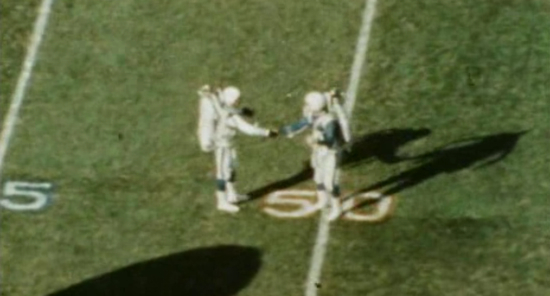
           The entertainment was billed as “Super Sights and Sounds.” An icon of that era, jazz trumpeter Al Hirt, did his thing. In step were the University of Arizona and Grambling State University marching bands, the Anaheim High School Drill Team. A pair of "rocket men" sporting James Bond jet packs and the insignia of each league, flew a bit and landed at midfield. Halftime saw the release of 10,000 helium-filled balloons and 4,000 pigeons.
          For the record, the favored (12-2) Packers coached by Vince Lombardi had bragging rights to four NFL titles in six years and 10 future Pro Football Hall of Famers on the roster. The (11-2-1) 18-point underdog Chiefs, led by Hank Stram, made a game of it in the first half. However, the “Pack” took over in the second half, winning big, 35-10. Bart Starr tossed two touchdown passes to Max McGee and won the MVP award and a trip to New York City to claim his red Corvette Sting Ray from Sport Magazine
          That was many long years ago - -the “grand-daddy of them all”-- Super Bowl One. "Our goal,” former NFL Commisioner Pete Rozelle said,
“from the first was to make this more than a game, to make it an event."           
                              (to be continued)
***Harvey Frommer is at work on REMEMBERING SUPER BOWL ONE: AN ORAL AND NARRATIVE HISTORY. He welcomes hearing from anyone with memories, perceptions, leads, memorabilia  for his newest book. ****


Saturday, January 19, 2013

“Just Win Baby” and Other Notable Tomes


          From acclaimed and deservedly so sports journalist and author Murray Olderman comes “Just Win Baby” (Triumph Books, $24.95, 203 pages). It is a deftly detailed account of the life and times of Al Davis of Oakland Raider fame. We are there for the inside look at this mercurial football maven from his growing up days in Brooklyn all the way through his triumphs with the silver and black.
          Initially Olderman who knew Davis for more than 50 years was commissioned by the electric executive to write his biography. Somehow, that book never made it into print.  “Just Win Baby” is Olderman’s third person account  - -and what an account it is. It uiilizes a great deal of the material given to Olderman and is enhanced by the prize winning author’s perspective, writing and organizational skills.  HIGHLY NOTABLE
          “The Muhammad Ali Reader” edited by Gerald Early(Ecco, $17.99, 336 pages) has bragging rights to over 30 pieces on “the Greatest” organized by decades. The 16 page photo insights showcase Ali in all his ways.
          “Yacht Clubs of the World” text by Bruno Cianci and Nicolo Reggio (Rizzoli, $100,00, 270 pages) is one of the most beautiful books ever produced by a company that has produced many beautiful books. Page after page in brilliant, bold, color unfolds as one turns the pages of this opulent opus. We are there with twenty storied venues like the New York Yacht Club, the Hong Kong Yacht Club, the Yacht Club de France and on and on. Yachting’s culture is on display and the reader (viewer) is all the better for it. MOST NOTABLE
 

Monday, January 14, 2013

REMEMBERING SUPER BOWL ONE


                   ''The most fun thing was watching the development of the Super Bowl because the game is what it's all about. I really felt a high at every Super Bowl with all the glitz and the spectacular halftime shows.'' – Pete Rozelle
                “The Super Bowl is an invention of American business.  It is American business.”  -  Roger Angell

        The merger of the American Football League and the National Football League led to the need for a championship game. The first contest was played on January 15, 1967. The NFL’s Vince Lombardi Green Bay Packers squared off against the AFL’s underdog Kansas City Chiefs coached by Hank Stram.

        That first Super Bowl was played at the Memorial Coliseum in Los Angeles before 61,946. Yes, there were empty seats – the first and only time the legendary event failed to sell out even with ticket prices that topped out at $12.

        The contest was officially known as the AFL-NFL World Championship;however, its unofficial name - the Super Bowl - was used by media, fans and players. The  name stuck.

        One theory for how the high flying name came about is that at an owner's meeting centered on what to call the game, one of the moguls had a "super ball" in his pocket that he had appropriated from his youngster earlier in the day. Not too taken with the long and ordinary sounding suggestions for what would become professional football's ultimate game, Lamar Hunt suggested the name Super Bowl. His suggestion was not greeted with much enthusiasm by the assembled group. Nevertheless, he mentioned the name to a reporter who loved it and, as they say, the rest is history.

        The first Super Bowl witnessed the first dual-network, color-coverage simulcast of a sports event in history, and attracted the largest viewership to ever see a sporting event up to that time. The Nielsen rating indicated that 73 million fans watched all or part of the game on one of the two networks, CBS or NBC.

        In actuality, the game was a contest between the two leagues and the two networks. CBS' allegiance was to the NFL. NBC's loyalty was to the AFL - a league it had virtually created with its network dollars.

          The networks charged $42,000 for a 30 second commercial. Frank Gifford was a sidelines reporter for CBS. Ray Scott handled the CBS play-by play for the first half while Jack Whitaker took over in the second half.  Curt Gowdy and Paul Christman handled the NBC telecast.

        There were many oddities and talking points about that first game.  Two jetpack pilots shook hands at the 50 yard line after landing there. Commercials for McDonald's (then boasting of "Over Two Billion Served") and Muriel cigars ("So much more cigar for just 10 cents") were all the rage.

         According to NFL Films President Steve Sabol, Commissioner Pete Rozelle had wanted to call the game "The Big One."  That never came to be. Neither did “Pro Bowl, another name the NFL head man favored.

         From the start (but not in that first game) there were unique  features to the Super Bowl including its designation with a Roman numeral rather than by a year - a move attributed to NFL Commissioner Pete Rozelle to give the game class and continuity.

        Max McGee of the Packers became an interesting footnote to Super Bowl history.

        "I knew I wouldn't play unless (Boyd) Dowler got hurt," he said later.  So McGee went out on the town the days (and nights) prior to the game. Curfews, it seems, were there for him to break.  Then, the unimaginable happened. Dowler suffered a separated shoulder throwing a block on the opening series.

        In came McGee who had caught only four passes all season. He snared 7 passes for 138 yards, hauling in the first touchdown in Super Bowl history—a 37-yard pass from Green Bay's Bart Starr. He caught another at the end of the third quarter for a 13-yard touchdown. Elijah Pitts ran for two other scores. The Chiefs' 10 points came in the second quarter, their only touchdown on a 7-yard pass from Len Dawson to Curtis McClinton.

        McGee stole the show and set a pattern that would be part of the ultimate game's history of unlikely heroes, strange twists of fate, footballs taking a wrong bounce for some teams, the right bounce for others.

        Quarterback Bart Starr was the first Most Valuable Player  leading the Packers to a 35-10 victory over KC. Starr completed 16-of-23 passes for 250 yards and three touchdowns.

         Today more Americans watch the Super Bowl than vote in presidential elections. Municipalities vigorously and ruthlessly compete for the rights to host a game and then work with the NFL, advertising and talent agencies, merchandisers, security personnel, and celebrity party planners more than a year in advance fine tuning myriad details.  A couple of million large-screen TVs are purchased weeks before the game.

        The grandest and gaudiest  annual one-day spectacle in American sports, Super Bowl Sunday has become an unofficial American holiday  with bragging rights to millions of  parties, betting pools, excessive consumption of food and drink.  TV networks charge as much as $2.5 million for a 30-second spot. Many viewers do not even watch the game itself, content to partake of the elaborate pre-game or halftime entertainment. The 2012 Super Bowl drew a television viewership of 111.3 million.

       It is all a mind boggling situation very different from 1967 when the Chiefs and the Packers clashed. And soon Super Bowl XLVII in New Orleans will be upon us. Watch out.

                       (to be continued)

***Harvey Frommer is at work on REMEMBERING SUPER BOWL ONE: AN ORAL AND NARRATIVE HISTORY. He welcomes hearing from anyone with memories, perceptions, leads, memorabilia  for his newest book. ****

Tuesday, January 01, 2013

Harvey Frommer's SPORTS BOOK REVIEW


          Read all about Len Berman’s “The Greatest Moments in Sports” and sporting fare books

          Famed and Emmy-Winning sportscaster Len Berman never seems to take a break and we are all the better for it. His newest effort is a rundown of 25 of the most thrilling upsets and underdogs in sports. The moments range from the Bobby Thomson home run that gave the old New York Giants the pennant to the U.S. Hockey team’s Miracle on Ice, to “A Horse Named Upset” who was the only horse to ever beat Man O’ War, to Althea Gibson, the female Jackie Robinson. All these and many more give insights, new awareness to classic sports moments. HIGHLY RECOMMENDED.

          In a hockey frame of mind there is “Wayne Gretsky’s Ghost” by Roy MacGregor (Vintage Canada, $19.95, 369 pages, paper). This is a book that will appeal to all generations and all fans of the sport covering as it does stars of the game from Jean Beliveau to Steve Yzerman.

          From Kent State University Press comes “The ’63 Steelers” by Rudy  Dicks, paper). Detailed, definitive in its scope, this terrific tome is a must read for football fans but especially those who root for the Steel City franchise.

          “Notre Dame’s Happy Returns” by Brian O’Conchubhair and Susan Mullen Guibert with photos by Matt Cashore (University of Notre Dame Press, $38.00, 184 pages, 174 color photos) is a winning photographic essay, a travel book, a sports guide. It is all about what makes Ireland special for fans of the Fighting Irish and contains an exploration of the intro of American football in Ireland and the role of Notre Dame enhancing the sport’s existence there.

Tuesday, November 27, 2012

Amazing, Historic, Lowest Scoring NBA Game & the Birth of the 24-Second Clock


Dr. Harvey Frommer on Sports
To watch the high-scoring action in the National Basketball Association today, it is hard to believe the way things once were. But back in the early years of the league, games were yawning affairs or stalling contests.
The 1950-1951 season saw the NBA go from an unwieldy 17-team league to 11 teams in a two-division setup. It was also a season that included the lowest-scoring game in NBA history.
It happened November 22, 1950 - the yawner of all yawners. The game pitted the Fort Wayne Piston (who became the Deroiters) against the Minneapolis Lakers (who became the Show Time bunch), and was played on the home court of the Lakers, who enjoyed a great home advantage. Their court was shorter and narrower than normal size. Their team was big, bulky and slow - all of which were perfectly suited for a slowdown game.
In the game, the two teams combined for just 31 shots. When it was over, Ft. Wayne had creaked out a 19-18 triumph in a painful and boring example of how dull a stalling contest could be. The game started serious talk throughout the NBA about ways to prevent those kinds of contests from taking place.
Then on January 6, 1951, a very cold night in Rochester, the Royals (who one day would evolve into the Sacramento Kings) played against the Indianapolis Olympians(evolved from the 1948 basketball Gold Medal winners) in what has gone down as the longest game in the annals of the NBA.
The game lasted a grand total of 78 minutes and included six overtimes. Some of the loyal Rochester fans booed, and hundreds of others walked out of the old Edgerton Park Arena. They just couldn't abide the slow-down stalling tactics of both teams.
In the half-dozen overtimes, just 23 shots were taken. At the start of each overtime, the team that earned the tip just held on to the ball for one last shot. Players just stood around gaping and staring at each other. One player dribbled or held the ball and looked around hoping to make the smart pass for a high percentage shot. Indianapolis finally won the game, 75-73.
Red Holzman told me in the late 1980s when I was writing his autobiography, "I played 76 of the 78 minutes in that opus. And although I was in great shape, my tail was dragging when the historic marathon was over". That game and the bore that was the 19-18 contest made players and coaches see the need and the urgency to speed up the game. It was these two games, and others like them, that set the stage for the creation of the 24-second clock - and the salvation of the NBA.
The clock was first used in the 1954-1955 season, and scoring jumped an average of 15 points a game as a result. The new NBA era was underway.
As a post-script to all of this, Holzman told me that back in 1951, after the 19-18 game, he got the idea for a shot clock and told some of the owners about it. They dismissed him as "a young squirt." But someone must have been listening.


About the Author

Dr. Harvey Frommer received his Ph.D. from New York University. Professor Emeritus, Distinguished Professor nominee, Recipient of the "Salute to Scholars Award" at CUNY where he taught writing for many years, the prolific author was cited by the Congressional Record and the New York State Legislature as a sports historian and journalist.
His sports books include autobiographies of sports legends Nolan Ryan, Red Holzman and Tony Dorsett, the classics "Shoeless Joe and Ragtime Baseball," "New York City Baseball: 1947-1957." The 1927 Yankees." His "Remembering Yankee Stadium" was published to acclaim in 2008. His latest book, a Boston Globe Best Seller, is "Remembering Fenway Park." Autographed and discounted copies of all Harvey Frommer books are available direct from the author. Please consult his home page: http://harveyfrommersports.com/remembering_fenway/  

Saturday, November 10, 2012

Sports Book Reviews From Random House, Canada


                    All kinds of intriguing sports books are now out for all to enjoy from Random House, Canada. They range from picture tomes, to biographies, to how-to, to commemorative editions. Something for everyone.
                Stephen Brunt’s “100 Grey Cups”  (McClelland & Stewart, 256 pages $45.00) is a coffee table gem about Canada’s  largest annual single sporting event. All the legendary teams from Canada’s storied football past are showcased in words and pictures.
          “Team Canada” as told by the players with Andrew Podnieks ($45.00, 293 pages) is another coffee table gem  - - the 40th anniversary celebration of the Summit Series in words and pictures.
          Famed Barry Melrose offers “Dropping the Gloves” ( Fenn/M&S, $27.99, 256 pages). The book is a sharing of Melrose’s many years of on-ice experience. Lots of insights.
           “The Great One” offers up the Complete Wayne Gretsky as seen through Sports Illustrated writings (Fenn/M&S, $22.99, 336 pages).
            Paul Henderson weighs in with “The Goal of My Life” (Fenn/M&S, $29.99, 304 pages. The memoir covers his two decades in hockey and more.
          For those in a NASCAR frame of mind there is “The Official NASCAR Trivia Book” by John C. Farrell (Fenn/M&S, $16.99, 448 pages) and also “NASCAR Nation” by Chris Myers with Michael Levin (Fenn/M&S, $24.99, 240  pages.  The former is a mighty lode of challenging trivia while the book
by Chris Myers is all about how racing values simulate and mirror America’s.
          “Coach” by Rosie DiManno (Doubleday Canada, $27.95, 336 pages) is a page turning terrific tome about one of the great NHL coaches. All kinds of personal insights into the complex coach abound.

Monday, October 29, 2012

The First World Series (From the Vault)


     The hype, hoopla and accomplishments of the 2012 baseball season will now belong to history along with the elongated play-offs and recent World Series which joins the first one that took place in 1903. The world, baseball and the World Series were very different then.

      Back in the 1880s for a period of seven years there had been play-offs between the champs of the National League and the American Association. Once the play-offs went to 15 games - 1887 between St. Louis and Detroit. Pittsburgh won its third straight National League pennant in 1903. Boston won the brand new American League title that season by 14 l/2 games over the Philadelphia Athletics.    

       The Pirates bragged about Honus Wagner whose .355 average earned him the batting title. Their swashbuckling manager Fred Clarke was runner-up with a .351 average. Boston boasted about two 20-game winners in Deacon Phillippe and Sam Leever.

        The first modern World Series came about at the suggestion of Boston owner Henry J. Killilea and Pittsburgh's owner Barney Dreyfuss. It was called "Championship of the United States" and it was a five of nine games affair. The first game was October l, 1903 at Boston's Huntington Avenue Grounds before 16,242. Deacon Phillippe pitched Pittsburgh to a 7-3 win over Boston's Cy Young.

      Throughout the game and the series Boston's rabid fans serenaded Pittsburgh players with a popular song of the day, "Tessie," but they substituted their own vulgar words for the regular lyrics. The routine definitely had a negative impact on the Pittsburgh players. "It was that damn song that caused us problems," grumbled Buc player Tommy Leach afterwards.

    Deacon Phillippe won three of the first four games of the series for Pittsburgh but then faltered. Boston then swept the next four games. Bill Dinneen and Cy Young won all five games for Boston in the series On October 13, only 7,455 showed up - the smallest crowd of the series. Phillippe pitched his fifth complete game of the series but lost, 3-0 to Dinneen and Boston had the championship.

    Right after the game ended players from both clubs lined up for a combination team photo. It was a remarkable display of good sportsmanship considering the bitterness that had existed between the junior American League and senior National League.

     An oddity of the World Series was that the losing players received more money that than the winners. Buc Owner Dreyfuss put his club's share of the gate receipts into the players' pool. Each Pittsburgh player netted $1,316 while each Boston player netted $1,182.

      Deacon Phillippe - heroic in his efforts in the series with five decisions and 44 innings pitched, still World Series records, was given a bonus and 10 shares of stock in the Pirates.

     Oddly enough there was no World Series played in 1904. Boston was ready, willing able. But the National League pennant winning New York Giants were not. Their manager John J. McGraw snarled: "We are the champions of the only major league." In 1905, the World Series resumed, fitted itself into its best of seven format and has been with us ever since.

Saturday, October 13, 2012

Sports Book Reviews: Tony La Russa’s “One Last Strike” and More


          An avalanche of fall sports books are on the shelves ready for reading. The range of subjects and approaches are amazing.  All have something of interest for readers, but topping the list as he topped the baseball world in so many ways is Tony La Russa’s “One Last Strike” (William Morrow, $27.99, 420 pages). The price is right and the reading is fascinating.   

          The book takes one inside the mind of the great LaRussa through the 2011 world championship season of the Cards offering insights and inside baseball that only the legendary Redbird skipper could. The book also offers much more than that  - -focusing as it does in intriguing details about personalities like Mark McGwire, Joe Torre, Sparky Anderson, Albert Pujols. Where most “memoirs” are rehashes of news stories – this book breaks new ground fort the genre. MUST HAVE

          The story of the man behind the Heisman Trophy is the subject of “Heisman” by John M. Heisman (Howard, Simon and Schuster, $25.00, 248 pages). Written by the subject’s great nephew along with author Mark Schlabach, this is a special kind of book for football fans revealing as it was the life and times of its subject - -the man behind the trophy. Archival photos and important research make the book a winner.

          “How the SEC became Goliath” by Ray Glier (Howard, Simon and Schuster, $22.99, 245 pages) is an engrossing view revealing the creation of the most dominant conference in collegiate football.

           "Baseball is Just Baseball" by David Shields (Blue Rider Press/Penguin, $14.00, 183 pages) is a slim and under-sized attempt to capitalize of the fabulous Japanese star's move from Seattle to the New York Yankees. Nevertheless, this unauthorized collection is serene reading and a provider of insights into the superstar.
          "Sandlot Stats" by Stanley Rothman (Johns Hopkins Press, 571 pages) is an over-sized tome that is truly a scholarly labor of love as its sub-title proclaims "learning statistics with baseball." For those interested in the subject - -this is your book - - one that attempts to explain the mathematical anchorage of baseball as a way to understand the universe of stats and probability.

          For fans of the Mick – “The Classic Mantle” by Buzz Bisssinger with photographs by Marvin E. Newman (Abrams, $19.95, 114 pages, 50 color and b/w photos) is the book for you. The price tag is a bit hefty for the slim volume but the tome packs a punch showcasing as it does images from Mantle’s heyday.

          “Lamar Hunt” by Michael MacCambridge (Universal Uclick, $27.99, 416 pages) is a page turning biography by one of the best football writers around. Page after page yields up anecdotes about Hunt’s impact on sports- -in fact three sports. Hunt is the only one inducted into three Halls of Fame. Hunt was a man who changed American sports, especially football. This is an important book for all those interested in sports and culture.

          From the Clerisy Press comes “Gone Pro Alabama” ($17.95, 368 pages, paper) a book that details the deeds of Crimson Tide athletes who went on to become legends.

          In a hockey frame of mind from McClelland and Stewart comes “The Life of Conn Smythe” ($19.00, 384 pages, paper). This is definitely a tome terrific for those interested in the life story of a true hockey legend.

Sunday, September 30, 2012

“Dat Day” - -Bobby Thomson's Famous Homer Lives On

Bobby Thompson


          Play-off baseball will soon be in the air; however, it is doubtful if any moment will take place to compare with what happened in Manhattan those  long years ago.
          Throughout the long history of baseball there have been poignant, exciting, dramatic moments. But nothing like what happened on October 3, 1951 at the old Polo Grounds in New York City.
          Some refer to that time as "The Miracle at Coogan's Bluff." Others, especially in Brooklyn, call it "Dat Day." But no matter what label is applied it was a time to remember.
          It was a time when the Giants played out of the Polo Grounds in Manhattan and the Dodgers entertained millions in their tiny Brooklyn ballpark, Ebbets Field. It was a time of tremendous fan devotion to each team.
          In July, Brooklyn manager Charlie Dressen had bragged, "The Giants is dead." It seemed to aptly describe the plight of Leo Durocher's team. For on August 12 the Giants trailed the Dodgers by 13 l/2 games in the standings.
          Then, incredibly the Giants locked into what has been called "The Miracle Run." They won 37 of their final 44 games - 16 of them in one frenetic stretch - and closed the gap.
          "It was a once-in-a-lifetime situation," recalls Monte Irvin, who batted .312 that year for the Giants. "We kept on winning. The Dodgers kept on losing. It seemed like we beat everybody in the seventh, eighth and ninth inning.
          The Giants and Dodgers finished the season in a flat-footed tie for first-place and met on the first day of October in the first game of the first play-off in the history of the National League. The teams split the first two games setting the stage for the third and final game.
          Star hurler Don Newcombe of the Dodgers was pitted against veteran Sal Maglie of the Giants. Both hurlers had won 23 games during the regular season.
          The game began under overcast skies and a threat of rain. Radio play-by-play filtered into schoolrooms, factories, office buildings, city prisons, barbershops.
          The Wall Street teletype intermingled stock quotations with play-by-play details of the Giant-Dodger battle.
          The game was tied 1-1 after seven innings. Then Brooklyn scored three times in the top of the eighth.
          Many of the Dodger fans at the Polo Grounds and the multitude listening to the game on the radio thought that the Giants would not come back.
          Leo Durocher and the Giants never gave up. "We knew that Newcombe would make the wrong pitch," said Monte Irvin. "That was his history."
          The Giants came to bat in the bottom of the ninth inning - only three outs remained in their miracle season.
          Shortstop Alvin Dark led off with a single through the right side of the infield. Outfielder Don Mueller slapped the ball past Dodger first baseman Gil Hodges. Irvin fouled out. A double by Whitey Lockman down the left field line. Dark scored.
          With runners on second and third Ralph Branca  came in to relieve Newcombe. Bobby Thomson waited to bat. Durocher said, "I did not know whether they would pitch to Thomson or not. First base was open. Willie Mays, just a rookie, was on deck."
          Veteran New York Giant announcer Russ Hodges described the moment to millions mesmerized at their radios that October afternoon:
          "Bobby Thomson up there swinging.... Bobby batting at .292. Branca pitches and Bobby takes a strike call on the inside corner. Lockman without too big of a lead at second but he'll be running like the wind if Thomson hits one.
          "Branca throws ... there's a long drive...it's gonna be, I believe. . .' The precise moment was 3:58 P.M., October 3, 1951.
          "... the Giants win the pennant!" Hodges screamed the words at the top of his voice, all semblance of journalistic objectivity gone. "The Giants win the pennant! The Giants win the pennant!"
          Hodges bellowed it out eight times - and then overcome by the moment and voiceless, he had to yield the microphone.
          Pandemonium was on parade at the Polo Grounds for hours after the game. For almost half an hour after the epic home run, there were so many phone calls placed by people in Manhattan and Brooklyn that the New York Telephone Company reported service almost broke down.
          Bobby Thomson and Ralph Branca would play out their major league careers. But the moment they shared - as hero and goat that October day at the Polo Grounds - would link them forever.